
Tesselated slime star (Pteraster tesselatus)
Source-cited species reference: taxonomy from WoRMS, biology from SeaLifeBase, occurrence map from GBIF, description from Wikipedia.

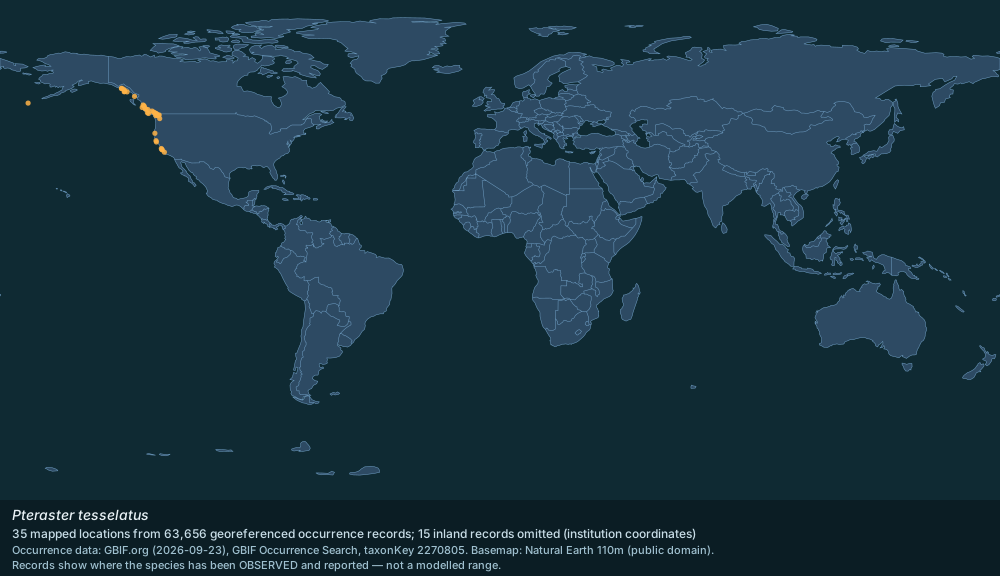
Distribution map plotted from GBIF.org occurrence records; basemap Natural Earth 110m · GBIF records CC0 / CC BY; Natural Earth public domain
Pteraster tesselatus, the slime star or cushion star, is a species of starfish in the family Pterasteridae found in the North Pacific.
- Scientific name
- Pteraster tesselatus
- Authority
- Ives, 1888
- Family
- Pterasteridae
- Order
- Velatida
- Maximum length
- 24 cm
- Depth range
- 6–436 m
- Habitat zone
- benthic
- Gbif occurrence records
- 63,656
Classification (WoRMS)
Full classification as recorded by WoRMS: Kingdom: Animalia · Phylum: Echinodermata · Class: Asteroidea · Order: Velatida · Family: Pterasteridae · Genus: Pteraster.
Accepted name: Pteraster tesselatus · Authority: Ives, 1888 · Taxonomic status: accepted · AphiaID: 369053.
Synonyms and superseded combinations recorded for this taxon: Pteraster (Retaster) gracilis H.L. Clark, 1901; Pteraster gracilis H.L. Clark, 1901; Pteraster hebes Verrill, 1909; Pteraster japonicus Uchida, 1931; Pteraster multispinus H.L. Clark, 1901; Retaster gracilis H.L. Clark, 1901.
Source: World Register of Marine Species (WoRMS) — https://www.marinespecies.org/aphia.php?p=taxdetails&id=369053 (CC BY 4.0). Accessed 2026-09-23.
Biology and life history (SeaLifeBase)
Measured values published by SeaLifeBase for Pteraster tesselatus. Only fields the database actually holds for this species are shown; these are database values, not aquarium guidance.
Maximum length: 24 cm · Depth range: 6–436 m · Habitat zone: benthic · Vulnerability index: 14 of 100.
SeaLifeBase notes: It is found on rocks in subtidal areas to a depth of 435 meters (Ref. 865).
Source: SeaLifeBase species summary (SpecCode 49496) — https://www.sealifebase.se/summary/Pteraster-tesselatus.html (CC BY-NC 3.0 — non-commercial use only). Accessed 2026-09-23.
Distribution and occurrence records (GBIF)
63,656 georeferenced occurrence records for Pteraster tesselatus are published through GBIF from 6 countries or marine areas. The map above plots 35 distinct locations from a sample of 3,000 records, omitting 15 inland records that carry an institution's coordinates rather than a collection site; it shows where the species has been observed and reported, not a modelled range.
Most records by country or area: United States of America (62,814); Canada (798); Korea, Republic of (40); United Arab Emirates (1); Malaysia (1).
The full country table, WoRMS marine regions and the sampling notes are on this species' Distribution page.
Source: GBIF Occurrence Search (taxonKey 2270805) — https://www.gbif.org/occurrence/search?taxon_key=2270805&has_coordinate=true (records CC0 / CC BY); WoRMS distribution records (MarineRegions) — https://www.marinespecies.org/aphia.php?p=taxdetails&id=369053 (CC BY 4.0); Natural Earth 110m basemap — https://www.naturalearthdata.com/ (public domain). Accessed 2026-09-23.
Description and natural history (Wikipedia)
The slime star's body has a wide central disc and five stumpy arms with upturned tips. It grows to a diameter of about 15 cm and has an inflated appearance as the entire aboral (upper) surface is covered by a thick, raised, fleshy membrane. This has a smooth soft texture and is pale brown, grey, red, or orange, often with a symmetrical darker pattern. It conceals the madreporite and scales on the aboral surface proper and the gap underneath it is filled with a spongy tissue. A central pore in this membrane allows for water movement. The arms have rows of fan-shaped groups of five to seven spines between which are two rows of tube feet. The red eyespot is surrounded by spines at the apex of each arm.
The slime star occurs in rocky areas on the west coast of North America from the Bering Sea southwards to central California at depths to 950 m. It is also known from the Aleutian Islands and Japan. It is usually found in places where the current is strong.
The slime star feeds on various benthic invertebrates, including the breadcrumb sponge (Halichondria panicea), the false jingle shell (Pododesmus macroschisma), other scallops and clams, and colonial sea squirts such as Aplidium and Didemnum species. It also feeds on the bacterial film that grows on the surface of mussels. If attacked by a predator such as the morning sun star (Solaster dawsoni) or the sunflower star (Pycnopodia helianthoides), the slime star emits great quantities of repellent mucus and can often evade the predator. The mucus is toxic and has been shown to kill other invertebrates immersed in it.
The slime star breeds in the summer, with a female releasing a small number of eggs into the water. Nearby males then release sperm and the fertilised eggs rise to the surface of the water. They are bright orange or yellow and are wrapped in a gelatinous membrane. They become planktonic and pass through several developmental stages over the course of about 25 days. They then undergo metamorphosis into juvenile starfish and settle onto the seabed.
One of several different species of polychaete worms often lives symbiotically within the ambulacral grooves on the oral (under) surface of the slime star.
Source: Wikipedia: Pteraster tesselatus — https://en.wikipedia.org/wiki/Pteraster_tesselatus (CC BY-SA 4.0). Accessed 2026-09-23.
Gallery
Related in Tesselated slime star
Links follow this subject's own source article.
Elsewhere in Tesselated slime star
Spotted an error? Know more?
Reader corrections go straight into our review queue. Suggest an edit · How this site is sourced