
Wrinkled sea star (Pteraster militaris)
Source-cited species reference: taxonomy from WoRMS, biology from SeaLifeBase, occurrence map from GBIF, description from Wikipedia.

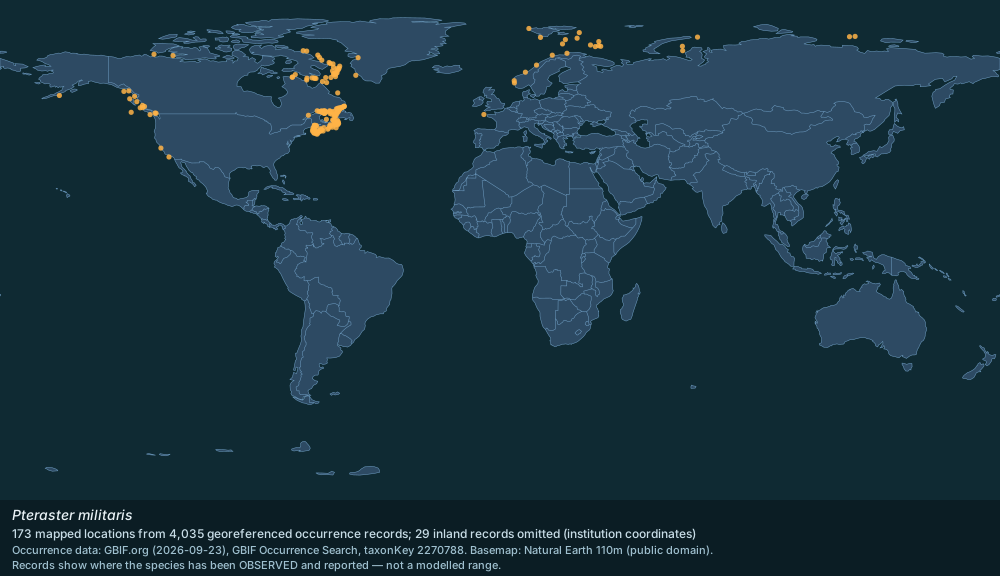
Distribution map plotted from GBIF.org occurrence records; basemap Natural Earth 110m · GBIF records CC0 / CC BY; Natural Earth public domain
Pteraster militaris, the wrinkled star, is a species of starfish in the family Pterasteridae. It is found in the northern Pacific Ocean, the Arctic Ocean, the Barents Sea, and the northern Atlantic Ocean.
- Scientific name
- Pteraster militaris
- Authority
- (O.F. Müller, 1776)
- Family
- Pterasteridae
- Order
- Velatida
- Maximum length
- 15 cm
- Depth range
- 6–3635 m
- Habitat zone
- benthic
- Gbif occurrence records
- 4,035
Classification (WoRMS)
Full classification as recorded by WoRMS: Kingdom: Animalia · Phylum: Echinodermata · Class: Asteroidea · Order: Velatida · Family: Pterasteridae · Genus: Pteraster.
Accepted name: Pteraster militaris · Authority: (O.F. Müller, 1776) · Taxonomic status: accepted · AphiaID: 124147.
Synonyms and superseded combinations recorded for this taxon: Asterias militaris O.F. Müller, 1776; Asteriscus militaris (O.F. Müller, 1776); Pteraster aporus Ludwig, 1886; Pterasterides aporus (Ludwig, 1886).
Source: World Register of Marine Species (WoRMS) — https://www.marinespecies.org/aphia.php?p=taxdetails&id=124147 (CC BY 4.0). Accessed 2026-09-23.
Biology and life history (SeaLifeBase)
Measured values published by SeaLifeBase for Pteraster militaris. Only fields the database actually holds for this species are shown; these are database values, not aquarium guidance.
Maximum length: 15 cm · Depth range: 6–3635 m · Habitat zone: benthic · Vulnerability index: 10 of 100.
SeaLifeBase notes: Maximum depth from Ref. 111335. It is found on soft bottoms in subtidal areas to a depth of 1,100 meters (Ref. 865).
Source: SeaLifeBase species summary (SpecCode 49492) — https://www.sealifebase.se/summary/Pteraster-militaris.html (CC BY-NC 3.0 — non-commercial use only). Accessed 2026-09-23.
Distribution and occurrence records (GBIF)
4,035 georeferenced occurrence records for Pteraster militaris are published through GBIF from 16 countries or marine areas. The map above plots 173 distinct locations from a sample of 3,000 records, omitting 29 inland records that carry an institution's coordinates rather than a collection site; it shows where the species has been observed and reported, not a modelled range.
Most records by country or area: Canada (3,641); Russian Federation (118); Norway (114); United States of America (90); Svalbard and Jan Mayen (21).
The full country table, WoRMS marine regions and the sampling notes are on this species' Distribution page.
Source: GBIF Occurrence Search (taxonKey 2270788) — https://www.gbif.org/occurrence/search?taxon_key=2270788&has_coordinate=true (records CC0 / CC BY); WoRMS distribution records (MarineRegions) — https://www.marinespecies.org/aphia.php?p=taxdetails&id=124147 (CC BY 4.0); Natural Earth 110m basemap — https://www.naturalearthdata.com/ (public domain). Accessed 2026-09-23.
Description and natural history (Wikipedia)
Pteraster militaris is a robust starfish with a wide disc, a large central pore and five short, wrinkled, triangular arms. The aboral (upper) surface is dotted with papulae, each topped with four short spines and above this is a papery covering giving the starfish an inflated, bulky appearance. It grows to a diameter of 85 mm and is usually orange, pale yellow or white, sometimes with red tips to its arms.
Pteraster militaris is found in rocky habitats in water down to a depth of 1100 m in the Arctic Ocean, the Bering Sea, the north west Pacific Ocean as far south as Oregon, the Barents Sea and the north east and north west Atlantic Ocean.
Pteraster militaris feeds on various species of sponge including the cloud sponge (Aphrocallistes vastus) and the white reticulated sponge (Iophon cheliferum) and also on hydrozoans such as the pink branching hydrocoral (Stylaster norvigicus) and the purple encrusting hydrocoral (Stylantheca).
Pteraster militaris is unusual among starfishes in that it broods some of its young. About forty fertilised eggs are retained in the water-filled chamber below its papery outer skin and these develop into juveniles that may reach 1 cm across before they make their way out through the central pore. Eggs that are too numerous to be brooded are released direct into the sea where they become planktonic larvae. The brooded juveniles seem to behave as ectoparasites of the female, feeding on maternal tissues in the brood chamber. They may also eat dead embryos, faecal material and mucus.
Source: Wikipedia: Pteraster militaris — https://en.wikipedia.org/wiki/Pteraster_militaris (CC BY-SA 4.0). Accessed 2026-09-23.
Gallery
Related in Wrinkled sea star
Links follow this subject's own source article.
Elsewhere in Wrinkled sea star
Spotted an error? Know more?
Reader corrections go straight into our review queue. Suggest an edit · How this site is sourced