
Nika shrimp (Processa edulis)
Source-cited species reference: taxonomy from WoRMS, biology from SeaLifeBase, occurrence map from GBIF, description from Wikipedia.

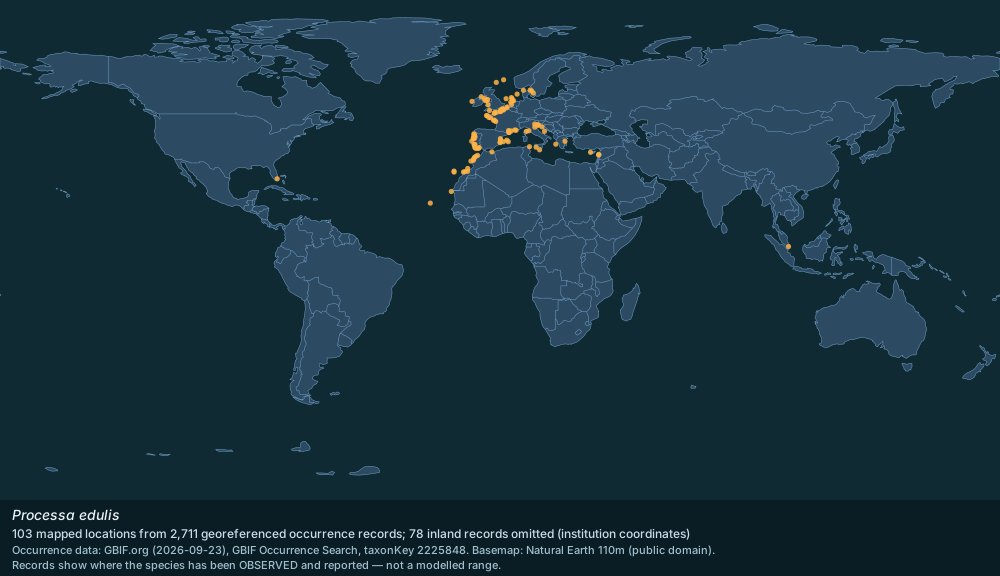
Distribution map plotted from GBIF.org occurrence records; basemap Natural Earth 110m · GBIF records CC0 / CC BY; Natural Earth public domain
Processa edulis is a species of caridean shrimp found in shallow water in the Atlantic Ocean and the Mediterranean Sea. It mostly inhabits seagrass beds and eelgrass flats, hiding by day and feeding at night. A common name for it is nika shrimp.
- Scientific name
- Processa edulis
- Authority
- (Risso, 1816)
- Family
- Processidae
- Order
- Decapoda
- Maximum length
- 5 cm
- Habitat zone
- benthic
- Gbif occurrence records
- 2,711
Classification (WoRMS)
Full classification as recorded by WoRMS: Kingdom: Animalia · Phylum: Arthropoda · Class: Malacostraca · Order: Decapoda · Family: Processidae · Genus: Processa.
Accepted name: Processa edulis · Authority: (Risso, 1816) · Taxonomic status: accepted · AphiaID: 107683.
Synonyms and superseded combinations recorded for this taxon: Cancer pellucidus Nardo, 1847; Nika edulis Risso, 1816; Nika edulis var. mediterranea f. typica Czerniavsky, 1884; Nikoides pontica Sowinsky, 1882; Processa edulis arcassonensis Nouvel & Holthuis, 1957; Processa edulis edulis (Risso, 1816); Processa pontica (Sowinsky, 1882).
Source: World Register of Marine Species (WoRMS) — https://www.marinespecies.org/aphia.php?p=taxdetails&id=107683 (CC BY 4.0). Accessed 2026-09-23.
Biology and life history (SeaLifeBase)
Measured values published by SeaLifeBase for Processa edulis. Only fields the database actually holds for this species are shown; these are database values, not aquarium guidance.
Maximum length: 5 cm · Habitat zone: benthic · Vulnerability index: 10 of 100 · Fishery importance: commercial.
SeaLifeBase notes: It occurs in shallow waters among Zostera, Cymodocea, and Posidonia spp. (Ref. 104052).
Source: SeaLifeBase species summary (SpecCode 25888) — https://www.sealifebase.se/summary/Processa-edulis.html (CC BY-NC 3.0 — non-commercial use only). Accessed 2026-09-23.
Distribution and occurrence records (GBIF)
2,711 georeferenced occurrence records for Processa edulis are published through GBIF from 26 countries or marine areas. The map above plots 103 distinct locations from a sample of 2,711 records, omitting 78 inland records that carry an institution's coordinates rather than a collection site; it shows where the species has been observed and reported, not a modelled range.
Most records by country or area: Portugal (1,705); France (652); Spain (100); Italy (86); United Kingdom of Great Britain and Northern Ireland (48).
The full country table, WoRMS marine regions and the sampling notes are on this species' Distribution page.
Source: GBIF Occurrence Search (taxonKey 2225848) — https://www.gbif.org/occurrence/search?taxon_key=2225848&has_coordinate=true (records CC0 / CC BY); WoRMS distribution records (MarineRegions) — https://www.marinespecies.org/aphia.php?p=taxdetails&id=107683 (CC BY 4.0); Natural Earth 110m basemap — https://www.naturalearthdata.com/ (public domain). Accessed 2026-09-23.
Description and natural history (Wikipedia)
Processa edulis is a moderate-sized shrimp, males being 12 to 34 mm in length and females 25 to 52 mm. The rostrum is short, not extending beyond the eyes, and is tipped with a tooth and a point. The first two pairs of legs are asymmetrical; leg 1 has a claw on the left side and a clamp on the right; leg 2 has a clamp on both sides, but the left leg is longer than the right. During the day this shrimp is white but at night it becomes pink or red, with a scattering of tiny white spots, which are the chromatophores. The main pigments that result in this red colouring are astaxanthin and derived esters.
Processa edulis occurs in the eastern Atlantic Ocean between 55° and 33° North, the North Sea, the English Channel, the Mediterranean Sea and the Black Sea. It is a shallow water species, being found on soft bottoms in seagrass beds and among eelgrass. It is common in Posidonia beds in the English Channel, and is sometimes found among seaweeds growing on the sandy seabed. It hides among the foliage or buries itself in the sand by day, emerging at night to feed.
Processa edulis feeds on small invertebrates such as nematodes, polychaete worms, amphipods, isopods, ostracods, decapod larvae, foraminifera, molluscs and fish eggs, and occasionally diatoms and fragments of seagrass and seaweed. An analysis of the stomach content of specimen procured from the sea near the Ebro Delta showed a negligible amount of plant matter, leading to the hypothesis that Processa edulis is exclusively carnivorous, and the plants were only ingested by accident.
It tears up its prey with its asymmetric front legs. Although this shrimp is edible, it has been little studied, perhaps because it is only caught when trawling takes place at night.
This shrimp is believed to be a protandric hermaphrodite, starting life as a male and becoming female as it grows larger. This view is born out by the presence of large numbers of moderate-sized females that make their appearance in mid-July, much the same time as there is a sharp decline in the number of males. At any time of year, small females are very rare, and the few there are may in fact be undifferentiated juveniles, and large males are non-existent. Breeding takes place between March and September, during which time several batches of eggs are laid. The female attaches the eggs to her abdominal legs; they are green at first, becoming grey before hatching after three to four weeks. The development of the planktonic larvae takes a further three to four weeks before they settle on the seabed to undergo metamorphosis into juvenile shrimps.
Its activity cycle has also been studied under laboratory conditions. While kept in constant darkness, Processa edulis maintained its circadian rhythm and emerged at the time of "expected night", with over half of the captured individuals remaining buried in the sand substrate during "expected day". When exposed to artificial light stimuli, the specimens exhibited a strong reaction that was synchronized in all individuals, which emerged from the sand after 1520 min after the light was turned off.
Source: Wikipedia: Processa edulis — https://en.wikipedia.org/wiki/Processa_edulis (CC BY-SA 4.0). Accessed 2026-09-23.
Gallery
Related in Nika shrimp
Links follow this subject's own source article.
Elsewhere in Nika shrimp
Spotted an error? Know more?
Reader corrections go straight into our review queue. Suggest an edit · How this site is sourced