
Scallop (Pecten novaezelandiae)
Source-cited species reference: taxonomy from WoRMS, biology from SeaLifeBase, occurrence map from GBIF, description from Wikipedia.
Pecten novaezelandiae, common name the New Zealand scallop, is a bivalve mollusc of the family Pectinidae, the scallops. Its name is sometimes found misspelt as Pecten novaezealandiae.
- Scientific name
- Pecten novaezelandiae
- Authority
- Reeve, 1852
- Family
- Pectinidae
- Order
- Pectinida
- Maximum length
- 14 cm
- Depth range
- 5–170 m
- Habitat zone
- benthic
- Gbif occurrence records
- 18,645
Classification (WoRMS)
Full classification as recorded by WoRMS: Kingdom: Animalia · Phylum: Mollusca · Class: Bivalvia · Order: Pectinida · Family: Pectinidae · Genus: Pecten.
Accepted name: Pecten novaezelandiae · Authority: Reeve, 1852 · Taxonomic status: accepted · AphiaID: 393937.
Synonyms and superseded combinations recorded for this taxon: Notovola marwicki H. J. Finlay, 1930; Notovola tainui H. J. Finlay, 1930; Pecten benedictus marwicki (H. J. Finlay, 1930); Pecten benedictus tepungai C. A. Fleming, 1957; Pecten benedictus zeehaenae C. A. Fleming, 1957; Pecten jacobaeus toi C. A. Fleming, 1957; Pecten kupei C. A. Fleming, 1951; Pecten laticostata J. E. Gray, 1835; Pecten modestus kupei C. A. Fleming, 1957; Pecten novaezelandiae rakiura C. A. Fleming, 1951; Pecten sulcicostatus var. casa van Bruggen, 1961; Pecten tainui (H. J. Finlay, 1930); Pecten tainui aotea C. A. Fleming, 1953; Pecten toi C. A. Fleming, 1951.
Source: World Register of Marine Species (WoRMS) — https://www.marinespecies.org/aphia.php?p=taxdetails&id=393937 (CC BY 4.0). Accessed 2026-09-23.
Biology and life history (SeaLifeBase)
Measured values published by SeaLifeBase for Pecten novaezelandiae. Only fields the database actually holds for this species are shown; these are database values, not aquarium guidance.
Maximum length: 14 cm · Depth range: 5–170 m · Habitat zone: benthic · Vulnerability index: 22.2 of 100 · Fishery importance: commercial.
SeaLifeBase notes: Minimum depth range from Ref. 114139. Found in soft sediments. Juveniles are preyed upon by sea stars, gastropods, octopus, snapper, and large rays (Ref. 1244). Feeds on phytoplankton (Ref. 114780).
Source: SeaLifeBase species summary (SpecCode 83809) — https://www.sealifebase.se/summary/Pecten-novaezelandiae.html (CC BY-NC 3.0 — non-commercial use only). Accessed 2026-09-23.
Distribution and occurrence records (GBIF)
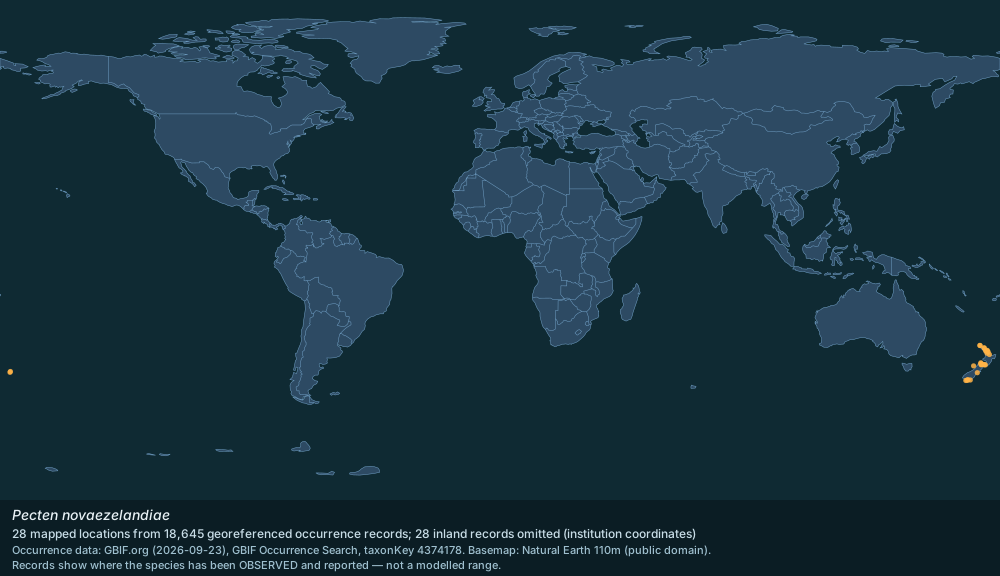
18,645 georeferenced occurrence records for Pecten novaezelandiae are published through GBIF from 2 countries or marine areas. The map above plots 28 distinct locations from a sample of 3,000 records, omitting 28 inland records that carry an institution's coordinates rather than a collection site; it shows where the species has been observed and reported, not a modelled range.
Most records by country or area: New Zealand (18,634); Australia (11).
The full country table, WoRMS marine regions and the sampling notes are on this species' Distribution page.
Source: GBIF Occurrence Search (taxonKey 4374178) — https://www.gbif.org/occurrence/search?taxon_key=4374178&has_coordinate=true (records CC0 / CC BY); WoRMS distribution records (MarineRegions) — https://www.marinespecies.org/aphia.php?p=taxdetails&id=393937 (CC BY 4.0); Natural Earth 110m basemap — https://www.naturalearthdata.com/ (public domain). Accessed 2026-09-23.
Description and natural history (Wikipedia)
Pecten novaezelandiae was first scientifically described by Lovell Augustus Reeve in 1852, as Pecten Novæ-Zelandiæ.
Pecten novaezelandiae is endemic to New Zealand. It is found in the North Island, South Island, Stewart Island, and the Chatham Islands.
Pecten novaezelandiae is found on sand, silt, and mud from low tide level to over 90 m. Large populations are found at depths of 10 to 25 m.
Pecten novaezelandiae is completely free-living, mobile and somewhat migratory. The two valves are asymmetric. The left valve is convex while the right is flat. The concave valve has approximately 16 ribs. The colour is variable, however the valves are usually a whitish pink, but sometimes can be a dark reddish brown. Natural predators are sea stars and octopus.
Sexually mature individuals are hermaphrodites. They are broadcast spawners. The season when the organisms spawn is variable between locations. However, in Tasman Bay / Te Tai-o-Aorere, the peak time is from November to March. Fertilisation occurs and a planktonic larva forms. This life stage is conserved for approximately three weeks. Metamorphosis occurs and the larvae changes from planktonic to a benthic existence by attaching itself to suitable substrate on the seafloor. The attachment lasts until the individual is at least five millimetres long. The individual then detaches from the substrate and begins to grow into an adult. Maturity is usually achieved by 18 months.
The New Zealand scallop is a large industry and export product of New Zealand. The large white adductor muscle is eaten; sometimes, the orange and white gonad is eaten, as well. P. novaezelandiae is considered a fine food and can be expensive to purchase. Recreational and commercial fishing of this species is allowed at particular times of the year, the scallop season. The size and number of scallops which can be caught are under control of the quota management system. In some areas of suitable habitat, such as Tasman Bay / Te Tai-o-Aorere, scallop spat is seeded in an attempt to achieve a sustainable fishery.
Source: Wikipedia: Pecten novaezelandiae — https://en.wikipedia.org/wiki/Pecten_novaezelandiae (CC BY-SA 4.0). Accessed 2026-09-23.
Gallery
Elsewhere in Scallop
Spotted an error? Know more?
Reader corrections go straight into our review queue. Suggest an edit · How this site is sourced