
Great mediterranean scallop (Pecten jacobaeus)
Source-cited species reference: taxonomy from WoRMS, biology from SeaLifeBase, occurrence map from GBIF, description from Wikipedia.
Pecten jacobaeus, the Mediterranean scallop, is a species of scallop, an edible saltwater scallop, a marine bivalve mollusc in the family Pectinidae, the scallops.
- Scientific name
- Pecten jacobaeus
- Authority
- (Linnaeus, 1758)
- Family
- Pectinidae
- Order
- Pectinida
- Maximum length
- 25 cm
- Depth range
- 0–500 m
- Habitat zone
- benthic
- Gbif occurrence records
- 1,386
Classification (WoRMS)
Full classification as recorded by WoRMS: Kingdom: Animalia · Phylum: Mollusca · Class: Bivalvia · Order: Pectinida · Family: Pectinidae · Genus: Pecten.
Accepted name: Pecten jacobaeus · Authority: (Linnaeus, 1758) · Taxonomic status: accepted · AphiaID: 394429.
Synonyms and superseded combinations recorded for this taxon: Ostrea jacobaea Linnaeus, 1758; Pecten (Pecten) jacobaeus (Linnaeus, 1758); Pecten (Pecten) jacobaeus var. squamulosa Sacco, 1897; Pecten (Pecten) jacobaeus var. subbipartita Sacco, 1897; Pecten intermedius Monterosato, 1899; Pecten jacobaeus var. squamulosa Sacco, 1897; Pecten jacobaeus var. subbipartita Sacco, 1897; Pecten jacobeus [sic]; Pecten subviridis G. B. Sowerby II, 1842; Vola jacobaea (Linnaeus, 1758); Vola jacobaea var. striatissima Foresti, 1876; Vola jacobea [sic]; Vola jacobea var. striatissima Foresti, 1876.
Source: World Register of Marine Species (WoRMS) — https://www.marinespecies.org/aphia.php?p=taxdetails&id=394429 (CC BY 4.0). Accessed 2026-09-23.
Biology and life history (SeaLifeBase)
Measured values published by SeaLifeBase for Pecten jacobaeus. Only fields the database actually holds for this species are shown; these are database values, not aquarium guidance.
Maximum length: 25 cm · Common length: 10 cm · Depth range: 0–500 m · Habitat zone: benthic · Vulnerability index: 36.9 of 100 · Fishery importance: commercial.
SeaLifeBase notes: Offshore (Ref. 437).
Source: SeaLifeBase species summary (SpecCode 83807) — https://www.sealifebase.se/summary/Pecten-jacobaeus.html (CC BY-NC 3.0 — non-commercial use only). Accessed 2026-09-23.
Distribution and occurrence records (GBIF)
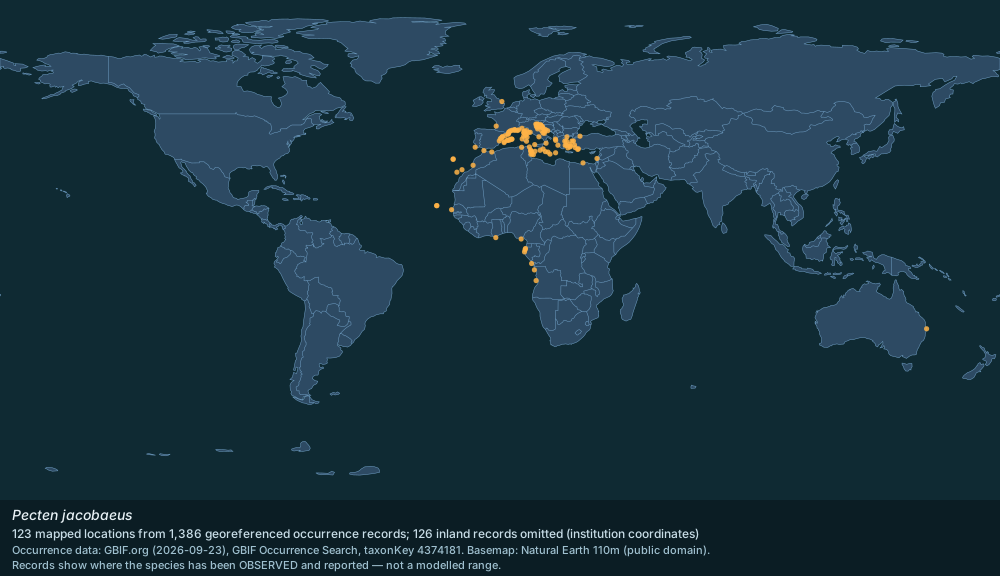
1,386 georeferenced occurrence records for Pecten jacobaeus are published through GBIF from 29 countries or marine areas. The map above plots 123 distinct locations from a sample of 1,386 records, omitting 126 inland records that carry an institution's coordinates rather than a collection site; it shows where the species has been observed and reported, not a modelled range.
Most records by country or area: Spain (433); France (348); Italy (281); Croatia (109); Greece (72).
The full country table, WoRMS marine regions and the sampling notes are on this species' Distribution page.
Source: GBIF Occurrence Search (taxonKey 4374181) — https://www.gbif.org/occurrence/search?taxon_key=4374181&has_coordinate=true (records CC0 / CC BY); WoRMS distribution records (MarineRegions) — https://www.marinespecies.org/aphia.php?p=taxdetails&id=394429 (CC BY 4.0); Natural Earth 110m basemap — https://www.naturalearthdata.com/ (public domain). Accessed 2026-09-23.
Description and natural history (Wikipedia)
Pecten jacobaeus usually reaches a length of about 120 - 140 mm, but the world record size reaches over 210 mm. The two valves have different shapes. The lower valve, with which the animal rests on the bottom, is very convex and light-colored, while the upper valve is flat and brown. They show 14 to 16 ribs (radial wrinkles) with a more or less rectangular cross section. The inside of the valves is porcelain-like smooth.
The mollusc has at the edge of the mantle many short tentacles, between which there are a total of 60 blue-millimeter lens eyes. By quickly closing of the two valves it can swim away several meters in case of danger.
These scallops eat planktonic organisms and other floating food particles, which they obtain by filtering sea water with their gills.
This species appears to be endemic to the Mediterranean Sea, but it may be conspecific with Pecten maximus, the great scallop, which has a larger distribution. Although these two species are morphologically similar, they present distinguishing features.
Fossils of Pecten jacobaeus first appear at the beginning of the Pliocene and are quite common in the Pliocene and Pleistocene deposits of Italy.
Scallops of this species are collected commercially for human consumption using such techniques as the Rapido trawl.
In a Christian context, this species is traditionally associated with Saint James, also known as James, son of Zebedee, also known as Saint Jacob, hence the specific name jacobaeus. It is also known as the "Pilgrim's scallop", as the shells were used by the pilgrims in the Middle Ages as a cup.
Source: Wikipedia: Pecten jacobaeus — https://en.wikipedia.org/wiki/Pecten_jacobaeus (CC BY-SA 4.0). Accessed 2026-09-23.
Gallery
Related in Great mediterranean scallop
Links follow this subject's own source article.
Elsewhere in Great mediterranean scallop
Spotted an error? Know more?
Reader corrections go straight into our review queue. Suggest an edit · How this site is sourced