
Spot shrimp (Pandalus platyceros)
Source-cited species reference: taxonomy from WoRMS, biology from SeaLifeBase, occurrence map from GBIF, description from Wikipedia.

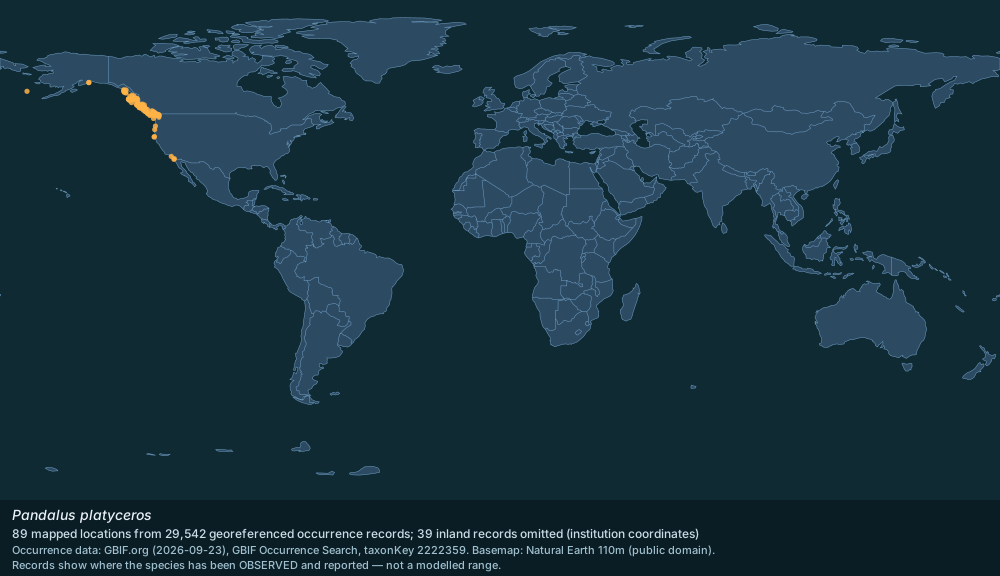
Distribution map plotted from GBIF.org occurrence records; basemap Natural Earth 110m · GBIF records CC0 / CC BY; Natural Earth public domain
Pandalus platyceros, commonly known as the spot prawn or spot shrimp), is considered a shrimp as it is of the Infraorder Caridea. Spot prawns are sometimes referred to by a regionally qualified name such as a BC Spot Prawn, California Spot Prawn, and Alaskan Prawn among others.
- Scientific name
- Pandalus platyceros
- Authority
- Brandt, 1851
- Family
- Pandalidae
- Order
- Decapoda
- Maximum length
- 30 cm
- Depth range
- 0–2648 m
- Habitat zone
- benthic
- Gbif occurrence records
- 29,542
Classification (WoRMS)
Full classification as recorded by WoRMS: Kingdom: Animalia · Phylum: Arthropoda · Class: Malacostraca · Order: Decapoda · Family: Pandalidae · Genus: Pandalus.
Accepted name: Pandalus platyceros · Authority: Brandt, 1851 · Taxonomic status: accepted · AphiaID: 423632.
Synonyms and superseded combinations recorded for this taxon: Pandalus pubesculentus Dana, 1852.
Source: World Register of Marine Species (WoRMS) — https://www.marinespecies.org/aphia.php?p=taxdetails&id=423632 (CC BY 4.0). Accessed 2026-09-23.
Biology and life history (SeaLifeBase)
Measured values published by SeaLifeBase for Pandalus platyceros. Only fields the database actually holds for this species are shown; these are database values, not aquarium guidance.
Maximum length: 30 cm · Depth range: 0–2648 m · Habitat zone: benthic · Vulnerability index: 38.2 of 100 · Fishery importance: commercial.
SeaLifeBase notes: Maximum depth from Ref. 104449. Maximum common depth from Ref. 104007. Epibenthic (Ref. 91773). Found in bed rocks to muddy sand substrates with adequate shelter for day light hiding (Ref. 91741). Also in crevices on rock faces and in lairs under boulders (Ref. 91824). Nocturnal. Carnivorous and feeds by scavenging on dead animal materials and preying on amphipods, euphausiids, limpets, annelids and other shrimps (Ref. 91741). Preyed upon by fish and octopuses. Also probably eaten by fish such as lingcod, dogfish, and Pacific cod (Ref. 91824). Associated with drift algae, specifically loose kelp (Ref. 91824). Predominantly uses Agarum fimbriatum and Agarum cribrosum kelp beds as nursery habitats (Ref. 91825).
Source: SeaLifeBase species summary (SpecCode 25897) — https://www.sealifebase.se/summary/Pandalus-platyceros.html (CC BY-NC 3.0 — non-commercial use only). Accessed 2026-09-23.
Distribution and occurrence records (GBIF)
29,542 georeferenced occurrence records for Pandalus platyceros are published through GBIF from 4 countries or marine areas. The map above plots 89 distinct locations from a sample of 3,000 records, omitting 39 inland records that carry an institution's coordinates rather than a collection site; it shows where the species has been observed and reported, not a modelled range.
Most records by country or area: Canada (29,155); United States of America (384); Mexico (2); Ireland (1).
The full country table, WoRMS marine regions and the sampling notes are on this species' Distribution page.
Source: GBIF Occurrence Search (taxonKey 2222359) — https://www.gbif.org/occurrence/search?taxon_key=2222359&has_coordinate=true (records CC0 / CC BY); WoRMS distribution records (MarineRegions) — https://www.marinespecies.org/aphia.php?p=taxdetails&id=423632 (CC BY 4.0); Natural Earth 110m basemap — https://www.naturalearthdata.com/ (public domain). Accessed 2026-09-23.
Description and natural history (Wikipedia)
The spot prawn ranges throughout the northern Pacific Ocean, (Unalaska Island, Alaska to San Diego, California), and also from the Sea of Japan to Korea Strait. While found in depths of 3.7 meters to 457.2 meters, spot prawn are most often found around 109.7 meters below sea level.
Spot prawn reach up to 27 centimeters in length, with females often longer than their male counterparts. Spot prawn have a translucent, reddish carapace with white stripes and pereopods and antennae which are banded dark and light red. Their first and fifth abdominal segments have white spots.
They are protandric hermaphrodites, meaning they first turn into males, with their appendix masculina lengthening while maturing and then gradually shortening until they turn into females.
Spot prawn harvests are relatively short, lasting only 6-8 weeks from May to June. The season opens in the spring because it is the new lifecycle for spot prawns.
The largest spot prawn harvests occur in British Columbia, Canada where approximately 2,450 metric tonnes are harvested annually, with about 65% of the harvest coming from the waters between Vancouver Island and the BC mainland. BC spot prawns are considered sustainable having been recognized by the Vancouver Aquarium's OceanWise program and as a “Good Alternative” by the Monterey Bay Aquarium's Seafood Watch program.
The largest US harvests occur in Alaska which limits annual harvest to under 800,000 lbs (Approximately 363 tonnes). The majority of the continental US landings occur in southern California, though fishing activity extends north to the Oregon border. California produced approximately 100 metric tonnes annually.
Spot prawns are renowned around the world for their flavour, freshness, and quality. Their meat has a sweet delicate flavour and firm texture. They are often sold in Japan as 'Botan Ebi' despite not being one of the 2 traditional domestic shrimp (Toyama ebi and Humpback Shrimp). This is because the spot prawn is a close relative of domestic Botan ebi and they can only be told apart by examining the head closely. Furthermore, one does not taste better than the other.
Source: Wikipedia: Pandalus platyceros — https://en.wikipedia.org/wiki/Pandalus_platyceros (CC BY-SA 4.0). Accessed 2026-09-23.
Gallery
Related in Spot shrimp
Links follow this subject's own source article.
Elsewhere in Spot shrimp
Spotted an error? Know more?
Reader corrections go straight into our review queue. Suggest an edit · How this site is sourced