
Aesop shrimp (Pandalus montagui)
Source-cited species reference: taxonomy from WoRMS, biology from SeaLifeBase, occurrence map from GBIF, description from Wikipedia.

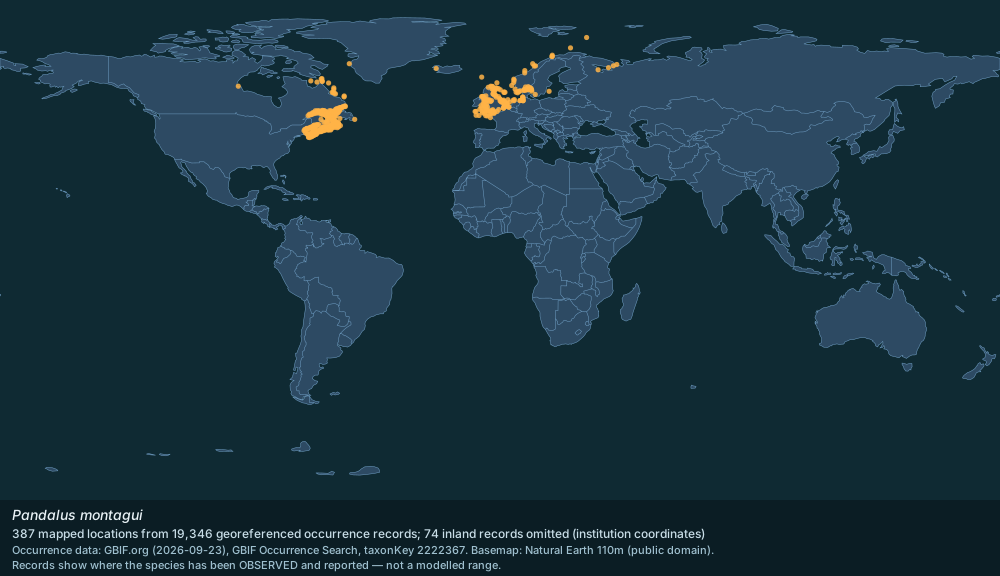
Distribution map plotted from GBIF.org occurrence records; basemap Natural Earth 110m · GBIF records CC0 / CC BY; Natural Earth public domain
Pandalus montagui is a species of cold-water shrimp in the family Pandalidae. It is the type species of the genus Pandalus and is variously known as the pink shrimp, Aesop shrimp and Aesop prawn.
- Scientific name
- Pandalus montagui
- Authority
- Leach, 1814
- Family
- Pandalidae
- Order
- Decapoda
- Maximum length
- 16 cm
- Depth range
- 0–968 m
- Habitat zone
- benthic
- Gbif occurrence records
- 19,346
Classification (WoRMS)
Full classification as recorded by WoRMS: Kingdom: Animalia · Phylum: Arthropoda · Class: Malacostraca · Order: Decapoda · Family: Pandalidae · Genus: Pandalus.
Accepted name: Pandalus montagui · Authority: Leach, 1814 · Taxonomic status: accepted · AphiaID: 107651.
Synonyms and superseded combinations recorded for this taxon: Astacus maculatus Leach, 1814; Boreocaris möbiusi Ortmann, 1893; Pandalus annulicornis Leach, 1815; Pandalus leptorhynchus Kinahan, 1858; Pandalus levigatus Stimpson, 1853.
Source: World Register of Marine Species (WoRMS) — https://www.marinespecies.org/aphia.php?p=taxdetails&id=107651 (CC BY 4.0). Accessed 2026-09-23.
Biology and life history (SeaLifeBase)
Measured values published by SeaLifeBase for Pandalus montagui. Only fields the database actually holds for this species are shown; these are database values, not aquarium guidance.
Maximum length: 16 cm · Depth range: 0–968 m · Habitat zone: benthic · Vulnerability index: 18.9 of 100 · Fishery importance: commercial.
SeaLifeBase notes: Common in offshore waters (Ref. 106917). Epifaunal in areas with sludge (Ref. 96352). Free-living (Ref. 3123).
Source: SeaLifeBase species summary (SpecCode 25895) — https://www.sealifebase.se/summary/Pandalus-montagui.html (CC BY-NC 3.0 — non-commercial use only). Accessed 2026-09-23.
Distribution and occurrence records (GBIF)
19,346 georeferenced occurrence records for Pandalus montagui are published through GBIF from 21 countries or marine areas. The map above plots 387 distinct locations from a sample of 3,000 records, omitting 74 inland records that carry an institution's coordinates rather than a collection site; it shows where the species has been observed and reported, not a modelled range.
Most records by country or area: Canada (9,070); United Kingdom of Great Britain and Northern Ireland (3,806); United States of America (3,440); Germany (981); Belgium (464).
The full country table, WoRMS marine regions and the sampling notes are on this species' Distribution page.
Source: GBIF Occurrence Search (taxonKey 2222367) — https://www.gbif.org/occurrence/search?taxon_key=2222367&has_coordinate=true (records CC0 / CC BY); WoRMS distribution records (MarineRegions) — https://www.marinespecies.org/aphia.php?p=taxdetails&id=107651 (CC BY 4.0); Natural Earth 110m basemap — https://www.naturalearthdata.com/ (public domain). Accessed 2026-09-23.
Description and natural history (Wikipedia)
Pandalus montagui is a translucent, pinkish shrimp, generally growing to about 5 cm long. Its colour is due to a number of red chromatophores and the few short red streaks running obliquely on the carapace. The rostrum is long, up-curved and divided at the tip with 10–12 teeth on its posterior dorsal edge. A spine is found under the eye on the carapace. The first antenna divides into two parts and the second is very long, exceeding the length of the body and being banded in pale and dark brown. This shrimp can be distinguished from the rather similar P. tridens by having a shorter rostrum and longer dactyls (claws) on the third and fourth pereopods (walking limbs).
Pandalus montagui has a boreo-arctic distribution. Its range extends from Greenland and Iceland, the Arctic Ocean, and the northern Atlantic Ocean, south to Rhode Island and the British Isles. It prefers hard substrates, but can be found on rock, gravel, sand, and mud. It is most common at depths between 20 and 100 m, but sometimes occurs near low-water mark or at depths to 700 m.
Pandalus montagui is an omnivore, predator, and scavenger. Its diet consists mainly of small crustaceans such as copepods, hydroids, and polychaete worms. Off the Labrador coast, a large daily vertical migration was found, with the shrimp being benthic in the daytime and pelagic at night.
Most individuals start life as males, but change sex to females at 12–15 months old. In the North Sea, off Britain, each female lays 2000–3000 eggs in November. When fertilised, she carries them around for a few days on her periopods. They then hatch and go through six zoeal and two to five decapod planktonic larval stages before undergoing metamorphosis and settling as juveniles. The rate of development of the larvae depends on the water temperature. In the more temperate parts of the range, the shrimp mature within a year.
In the North Sea, P. montagui is often found living in association with the polychaete worm Sabellaria spinulosa. The worm sometimes forms cold-water reefs, and these are an important source of food for the shrimp. Fishermen have used this fact by identifying the locations of reefs and then trawling for shrimp nearby.
The Aesop shrimp is sometimes found to be parasitized by the bopyrid isopod, Hemiarthrus abdominalis. This isopod also parasitizes several other species of shrimp, but has never been found on Pandalus borealis.
This species is fished commercially in the United Kingdom, but mostly taken as an alternative to the larger P. borealis. About 500 tons a year of P. montagui were caught globally in the period 2005–2007, catches also being recorded from Belgium, Denmark, the Faröe Islands, the Netherlands, Iceland, Norway, and Sweden.
Source: Wikipedia: Pandalus montagui — https://en.wikipedia.org/wiki/Pandalus_montagui (CC BY-SA 4.0). Accessed 2026-09-23.
Gallery
Related in Aesop shrimp
Links follow this subject's own source article.
Elsewhere in Aesop shrimp
Spotted an error? Know more?
Reader corrections go straight into our review queue. Suggest an edit · How this site is sourced