
Cushioned star (Oreaster reticulatus)
Source-cited species reference: taxonomy from WoRMS, biology from SeaLifeBase, occurrence map from GBIF, description from Wikipedia.

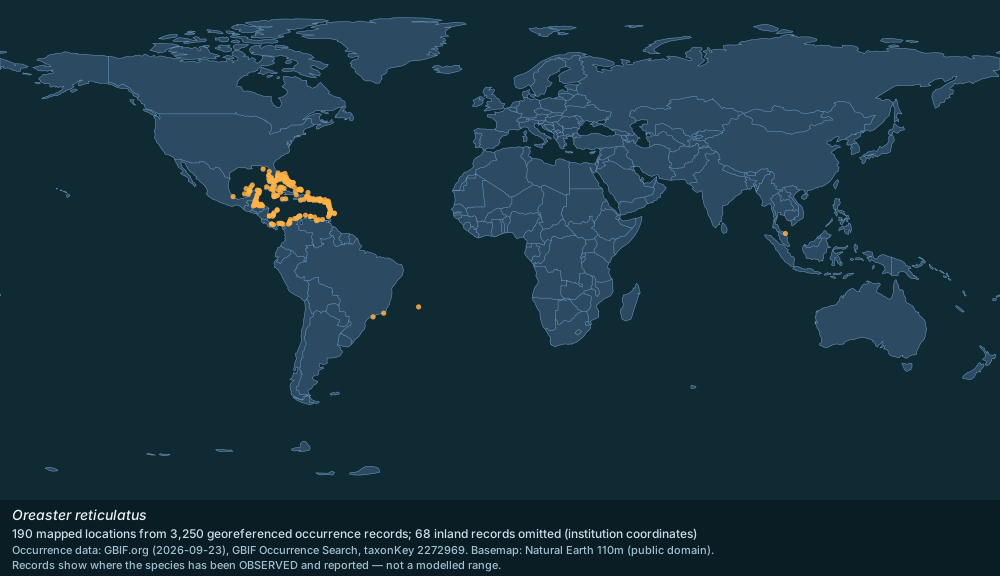
Distribution map plotted from GBIF.org occurrence records; basemap Natural Earth 110m · GBIF records CC0 / CC BY; Natural Earth public domain
Oreaster reticulatus, commonly known as the red cushion sea star or the West Indian sea star, is a species of marine invertebrate, a starfish in the family Oreasteridae. It is found in shallow water in the western Atlantic Ocean and the Caribbean Sea.
- Scientific name
- Oreaster reticulatus
- Authority
- (Linnaeus, 1758)
- Family
- Oreasteridae
- Order
- Valvatida
- Depth range
- 0–69 m
- Habitat zone
- benthic
- Gbif occurrence records
- 3,250
Classification (WoRMS)
Full classification as recorded by WoRMS: Kingdom: Animalia · Phylum: Echinodermata · Class: Asteroidea · Order: Valvatida · Family: Oreasteridae · Genus: Oreaster.
Accepted name: Oreaster reticulatus · Authority: (Linnaeus, 1758) · Taxonomic status: accepted · AphiaID: 178210.
Synonyms and superseded combinations recorded for this taxon: Asterias gigas Linnaeus, 1753; Asterias pentacyphus Bruzelius, 1805; Asterias reticulata Linnaeus, 1758; Asterias sebae de Blainville, 1830; Oreaster aculeatus (Gray, 1840); Oreaster bermudensis H.L. Clark, 1942; Oreaster gigas Lutken, 1859; Oreaster lapidarius Grube, 1857; Oreaster reticulatus var. bermudensis; Oreaster tuberosus Behn in Möbius, 1859; Pentaceros aculeatus Gray, 1840; Pentaceros gibbus Gray, 1840; Pentaceros grandis Gray, 1840; Pentaceros reticulatus Gray, 1840.
Source: World Register of Marine Species (WoRMS) — https://www.marinespecies.org/aphia.php?p=taxdetails&id=178210 (CC BY 4.0). Accessed 2026-09-23.
Biology and life history (SeaLifeBase)
Measured values published by SeaLifeBase for Oreaster reticulatus. Only fields the database actually holds for this species are shown; these are database values, not aquarium guidance.
Depth range: 0–69 m · Habitat zone: benthic.
SeaLifeBase notes: Inhabits Thalassia sp. beds and mangrove channels (Ref. 415, 87194). Known as a potential corallivore that particularly feeds on Agaricia tenuifolia (Ref. 86570).
Source: SeaLifeBase species summary (SpecCode 49317) — https://www.sealifebase.se/summary/Oreaster-reticulatus.html (CC BY-NC 3.0 — non-commercial use only). Accessed 2026-09-23.
Distribution and occurrence records (GBIF)
3,250 georeferenced occurrence records for Oreaster reticulatus are published through GBIF from 39 countries or marine areas. The map above plots 190 distinct locations from a sample of 3,000 records, omitting 68 inland records that carry an institution's coordinates rather than a collection site; it shows where the species has been observed and reported, not a modelled range.
Most records by country or area: United States of America (539); Mexico (436); Panama (327); Bahamas (226); Cayman Islands (217).
The full country table, WoRMS marine regions and the sampling notes are on this species' Distribution page.
Source: GBIF Occurrence Search (taxonKey 2272969) — https://www.gbif.org/occurrence/search?taxon_key=2272969&has_coordinate=true (records CC0 / CC BY); WoRMS distribution records (MarineRegions) — https://www.marinespecies.org/aphia.php?p=taxdetails&id=178210 (CC BY 4.0); Natural Earth 110m basemap — https://www.naturalearthdata.com/ (public domain). Accessed 2026-09-23.
Description and natural history (Wikipedia)
The red cushion star is the largest sea star found within its range, sometimes growing to about 50 cm in diameter. It usually has five thick, broad arms projecting from a broad cushioned disc but some specimens have four, six or seven. The upper surface is hard and is covered with blunt spines. The color of adults is some shade of red, orange, yellow or brown. The juveniles are greenish-brown with mottled markings.
The red cushion star occurs in many regions of the Western Central Atlantic, including the Bahamas, Cape Frio, Cape Hatteras, the Caribbean Sea, Florida, the Gulf of Mexico, Guyanas and Yucatán. Adults are usually found on sandy bottoms and coral rubble at depths of up to 37 m while juveniles inhabit seagrass meadows where their colouring helps provide camouflage. In the winter, the red cushion star migrates to offshore locations with little water movement in order to avoid turbulence.
The red cushion star is an omnivore and feeds on the seabed sediment and the epiphytic algae, sponges and small invertebrates it finds there. It rakes together heaps of sediment and then turns its cardiac stomach inside out and engulfs the mass. Edible sponge species are chosen in preference to other prey and tend to be eliminated from areas where the starfish abound.
The sexes are separate in the red cushion star. In subtropical areas it breeds in the summer, but in more tropical locations it breeds all year. Large numbers of individuals may collect together in one location at breeding time with densities sometimes reaching fourteen per square metre (yard). This concentration of individuals enhances the chance of fertilization when the gametes are liberated into the sea. The larvae form part of the zooplankton and drift with the currents. After passing through several developmental stages they settle on the seabed, usually among seagrass, and undergo metamorphosis into juvenile starfish.
Harvesting Oreaster reticulatus is illegal in some places including Florida waters.
Source: Wikipedia: Oreaster reticulatus — https://en.wikipedia.org/wiki/Oreaster_reticulatus (CC BY-SA 4.0). Accessed 2026-09-23.
Gallery
Related in Cushioned star
Links follow this subject's own source article.
Elsewhere in Cushioned star
Spotted an error? Know more?
Reader corrections go straight into our review queue. Suggest an edit · How this site is sourced