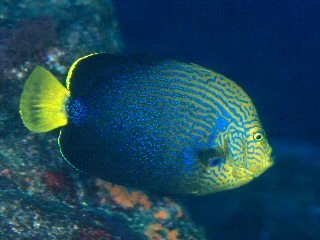
Orangeface angelfish (Chaetodontoplus chrysocephalus)
Source-cited species reference: taxonomy from WoRMS, biology from FishBase, conservation from IUCN Red List, description from Wikipedia.

The orangeface angelfish (Chaetodontoplus chrysocephalus), also known as the blue vermiculate angelfish or maze angelfish, is a species of marine ray-finned fish, a marine angelfish belonging to the family Pomacanthidae. It is found in the Pacific Ocean.
- Scientific name
- Chaetodontoplus chrysocephalus
- Authority
- (Bleeker, 1855)
- Family
- Pomacanthidae
- Order
- Acanthuriformes
- Maximum length
- 22 cm
- Depth range
- 15–25 m
- Habitat zone
- reef-associated
- Iucn red list
- Least Concern
A Study in Contrasting Colours
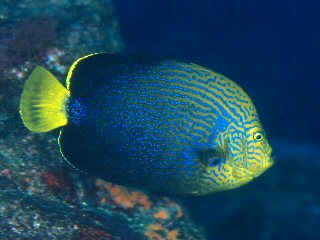
The orangeface angelfish presents one of the more striking colour contrasts among marine angelfishes. Its face takes on a warm brownish-orange tone that stands out sharply against the cooler greenish-blue stripes running along the rest of the body. Moving posteriorly, the body gradually deepens into a dark brown, which then gives way to a vivid yellow caudal fin, creating a dramatic gradient from head to tail. In terms of fin architecture, the dorsal fin bears thirteen spines followed by seventeen or eighteen soft rays, while the anal fin carries three spines paired with a similar count of seventeen to eighteen soft rays. The species reaches a maximum total length of twenty-two centimetres, roughly eight and a half inches, placing it in the medium range for its family. Commonly encountered under alternative names such as the blue vermiculate angelfish or the maze angelfish, this member of the Pomacanthidae family is a ray-finned marine fish whose intricate striping pattern has earned it the "maze" moniker among those who have glimpsed it.
An Elusive Presence in the Western Pacific
Despite belonging to a family that includes many well-known reef species, the orangeface angelfish remains one of the most poorly documented members of its genus. Its confirmed range is restricted to the western Pacific Ocean, and more specifically, it has been reliably recorded only from the Java Sea off the coast of Indonesia. Sighting reports from other locations, including the Philippines and the waters around Taiwan, are widely regarded by ichthyologists as probable misidentifications of closely related species, particularly C. caeruleopunctatus and C. cephalareticulatus. This narrow and uncertain distribution makes the species exceptionally difficult to study. The most recent credible observation places the fish at Karimnjawa in the Java Sea, reported around the year 2002. The combination of its restricted range, infrequent sightings, and the likelihood that many historical records actually represent other species means that the true population size and geographic extent of the orangeface angelfish remain largely unknown to science.
Life on the Deep Reef
What is known about the daily existence of the orangeface angelfish is limited to a narrow set of observations. The species has been recorded at depths between twenty and twenty-five metres, roughly sixty-six to eighty-two feet, in the waters of the Java Sea. Within this relatively deep zone, it is thought to inhabit rocky reef environments, though the full scope of its habitat preferences remains uncertain due to the scarcity of data. Its feeding ecology points to a specialised diet centred on sponges and tunicates, placing it among the selective-feeding angelfishes that graze on sessile invertebrates attached to reef structures. Beyond these few details, the broader biology of the species—its reproductive behaviour, social structure, growth patterns, and seasonal movements—remains virtually unexplored. The combination of its depth range, its apparent preference for rocky substrates, and its specialised diet paints a picture of a fish adapted to a relatively stable, three-dimensional reef environment, yet the sheer paucity of observations means that much of its natural history is still open to discovery.
A Name Born from Gold and Head
The formal scientific description of the orangeface angelfish traces back to 1855, when the Dutch naturalist Pieter Bleeker, a physician and ichthyologist active in the mid-nineteenth century, published the species under the name Holocanthus chrysocephalus. Bleeker, who lived between 1819 and 1878, designated Jakarta as the type locality, anchoring the species' identity to the waters surrounding the Indonesian capital. The specific epithet is a straightforward compound drawn from Greek: chrysos, meaning "gold," combined with cephalus, meaning "head," a direct reference to the fish's distinctive yellowish-orange facial colouration. Over time, taxonomic revisions moved the species into the genus Chaetodontoplus, giving it its current binomial Chaetodontoplus chrysocephalus. Despite its formal recognition for nearly two centuries, the orangeface angelfish appears extremely infrequently in the aquarium trade, a testament to how rarely it is encountered by collectors or divers. Its obscurity in both the wild and in captivity underscores just how little is known about this small, colourful inhabitant of the deep Java Sea.
Gallery
Spotted an error? Know more?
Reader corrections go straight into our review queue. Suggest an edit · How this site is sourced