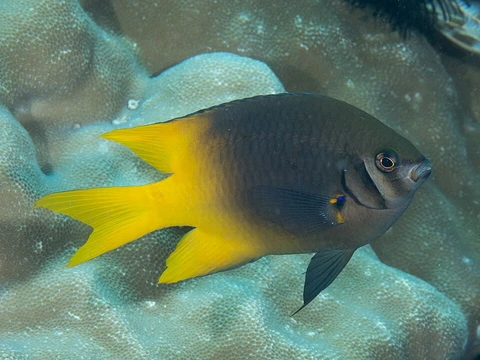
Black-and-gold chromis (Neoglyphidodon nigroris)
Source-cited species reference: taxonomy from WoRMS, biology from FishBase, occurrence map from GBIF, conservation from IUCN Red List, description from Wikipedia.

Neoglyphidodon nigroris, commonly known as the black-and-gold chromis or Behn's damsel, is a species of damselfish found in the Indo-West Pacific. It occasionally makes its way into the aquarium trade.
- Scientific name
- Neoglyphidodon nigroris
- Authority
- (Cuvier, 1830)
- Family
- Pomacentridae
- Order
- Ovalentaria incertae sedis
- Maximum length
- 13 cm
- Depth range
- 2–23 m
- Habitat zone
- reef-associated
- Iucn red list
- Least Concern
- Gbif occurrence records
- 4,295
Classification (WoRMS)
Full classification as recorded by WoRMS: Kingdom: Animalia · Phylum: Chordata · Class: Teleostei · Order: Ovalentaria incertae sedis · Family: Pomacentridae · Genus: Neoglyphidodon.
Accepted name: Neoglyphidodon nigroris · Authority: (Cuvier, 1830) · Taxonomic status: accepted · AphiaID: 278813.
Synonyms and superseded combinations recorded for this taxon: Abudefduf behnii (Bleeker, 1847); Abudefduf coracinus Seale, 1910; Abudefduf filifer Weber, 1913; Abudefduf xanthurus (Bleeker, 1853); Chromis bitaeniatus Fowler & Bean, 1928; Chrysiptera xanthura xanthura (Bleeker, 1853); Glyphisodon behnii Bleeker, 1847; Glyphisodon nigroris Cuvier, 1830; Glyphisodon xanthurus Bleeker, 1853; Paraglyphidodon behni (Bleeker, 1847); Paraglyphidodon behnii (Bleeker, 1847); Paraglyphidodon nigroris (Cuvier, 1830); Paraglyphipodon nigroris (Cuvier, 1830).
Source: World Register of Marine Species (WoRMS) — https://www.marinespecies.org/aphia.php?p=taxdetails&id=278813 (CC BY 4.0). Accessed 2026-09-23.
Biology and life history (FishBase)
Measured values published by FishBase for Neoglyphidodon nigroris. Only fields the database actually holds for this species are shown; these are database values, not aquarium guidance.
Maximum length: 13 cm · Depth range: 2–23 m · Habitat zone: reef-associated · Body shape: short and / or deep · Vulnerability index: 10 of 100 · Fishery importance: commercial · Aquarium trade: public aquariums.
FishBase notes: Two forms: long-tailed and black as adults occur in the Andaman Sea, ranging east to western Bali and north to Japan. Second form, probably valid as N. xanthurus occur in the rest of the West Pacific and the two overlap in range on Bali's north coast (Ref. 48636). Occur in coral-rich areas of lagoon and seaward reefs. Usually solitary (Ref. 1602). Feed on algae, crustaceans, and pelagic tunicates and salps. Oviparous, distinct pairing during breeding (Ref. 205). Eggs are demersal and adhere to the substrate (Ref. 205). Males guard and aerate the eggs (Ref. 205). Diurnal species (Ref. 54980; 113699).
Source: FishBase species summary (SpecCode 5708) — https://www.fishbase.se/summary/Neoglyphidodon-nigroris.html (CC BY-NC 3.0 — non-commercial use only). Accessed 2026-09-23.
Distribution and occurrence records (GBIF)
4,295 georeferenced occurrence records for Neoglyphidodon nigroris are published through GBIF from 21 countries or marine areas. The map above plots 213 distinct locations from a sample of 3,000 records, omitting 27 inland records that carry an institution's coordinates rather than a collection site; it shows where the species has been observed and reported, not a modelled range.
Most records by country or area: Australia (2,903); New Caledonia (399); Indonesia (372); Philippines (159); Japan (112).
The full country table, WoRMS marine regions and the sampling notes are on this species' Distribution page.
Source: GBIF Occurrence Search (taxonKey 2398588) — https://www.gbif.org/occurrence/search?taxon_key=2398588&has_coordinate=true (records CC0 / CC BY); WoRMS distribution records (MarineRegions) — https://www.marinespecies.org/aphia.php?p=taxdetails&id=278813 (CC BY 4.0); Natural Earth 110m basemap — https://www.naturalearthdata.com/ (public domain). Accessed 2026-09-23.
Conservation status (IUCN Red List)
The IUCN Red List assesses Neoglyphidodon nigroris (Cuvier, 1830) as Least Concern (code LC). No trend, population estimate or threat analysis is given here, because none is available from this source without the Red List API; follow the source link for the full assessment, including its date.
Source: IUCN Red List of Threatened Species (taxon 188588) — https://www.iucnredlist.org/species/188588/0; GBIF IUCN Red List category endpoint (taxonKey 2398588) — https://api.gbif.org/v1/species/2398588/iucnRedListCategory. Accessed 2026-09-23.
Description and natural history (Wikipedia)
This species of damselfish is found throughout the Indo-Pacific region. In the Indian Ocean, it is found around Sri Lanka, the Andaman Sea, Indonesia, and Australia. In the Pacific Ocean, it is found around Indonesia, the Philippines, Australia, Vietnam, Japan, Malaysia, the Solomon Islands, Vanuatu, and Hawaii. It lives in coral reefs and lagoons rich in corals, and is found at depths of 2-21 m.
Adults can grow up to 13 cm in total length. There are two coloration varieties in adults: individuals ranging from the Andaman Sea to Japan are black, while individuals from the western Pacific Ocean have a tan front and a yellow rear. The latter variety may deserve species status under the name N. xanthurus, and the two varieties overlap around the island of Bali. Juveniles are yellow with 2 longitudinal black stripes and a black spot at the pectoral-fin base.
This species is omnivorous, feeding mainly on algae, crustaceans, tunicates, and salps.
This species is diurnal and normally solitary. It is also territorial, a trait that becomes more and more apparent as the fish gets older.
During breeding, the female lays her eggs (which are demersal) on substrate. The male then guards them and aerates them until they hatch.
Juveniles are occasionally available for the aquarium trade. Most people keep this fish in water conditions of 1.020 to 1.025 gravity, pH 8.1 to 8.4, and 22-25 C. It chases smaller fishes and hides in crevices in order to avoid bigger fishes.
Source: Wikipedia: Neoglyphidodon nigroris — https://en.wikipedia.org/wiki/Neoglyphidodon_nigroris (CC BY-SA 4.0). Accessed 2026-09-23.
Related in Black-and-gold chromis
Links follow this subject's own source article.
Elsewhere in Black-and-gold chromis
Spotted an error? Know more?
Reader corrections go straight into our review queue. Suggest an edit · How this site is sourced