Milk shark (Rhizoprionodon acutus)
Source-cited species reference: taxonomy from WoRMS, biology from FishBase, occurrence map from GBIF, conservation from IUCN Red List, description from Wikipedia.
Last updated

Karunakar Rayker from India · via Wikipedia: Milk shark · CC BY 2.0
The milk shark (Rhizoprionodon acutus) is a species of requiem shark, and part of the family Carcharhinidae, whose common name comes from an old Indian belief that consumption of its meat promotes lactation. The largest and most widely distributed member of its genus, the milk shark typically measures 1.1 m long, and can be found in coastal tropical waters throughout the eastern Atlantic and the Indo-Pacific regions.
Occurring from the surface to a depth of 200 m, this species is common near beaches and in estuaries, and has been recorded swimming up rivers in Cambodia. Juveniles are known to inhabit tidal pools and seagrass meadows. The milk shark has a slender body with a long, pointed snout and large eyes, and is a nondescript gray above and white below.
Scientific classification
- KingdomAnimalia
- PhylumChordata
- ClassChondrichthyes
- SubclassElasmobranchii
- DivisionSelachii
- OrderCarcharhiniformes
- FamilyCarcharhinidae
- GenusRhizoprionodon
- SpeciesRhizoprionodon acutus
Named by (Rüppell, 1837)
Close relatives
Other species of Rhizoprionodon with a Codexery entry.
- Atlantic sharpnose shark Rhizoprionodon terraenovae
- Brazilian sharpnose shark Rhizoprionodon lalandii
Sources: Wikipedia taxobox: Milk shark (CC BY-SA 4.0) · order, family and genus agree with WoRMS AphiaID 105802 (CC BY 4.0)
Conservation status
Vulnerable (VU)
- LC
- NT
- VU▲ this species
- EN
- CR
- EW
- EX
Source: IUCN Red List assessment · GBIF copy of the Red List category
How big is it?
Largest length in the source, 1.75 m, next to a 1.8 m person.
Diagram: drawn by Codexery, schematic shapes to scale (not a likeness). Length: FishBase species summary
Classification (WoRMS)
Full classification as recorded by WoRMS: Kingdom: Animalia · Phylum: Chordata · Class: Elasmobranchii · Order: Carcharhiniformes · Family: Carcharhinidae · Genus: Rhizoprionodon.
Accepted name: Rhizoprionodon acutus · Authority: (Rüppell, 1837) · Taxonomic status: accepted · AphiaID: 105802.
Synonyms and superseded combinations recorded for this taxon: Carcharhinus acutus (Rüppell, 1837); Carcharias aaronis Hemprich & Ehrenberg, 1899; Carcharias acutus Rüppell, 1837; Carcharias crenidens Klunzinger, 1880; Carcharias eumeces Pietschmann, 1913; Carcharias sorrahkowah Bleeker, 1853; Carcharias sorrakowah (Cuvier, 1829); Carcharias walbeehmi Bleeker, 1856; Carcharias walbeehmii (Bleeker, 1856); Carcharias walbenii Bleeker, 1856; Cynocephalus acutus (Rüppell, 1837); Hypoprion acutus (Rüppell, 1837); Scoliodon acutus (Rüppell, 1837); Scoliodon longmani Ogilby, 1912; Scoliodon palasorra (Bleeker, 1853); Scoliodon palasorrah (Bleeker, 1853); Scoliodon sorrahkowah (Bleeker, 1853); Scoliodon vagatus Garman, 1913; Scoliodon walbeehmi (Bleeker, 1856); Scoliodon walbeehmii (Bleeker, 1856); Scoliodon walbeemii (Bleeker, 1856); Scolliodon walbechmii (Bleeker, 1856); Squalus sorrakowah Cuvier, 1829.
Source: World Register of Marine Species (WoRMS) — https://www.marinespecies.org/aphia.php?p=taxdetails&id=105802 (CC BY 4.0). Accessed 2026-09-28.
Biology and life history (FishBase)
Measured values published by FishBase for Rhizoprionodon acutus. Only fields the database actually holds for this species are shown; these are database values, not aquarium guidance.
Maximum length: 175 cm · Common length: 110 cm · Depth range: 1–200 m · Habitat zone: benthopelagic · Body shape: fusiform / normal · Vulnerability index: 61 of 100 · Fishery importance: commercial · Aquarium trade: never/rarely.
FishBase notes: Found on continental shelves, often on sandy beaches and rarely in estuaries (Ref. 244). Reported to enter freshwater and recorded several times from Cambodia as far upstream as the Great Lake (Ref. 12693). Occurs near the surface in shallow waters (Ref. 12693). Feeds mainly on small pelagic and benthic bony fishes, also cephalopods and other invertebrates (Ref.
244). Viviparous (Ref. 50449). Utilized fresh and possibly dried salted for human consumption and for fishmeal (Ref. 9997). The 178 cm specimen recorded off Africa is possibly based on some other species (Ref. 9997).
Source: FishBase species summary (SpecCode 899) — https://www.fishbase.se/summary/Rhizoprionodon-acutus.html (CC BY-NC 3.0 — non-commercial use only). Accessed 2026-09-28.
Distribution and occurrence records (GBIF)
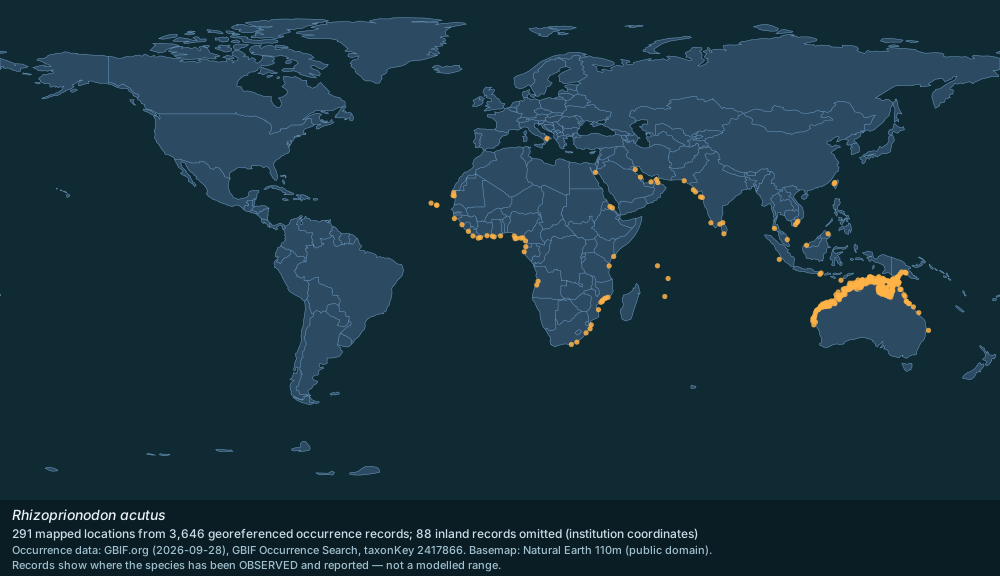
3,646 georeferenced occurrence records for Rhizoprionodon acutus are published through GBIF from 55 countries or marine areas. The map above plots 291 distinct locations from a sample of 3,000 records, omitting 88 inland records that carry an institution's coordinates rather than a collection site; it shows where the species has been observed and reported, not a modelled range.
Most records by country or area: Australia (2,102); Cameroon (215); Mauritania (183); Papua New Guinea (133); Nigeria (118).
The full country table, WoRMS marine regions and the sampling notes are on this species' Distribution page.
Source: GBIF Occurrence Search (taxonKey 2417866) — https://www.gbif.org/occurrence/search?taxon_key=2417866&has_coordinate=true (records CC0 / CC BY); WoRMS distribution records (MarineRegions) — https://www.marinespecies.org/aphia.php?p=taxdetails&id=105802 (CC BY 4.0); Natural Earth 110m basemap — https://www.naturalearthdata.com/ (public domain). Accessed 2026-09-28.
Conservation status (IUCN Red List)
The IUCN Red List assesses Rhizoprionodon acutus (Rüppell, 1837) as Vulnerable (code VU). No trend, population estimate or threat analysis is given here, because none is available from this source without the Red List API; follow the source link for the full assessment, including its date.
Source: IUCN Red List of Threatened Species (taxon 41850) — https://www.iucnredlist.org/species/41850/0; GBIF IUCN Red List category endpoint (taxonKey 2417866) — https://api.gbif.org/v1/species/2417866/iucnRedListCategory. Accessed 2026-09-28.
Description and natural history (Wikipedia)
Among the most abundant sharks within its range, the milk shark feeds primarily on small bony fishes, but also takes cephalopods and crustaceans. In turn, it often falls prey to larger sharks and possibly marine mammals. In common with other members of its family, this species is viviparous, with the developing embryos sustained by a placental connection. Females give birth to one to eight young either during a defined breeding season or throughout the year, depending on location.
Human interactions
The reproductive cycle is usually annual, but may be biennial or triennial. Large numbers of milk sharks are caught by artisanal and commercial fisheries in many countries for meat, fins, and fishmeal. The International Union for Conservation of Nature has assessed this species as being vulnerable.
Taxonomy and phylogeny
The German naturalist Eduard Rüppell published the first scientific description of the milk shark, as Carcharias acutus (the specific epithet means "sharp" in Latin), in his 1837 Fische des Rothen Meeres (Fishes of the Red Sea). It has since been listed under several different genera, including Carcharhinus and Scoliodon, before finally being placed in the genus Rhizoprionodon via synonymization with the type species, R. crenidens. As Rüppell did not mention a type specimen, in 1960, Wolfgang Klausewitz designated a 44 cm-long male caught off Jeddah, Saudi Arabia as the lectotype for this species.
The common name "milk shark" comes from a belief held in India that eating this shark's meat enhances lactation. Other names for this species include fish shark, grey dog shark, little blue shark, Longmans dogshark, milk dog shark, sharp-nosed (milk) shark, Walbeehm's sharp-nosed shark, and white-eye shark. A 1992 phylogenetic analysis by Gavin Naylor, based on allozymes, found that the milk shark is the most basal of the four Rhizoprionodon species examined. The extinct R. fischeuri, known from Middle Miocene (16–12 Ma) deposits in southern France and Portugal, may be the same as R. acutus.
Distribution and habitat
The milk shark has the widest distribution of any Rhizoprionodon species. In the eastern Atlantic Ocean, it is found from Mauritania to Angola, as well as around Madeira. Since 1985, there have been four occurrences, temporally and spatially distinct, of the milk shark in the central Mediterranean Sea, with a likely entry via the Strait of Gibraltar.
In the Indian Ocean, it occurs from South Africa and Madagascar northward to the Arabian Peninsula, and eastward to South and Southeast Asia. In the Pacific Ocean, this species occurs from China and southern Japan, through the Philippines and Indonesia, to New Guinea and northern Australia. The milk shark likely once had a contiguous distribution by way of the Tethys Sea, until during the Miocene epoch, when eastern Atlantic sharks were isolated from Indo-Pacific sharks by the collision of Asia and Africa.
Occurring close to shore from the surf zone to a depth of 200 m, the milk shark favors turbid water off sandy beaches and occasionally enters estuaries. In Shark Bay, Western Australia, juvenile milk sharks inhabit seagrass meadows composed of Amphibolis antarctica and Posidonia australis.
Although some sources state this species avoids low salinities, it has been reported several times from fresh water in Cambodia, as far upstream as the Tonlé Sap. Milk sharks may be found anywhere in the water column from the surface to the bottom. Off KwaZulu-Natal, South Africa, its numbers fluctuate annually with a peak in summer, suggesting some form of seasonal movement.
Description
The largest member of its genus, off West Africa the milk shark has been reported to reach 1.78 m and 22 kg for males, and 1.65 m and 17 kg for females, though there is uncertainty regarding the species identity of these specimens. Even if accepted, these figures are considered exceptional and most individuals do not exceed 1.1 m in length. Generally, females are heavier and attain a greater maximum size than males.
The milk shark has a slender build with a long, pointed snout, large, round eyes with nictitating membranes (protective third eyelids), and no spiracles. On each side of the head behind the corner of the jaw, there are usually seven to 15 enlarged pores. The nostrils are small, as are the adjacent triangular skin flaps. There are long furrows at the corners of the mouth on both the upper and lower jaws.
The tooth rows number 24–25 in both jaws. The upper teeth are finely serrated and strongly oblique; the lower teeth have a similar shape, though the serrations are smaller and the tips curve gently upward. The teeth of juveniles are smooth-edged.
The broad, triangular pectoral fins originate below the third or fourth gill slits, and are no longer than the front margin of the first dorsal fin. The anal fin is about twice as long as the second dorsal fin and preceded by long ridges. The first dorsal fin originates over the pectoral fin free rear tips, and the much smaller second dorsal fin originates over the last third of the anal fin base. The dorsal fins do not have a ridge between them.
The lower lobe of the caudal fin is well-developed and the upper lobe has a ventral notch near the tip. This shark is plain gray, brown-gray, or purple-gray above, and white below. The leading edge of the first dorsal fin and the trailing edge of the caudal fin may be dark, and the trailing edges of the pectoral fins may be light.
One of the most (if not the most) abundant near-shore sharks within its range, the milk shark feeds mainly on small benthic and bony fishes. Occasionally squid, octopus, cuttlefish, crabs, shrimp, and gastropods are also taken.
In Shark Bay, the most important prey are silversides, herring, smelt-whitings, and wrasses; this is also the only local shark species that preys on the Waigeo seaperch (Psammoperca waigiensis), found in seagrass beds avoided by other sharks. In the Gulf of Carpentaria, it feeds mainly on halfbeaks, herring, and mullets, and is also a major predator of penaeid prawns. Smaller sharks eat proportionately more cephalopods and crustaceans, switching to fish as they grow older.
Many predators feed on the milk shark, including larger sharks such as the blacktip shark (Carcharhinus limbatus) and Australian blacktip shark (Carcharhinus tilstoni), and possibly also marine mammals. Off KwaZulu-Natal, the decimation of large sharks by the use of gillnets to protect beaches has led to a recent increase in milk shark numbers. A known parasite of this species is the copepod Pseudopandarus australis. There is some evidence that male and female milk sharks segregate from each other.
Like other requiem sharks, the milk shark is viviparous; females usually have a single functional ovary (on the left) and two functional uteruses divided into separate compartments for each embryo. The details of its life history vary across different parts of its range. Females generally produce young every year, though some give birth every other year or even every third year.
Mating and parturition take place in spring or early summer (April to July) off western and southern Africa, and in winter off India, Alternately, off Oman parturition occurs year-round with a peak in spring. Parturition also occurs continuously in Australian waters; in the Herald Bight of Shark Bay, the number of newborns peaks in April and again in July. One proposed explanation for the lack of reproductive seasonality in these subpopulations is a lengthier and/or more complex reproductive cycle than has been detected (such as a period of dormancy in embryonic development, though there is presently no evidence of this occurring).
Source: Wikipedia: Milk shark — https://en.wikipedia.org/wiki/Milk_shark (CC BY-SA 4.0). Accessed 2026-09-28.
Related in Milk shark
Links follow this subject's own source article.
Elsewhere in Milk shark
Test yourself
Three questions drawn from this entry’s sources. Pick an answer to check it.
Answers checked against the source article
Sources
Compiled from Wikipedia and the sources listed below. Text from Wikipedia is available under CC BY-SA 4.0; this entry is adapted from it.
- Wikipedia: Milk shark (CC BY-SA 4.0).
- Classification: the source article's taxobox; order, family and genus checked against WoRMS, the World Register of Marine Species (CC BY 4.0).
- Conservation status: IUCN Red List assessment.
- Biology values: FishBase species summary (CC BY-NC 3.0, non-commercial).
- Word definitions: the Codexery glossary, each quoted from its Wikipedia article.
Spotted an error? Know more?
Reader corrections go straight into our review queue. Suggest an edit · How this site is sourced