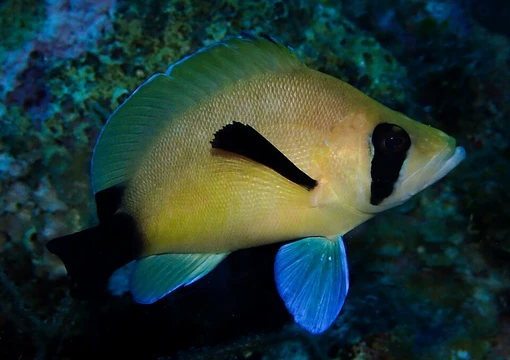
El Búho Oscuro
Eight arms, three hearts, and a gaze that watches the reef like a dark owl in the shallows.

El Búho Oscuro ("the Dark Owl") is a local common name applied to a mid-sized reef-dwelling octopus of the family Octopodidae, most closely associated with the genus Octopus. In the coral-reef and rocky-substrate habitats of the western Atlantic and eastern Pacific, this cephalopod occupies a keystone predatory niche, its broad, owl-like eyes and cryptic mantle giving rise to the folk name. It is a solitary, highly intelligent invertebrate whose chromatophore-driven camouflage and problem-solving reputation make it one of the most studied invertebrate predators in marine ecology.
- Taxonomic group
- Class Cephalopoda, Order Octopoda, Family Octopodidae
- Common name (local)
- El Búho Oscuro
- Habitat
- Tropical and subtropical coral reefs, rocky outcrops, seagrass beds
- Body plan
- Eight arms, no internal shell, beak, three hearts
- Blood pigment
- Hemocyanin (blue blood)
- Nervous system
- Distributed; ~two-thirds of neurons reside in the arms
- Ecological role
- Apex invertebrate predator; prey for moray eels, groupers, and sharks
Lore & Background
The creature that reef divers call El Búho Oscuro is a master of concealment. Its mantle is studded with thousands of chromatophores, iridophores, and papillae that let it shift colour, pattern, and even surface texture in a fraction of a second, blending into coral rubble, sand, or the mottled interior of a sea-cucumber hideout. The broad, forward-facing eyes—each with a W-shaped pupil—give the animal its owl-like stare, and the name sticks: in several Caribbean and Pacific fishing communities the octopus is spoken of as the dark owl that watches from the reef shelf.
Unlike most invertebrates, this octopus possesses a distributed nervous system. Roughly two-thirds of its neurons are embedded in the arms themselves, allowing each limb to taste, grip, and explore semi-independently while the central brain coordinates the whole. It has three hearts—two branchial hearts pumping blood over the gills and one systemic heart driving circulation through the body—and its blood is oxygenated by hemocyanin, a copper-based protein that gives it a faint blue tint. The animal has no rigid skeleton; its only hard structures are the chitinous beak and the small internal stylet (vestigial in females), so it can compress its body through gaps barely wider than its eye.
Reproductively, the species is semelparous in many populations: the male dies shortly after mating, and the female guards her egg mass for weeks or months, feeding little or not at all, until the young hatch and disperse into the planktonic phase. This single, all-in reproductive strategy, combined with a lifespan of roughly one to three years depending on size and sex, makes each individual a brief but intense chapter in the reef's food web.
Reader's Guide
Act I – The Reef Shelf (tropical/subtropical Indo-Pacific and Atlantic, year-round presence).
Mask and physicality: The "mask" is the mantle and the eight arms themselves—a living chameleon of chromatophores and papillae. The broad, forward-set eyes with their W-shaped pupils give the animal its owl-like expression. The body is soft, boneless, and compressible; the only hard parts are the beak and a vestigial stylet.
Signature moves (in-universe names): • "Ojo de Búho" – the fixed, unblinking stare used to lock onto prey before the strike. • "Manto Gris" – full-body chromatophore flush to grey-brown, rendering the animal invisible against rubble. • "Ocho Brazos" – all eight arms deployed simultaneously to envelop and restrain a struggling fish or crustacean. • "Fuga del Huevo" – the rapid, jet-propelled escape through a gap narrower than the eye, leaving only a trail of ink.
Key feuds: Moray eels and groupers are the principal predators that hunt it in its dens; in turn, El Búho Oscuro is the parrotfish's and the hermit crab's most persistent reef predator.
Legacy line: "The dark owl does not rule the reef; it simply watches, waits, and when it moves, the reef rearranges itself around the absence."
Did You Know?
- Approximately two-thirds of an octopus's neurons are located in its arms, meaning each limb can process sensory information and execute fine motor tasks semi-independently of the central brain.
- Octopuses produce ink from a dedicated ink sac and can eject it as a smoke screen; some species also release a cloud of bioluminescent mucus that disorients predators in the deep.
More in Wrestlers
Elsewhere in Masked Hamlet
Spotted an error? Know more?
Reader corrections go straight into our review queue. Suggest an edit · How this site is sourced