
Libinia ferreirae
Source-cited species reference: taxonomy from WoRMS, biology from SeaLifeBase, occurrence map from GBIF, description from Wikipedia.

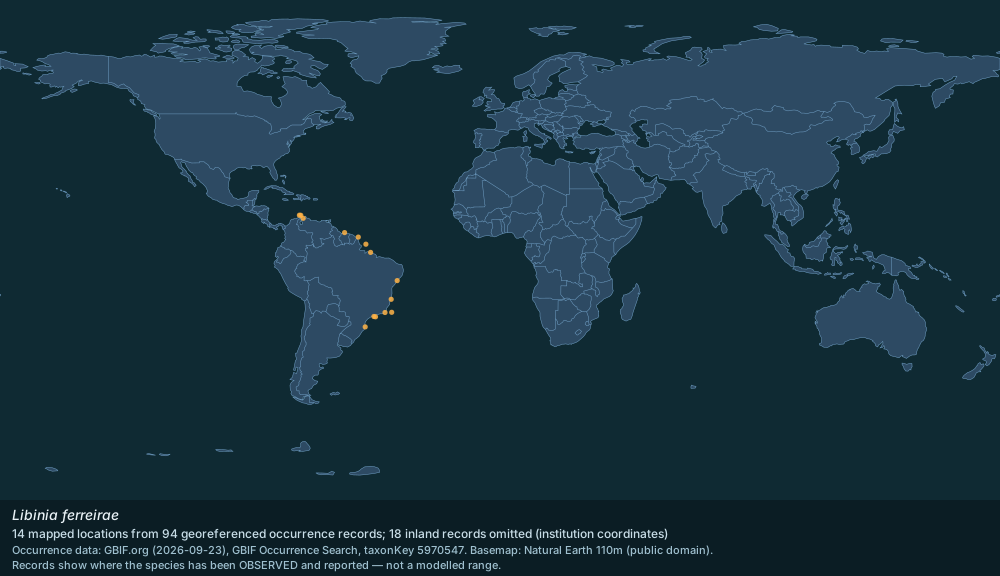
Distribution map plotted from GBIF.org occurrence records; basemap Natural Earth 110m · GBIF records CC0 / CC BY; Natural Earth public domain
Libinia ferreirae is a species of tropical spider crab in the family Epialtidae. It is found on the seabed in shallow waters off the Atlantic coast of South America.
- Scientific name
- Libinia ferreirae
- Authority
- de Brito Capello, 1871
- Family
- Epialtidae
- Order
- Decapoda
- Maximum length
- 6.05 cm
- Habitat zone
- benthic
- Gbif occurrence records
- 94
Classification (WoRMS)
Full classification as recorded by WoRMS: Kingdom: Animalia · Phylum: Arthropoda · Class: Malacostraca · Order: Decapoda · Family: Epialtidae · Genus: Libinia.
Accepted name: Libinia ferreirae · Authority: de Brito Capello, 1871 · Taxonomic status: accepted · AphiaID: 441595.
Synonyms and superseded combinations recorded for this taxon: Libinia gibbosa A. Milne-Edwards, 1878.
Source: World Register of Marine Species (WoRMS) — https://www.marinespecies.org/aphia.php?p=taxdetails&id=441595 (CC BY 4.0). Accessed 2026-09-23.
Biology and life history (SeaLifeBase)
Measured values published by SeaLifeBase for Libinia ferreirae. Only fields the database actually holds for this species are shown; these are database values, not aquarium guidance.
Maximum length: 6.05 cm · Habitat zone: benthic · Vulnerability index: 10 of 100 · Aquarium trade: never/rarely.
SeaLifeBase notes: Carapace width range: 0.57 to 6.05 cm (Ref. 93549).
Source: SeaLifeBase species summary (SpecCode 154923) — https://www.sealifebase.se/summary/Libinia-ferreirae.html (CC BY-NC 3.0 — non-commercial use only). Accessed 2026-09-23.
Distribution and occurrence records (GBIF)
94 georeferenced occurrence records for Libinia ferreirae are published through GBIF from 4 countries or marine areas. The map above plots 14 distinct locations from a sample of 94 records, omitting 18 inland records that carry an institution's coordinates rather than a collection site; it shows where the species has been observed and reported, not a modelled range.
Most records by country or area: Brazil (87); Colombia (3); Venezuela (Bolivarian Republic of) (3); Suriname (1).
Marine regions with a valid WoRMS distribution record: Lesser Antilles; Estado Nueva Esparta; Colombian part of the Caribbean Sea.
Source: GBIF Occurrence Search (taxonKey 5970547) — https://www.gbif.org/occurrence/search?taxon_key=5970547&has_coordinate=true (records CC0 / CC BY); WoRMS distribution records (MarineRegions) — https://www.marinespecies.org/aphia.php?p=taxdetails&id=441595 (CC BY 4.0); Natural Earth 110m basemap — https://www.naturalearthdata.com/ (public domain). Accessed 2026-09-23.
Description and natural history (Wikipedia)
Like other spider crabs, Libinia ferreirae has a roughly circular spiny carapace that extends forwards into a rostrum between the two, stalked eyes. It has five pairs of walking limbs.
Libinia ferreirae is found off the Atlantic coast of South America in the intertidal zone and at depths down to about 35 m. The range extends from Venezuela and the Guianas, through parts of Brazil to Uruguay.
The larvae of Libinia ferreirae are planktonic and have one prezoeal stage, two zoeal stages and one megalopa stage. The carapace of the zoea has one short rostral and one curved dorsal spine and some of the abdominal segments have spiny projections. The post-larval megalopa has a downturned rostrum, a carapace with various protuberances and four pairs of abdominal appendages.
Libinia ferreirae is often found in association with the jellyfish, Lychnorhiza lucerna. Juvenile crabs are found living within the bell, on the oral arms or clinging to the exterior, even on jellies that have been stranded on the shore. The crabs are mostly less than 3 cm in diameter and probably colonized the jellyfish when they were larvae. The number of jellyfish acting as host is low but increases with the size of the jellyfish and the inhabited ones mostly house a single crab. The crab may be immune to or able to tolerate the jellyfish stings. It is thought that the crab benefits from using the jellyfish as a nursery because free-living, young crabs are eaten by predatory fish. Other benefits of this arrangement to the crab are a potential increase in food supply and transport to new locations. There do not seem to be any benefits to the jellyfish and the arrangement may be deleterious to it if the crab nibbles its interior tissues, as happens in some other crab/jellyfish relationships. At some stage the crab emerges from the bell and falls to the sea bed.
Adult Libinia ferreirae often have faunal epibionts growing on their carapace. These include algae, polychaete worms, sea anemones, barnacles, bryozoans and hydroids. The most common species growing on the carapace was the sea anemone, Calliactis tricolor, which seems to be used by the crabs as camouflage. Bryozoans colonised the legs as well as the carapace.
Source: Wikipedia: Libinia ferreirae — https://en.wikipedia.org/wiki/Libinia_ferreirae (CC BY-SA 4.0). Accessed 2026-09-23.
Gallery
Spotted an error? Know more?
Reader corrections go straight into our review queue. Suggest an edit · How this site is sourced