
Portly spider crab (Libinia emarginata)
Source-cited species reference: taxonomy from WoRMS, biology from SeaLifeBase, occurrence map from GBIF, description from Wikipedia.

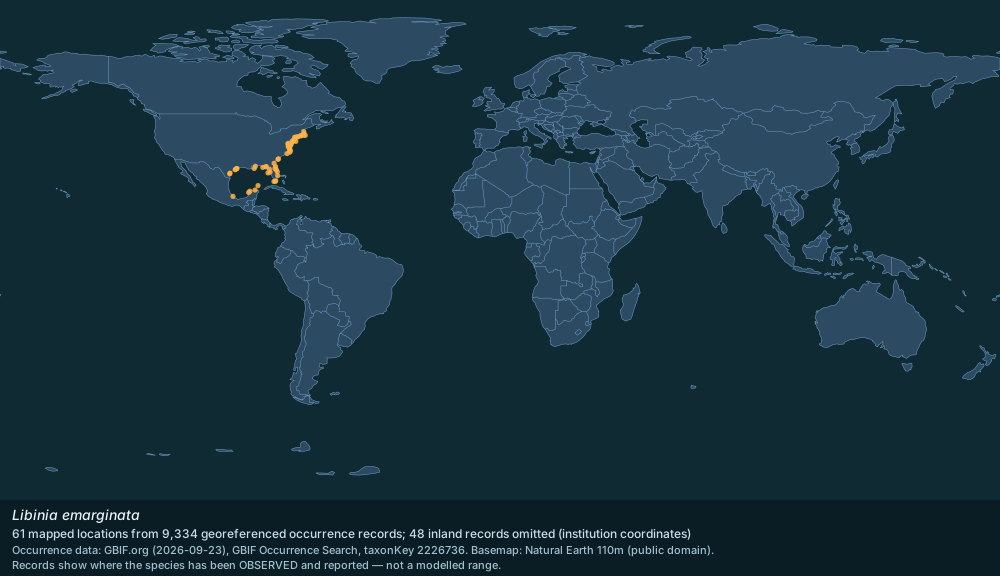
Distribution map plotted from GBIF.org occurrence records; basemap Natural Earth 110m · GBIF records CC0 / CC BY; Natural Earth public domain
Libinia emarginata, the portly spider crab, common spider crab or nine-spined spider crab, is a species of stenohaline crab that lives on the Atlantic coast of North America.
- Scientific name
- Libinia emarginata
- Authority
- Leach, 1815
- Family
- Epialtidae
- Order
- Decapoda
- Depth range
- 0–124 m
- Habitat zone
- benthic
- Gbif occurrence records
- 9,334
Classification (WoRMS)
Full classification as recorded by WoRMS: Kingdom: Animalia · Phylum: Arthropoda · Class: Malacostraca · Order: Decapoda · Family: Epialtidae · Genus: Libinia.
Accepted name: Libinia emarginata · Authority: Leach, 1815 · Taxonomic status: accepted · AphiaID: 158426.
Synonyms and superseded combinations recorded for this taxon: Libinia affinis Randall, 1840; Libinia canaliculata Say, 1817.
Source: World Register of Marine Species (WoRMS) — https://www.marinespecies.org/aphia.php?p=taxdetails&id=158426 (CC BY 4.0). Accessed 2026-09-23.
Biology and life history (SeaLifeBase)
Measured values published by SeaLifeBase for Libinia emarginata. Only fields the database actually holds for this species are shown; these are database values, not aquarium guidance.
Depth range: 0–124 m · Habitat zone: benthic.
Source: SeaLifeBase species summary (SpecCode 26952) — https://www.sealifebase.se/summary/Libinia-emarginata.html (CC BY-NC 3.0 — non-commercial use only). Accessed 2026-09-23.
Distribution and occurrence records (GBIF)
9,334 georeferenced occurrence records for Libinia emarginata are published through GBIF from 5 countries or marine areas. The map above plots 61 distinct locations from a sample of 3,000 records, omitting 48 inland records that carry an institution's coordinates rather than a collection site; it shows where the species has been observed and reported, not a modelled range.
Most records by country or area: United States of America (9,255); Mexico (47); Canada (29); Panama (1); Tonga (1).
The full country table, WoRMS marine regions and the sampling notes are on this species' Distribution page.
Source: GBIF Occurrence Search (taxonKey 2226736) — https://www.gbif.org/occurrence/search?taxon_key=2226736&has_coordinate=true (records CC0 / CC BY); WoRMS distribution records (MarineRegions) — https://www.marinespecies.org/aphia.php?p=taxdetails&id=158426 (CC BY 4.0); Natural Earth 110m basemap — https://www.naturalearthdata.com/ (public domain). Accessed 2026-09-23.
Description and natural history (Wikipedia)
Libinia emarginata occurs from Nova Scotia to the Florida Keys and through the Gulf of Mexico. It lives at depths of up to 160 ft, with exceptional records of up to 400 ft.
Libinia emarginata is roughly triangular in outline and very heavily calcified, with a carapace about 4 in long and a leg span of 12 in. The whole crab is khaki, and the carapace is covered in spines and tubercles, and, as with other decorator crabs, often clothes itself in debris and small invertebrates.
Mating takes place, and eggs are produced from June to September. The eggs are initially a bright orange-red, but turn brown during development, which takes around 25 days. The eggs then hatch as zoea larvae, and the female can produce another brood of eggs within 12 hours, unlike many other crab species whose females only mate immediately after molting.
Libinia emarginata is very similar to Libinia dubia with which it is largely sympatric. They can be told apart by examining the row of spines along the center of the carapace: in L. emarginata there are nine, while in L. dubia there are only six. Also, the rostrum of L. dubia is more deeply forked than that of L. emarginata.
Libinia emarginata lives on various substrates, at depths of up to 150 ft. Adults are sluggish and not aggressive, and younger crabs are frequently covered with sponges and hydroids.
Despite its small size, in comparison to other predatory crabs, L. emarginata feeds on large starfish such as Asterias forbesi.
Unusually for crabs, L. emarginata preferentially walks forwards, rather than sideways, although they are also capable of sidelong movement. Its skeletal, muscular and neural anatomy more closely resembles that of forward-walking species, rather than that of more closely related sideways-walking species.
L. emarginata will mate in large aggregations. These aggregations may function as a protective mechanism during reproduction. Males of L. emarginata show an unusual "obstetrical behavior", in which gravid females who are about to release their larvae are held behind the male and aggressively protected.
Source: Wikipedia: Libinia emarginata — https://en.wikipedia.org/wiki/Libinia_emarginata (CC BY-SA 4.0). Accessed 2026-09-23.
Gallery
Related in Portly spider crab
Links follow this subject's own source article.
Elsewhere in Portly spider crab
Spotted an error? Know more?
Reader corrections go straight into our review queue. Suggest an edit · How this site is sourced