
Chocolate chip sea cucumber (Isostichopus badionotus)
Source-cited species reference: taxonomy from WoRMS, biology from SeaLifeBase, occurrence map from GBIF, conservation from IUCN Red List, description from Wikipedia.
Isostichopus badionotus, also known as the chocolate chip cucumber or the cookie dough sea cucumber, is a species of sea cucumber in the family Stichopodidae. This common species is found in warm parts of the Atlantic Ocean.
- Scientific name
- Isostichopus badionotus
- Authority
- (Selenka, 1867)
- Family
- Stichopodidae
- Order
- Synallactida
- Maximum length
- 20 cm
- Depth range
- 0–65 m
- Habitat zone
- benthic
- Iucn red list
- Endangered
- Gbif occurrence records
- 3,222
Classification (WoRMS)
Full classification as recorded by WoRMS: Kingdom: Animalia · Phylum: Echinodermata · Class: Holothuroidea · Order: Synallactida · Family: Stichopodidae · Genus: Isostichopus.
Accepted name: Isostichopus badionotus · Authority: (Selenka, 1867) · Taxonomic status: accepted · AphiaID: 367868.
Synonyms and superseded combinations recorded for this taxon: Stichopus acanthomela Clark in Lloyd, 1900; Stichopus assimilis Bell, 1883; Stichopus badionotus Selenka, 1867; Stichopus diaboli Heilprin, 1888; Stichopus errans Ludwig, 1875; Stichopus haytiensis Semper, 1868; Stichopus Möbii Semper, 1868; Stichopus moebii Semper, 1868; Stichopus xanthomela Heilprin, 1888.
Source: World Register of Marine Species (WoRMS) — https://www.marinespecies.org/aphia.php?p=taxdetails&id=367868 (CC BY 4.0). Accessed 2026-09-23.
Biology and life history (SeaLifeBase)
Measured values published by SeaLifeBase for Isostichopus badionotus. Only fields the database actually holds for this species are shown; these are database values, not aquarium guidance.
Maximum length: 20 cm · Depth range: 0–65 m · Habitat zone: benthic · Vulnerability index: 22 of 100 · Aquarium trade: never/rarely.
SeaLifeBase notes: Inhabits Thalassia beds and sandy areas (Ref. 415, 86832), particularly muddy sand (Ref. 86832).
Source: SeaLifeBase species summary (SpecCode 84472) — https://www.sealifebase.se/summary/Isostichopus-badionotus.html (CC BY-NC 3.0 — non-commercial use only). Accessed 2026-09-23.
Distribution and occurrence records (GBIF)
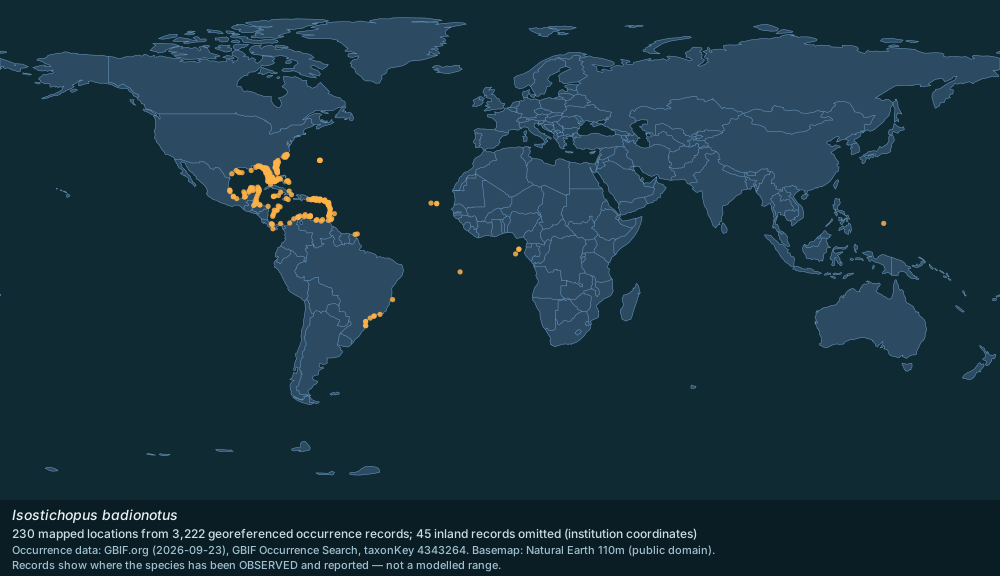
3,222 georeferenced occurrence records for Isostichopus badionotus are published through GBIF from 43 countries or marine areas. The map above plots 230 distinct locations from a sample of 3,000 records, omitting 45 inland records that carry an institution's coordinates rather than a collection site; it shows where the species has been observed and reported, not a modelled range.
Most records by country or area: Puerto Rico (1,593); United States of America (528); Mexico (229); Guadeloupe (103); Panama (101).
The full country table, WoRMS marine regions and the sampling notes are on this species' Distribution page.
Source: GBIF Occurrence Search (taxonKey 4343264) — https://www.gbif.org/occurrence/search?taxon_key=4343264&has_coordinate=true (records CC0 / CC BY); WoRMS distribution records (MarineRegions) — https://www.marinespecies.org/aphia.php?p=taxdetails&id=367868 (CC BY 4.0); Natural Earth 110m basemap — https://www.naturalearthdata.com/ (public domain). Accessed 2026-09-23.
Conservation status (IUCN Red List)
The IUCN Red List assesses Isostichopus badionotus (Selenka, 1867) as Endangered (code EN). No trend, population estimate or threat analysis is given here, because none is available from this source without the Red List API; follow the source link for the full assessment, including its date.
Source: IUCN Red List of Threatened Species (taxon 180519) — https://www.iucnredlist.org/species/180519/0; GBIF IUCN Red List category endpoint (taxonKey 4343264) — https://api.gbif.org/v1/species/4343264/iucnRedListCategory. Accessed 2026-09-23.
Description and natural history (Wikipedia)
This is a large species that can grow to a length of 45 cm, but the average adult size is about 21 cm. It has distinctive dark coloured "warts" in three coarse rows on its dorsal surface, the rest of the body may vary from white through to shades of orange to brown, with sometimes large brownish stains. The mouth is located ventrally and surrounded by about 20 large tentacles.
This species is widespread in the warm Atlantic, where found from North Carolina (USA), through the Caribbean, to north Brazil, at Ascension Island and in the Gulf of Guinea. It is found at depths between 0.
It inhabits shallow waters, in a wide variety of bottoms (sand, mud, rock, seaweeds...).
Similar to other tropical Holothuroidea, the Isostichopus badiontus is dioecious. Males and females release their gametes into water where fertilization happens externally. A study in the Caribbean Sea observed that the species has an increase in reproductive activity when temperatures increase.
As bottom feeders, Isostichopus badionotus individuals are threatened by contaminated substrates due to metals left behind by boats. Additionally, they are popular in Asian cuisine, and are also threatened by illegal fishing and trafficking.
Source: Wikipedia: Isostichopus badionotus — https://en.wikipedia.org/wiki/Isostichopus_badionotus (CC BY-SA 4.0). Accessed 2026-09-23.
Gallery
Related in Chocolate chip sea cucumber
Links follow this subject's own source article.
Elsewhere in Chocolate chip sea cucumber
Spotted an error? Know more?
Reader corrections go straight into our review queue. Suggest an edit · How this site is sourced