Teatfish (Holothuria whitmaei)
Source-cited species reference: taxonomy from WoRMS, biology from SeaLifeBase, occurrence map from GBIF, conservation from IUCN Red List, description from Wikipedia.

Holothuria (Microthele) whitmaei, commonly known as the black teatfish, is a species of sea cucumber in the family Holothuriidae. The sea cucumber is distributed in the western Indian and Pacific oceans, with specimens being found off of Tanzania, New Caledonia and the Philippines. They are usually found in groups of 5-25 individuals.
- Scientific name
- Holothuria whitmaei
- Authority
- Bell, 1887
- Family
- Holothuriidae
- Order
- Holothuriida
- Maximum length
- 55 cm
- Depth range
- 0–40 m
- Habitat zone
- benthic
- Iucn red list
- Endangered
- Gbif occurrence records
- 798
Classification (WoRMS)
Full classification as recorded by WoRMS: Kingdom: Animalia · Phylum: Echinodermata · Class: Holothuroidea · Order: Holothuriida · Family: Holothuriidae · Genus: Holothuria.
Accepted name: Holothuria whitmaei · Authority: Bell, 1887 · Taxonomic status: accepted · AphiaID: 1672780.
Synonyms and superseded combinations recorded for this taxon: Holothuria (Bohadschia) whitmaei Bell, 1887; Holothuria (Microthele) whitmaei Bell, 1887; Holothuria mammifera Saville-Kent, 1890; Muelleria maculata (Brandt).
Source: World Register of Marine Species (WoRMS) — https://www.marinespecies.org/aphia.php?p=taxdetails&id=1672780 (CC BY 4.0). Accessed 2026-09-23.
Biology and life history (SeaLifeBase)
Measured values published by SeaLifeBase for Holothuria whitmaei. Only fields the database actually holds for this species are shown; these are database values, not aquarium guidance.
Maximum length: 55 cm · Depth range: 0–40 m · Habitat zone: benthic · Vulnerability index: 42 of 100 · Fishery importance: highly commercial.
SeaLifeBase notes: Found on sandy areas also on dead coral down to 20 m; covered with a layer of sand (Ref. 800).
Source: SeaLifeBase species summary (SpecCode 85133) — https://www.sealifebase.se/summary/Holothuria-whitmaei.html (CC BY-NC 3.0 — non-commercial use only). Accessed 2026-09-23.
Distribution and occurrence records (GBIF)
798 georeferenced occurrence records for Holothuria whitmaei are published through GBIF from 19 countries or marine areas. The map above plots 109 distinct locations from a sample of 798 records, omitting 17 inland records that carry an institution's coordinates rather than a collection site; it shows where the species has been observed and reported, not a modelled range.
Most records by country or area: United States of America (446); Australia (100); New Caledonia (70); United States Minor Outlying Islands (63); Wallis and Futuna (36); Guam (19); French Polynesia (13); Micronesia (Federated States of) (11); Northern Mariana Islands (9); Papua New Guinea (7); Marshall Islands (5); Cook Islands (4); Niue (4); Fiji (3); Vanuatu (3).
Source: GBIF Occurrence Search (taxonKey 4342924) — https://www.gbif.org/occurrence/search?taxon_key=4342924&has_coordinate=true (records CC0 / CC BY); WoRMS distribution records (MarineRegions) — https://www.marinespecies.org/aphia.php?p=taxdetails&id=1672780 (CC BY 4.0); Natural Earth 110m basemap — https://www.naturalearthdata.com/ (public domain). Accessed 2026-09-23.
Conservation status (IUCN Red List)
The IUCN Red List assesses Holothuria whitmaei Bell, 1887 as Endangered (code EN). No trend, population estimate or threat analysis is given here, because none is available from this source without the Red List API; follow the source link for the full assessment, including its date.
Source: IUCN Red List of Threatened Species (taxon 180440) — https://www.iucnredlist.org/species/180440/0; GBIF IUCN Red List category endpoint (taxonKey 4342924) — https://api.gbif.org/v1/species/4342924/iucnRedListCategory. Accessed 2026-09-23.
Description and natural history (Wikipedia)
H. whitmaei is now classified as a separate species from H. nobilis. H. whitmaei used to be included in H. nobilis.
Seasonal trends from two populations of H. whitmaei were investigated, between the Great Barrier Reef and Ningaloo Reef. The gonad index was found to peak between April and June. Macroscopic and histological analysis revealed “that large germinal tubules, positioned centrally on the gonad basis, progressed through four maturity stages: growing (II); mature (III); partly spawned (IV); and spent (V)”.
In one study in 2003, they were unsure why “up to 23% of H. whitmaei specimens were hidden from some time during the night until midday". Although in another study to obtain ecological data on H. whitmaei, “rates of activity in marked specimens increased significantly in the initial hours after marking”. This suggests that marking the specimens likely compromises the research.
“Diurnal studies of 30 black teat fish on the Ningaloo Reef...found that the proportion of animals sheltered (and therefore hidden when viewed from directly above) was significantly greater in the morning...relative to the afternoon”. A different study found that (on marked and unmarked specimens) they were most active between the hours of 2:30-5:30pm.
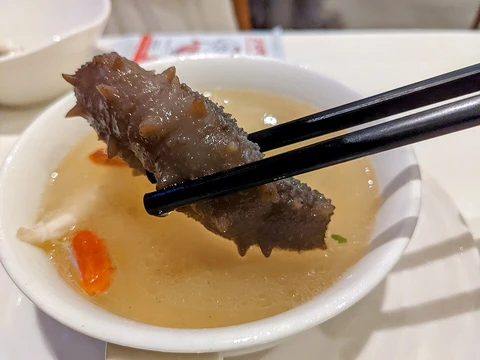
Many sea cucumbers are processed, dried, and boiled to become beche-de-mar. It is a very important and profitable commodity in many Pacific countries and communities, particularly in Papua New Guinea, the Solomon Islands, Australia, and the Fiji Islands. H. whitmaei are "among the highest value species and well-dried ‘A’ grade product may command a price of $US 70–190 per kg depending on size and quality". Although a moratorium due to overproduction has prevented supply from Papua New Guinea since 2009. Fiji on the other hand exports 243 tons of sea cucumber food per year.
Source: Wikipedia: Holothuria whitmaei — https://en.wikipedia.org/wiki/Holothuria_whitmaei (CC BY-SA 4.0). Accessed 2026-09-23.
Spotted an error? Know more?
Reader corrections go straight into our review queue. Suggest an edit · How this site is sourced