
White threads fish (Holothuria leucospilota)
Source-cited species reference: taxonomy from WoRMS, biology from SeaLifeBase, occurrence map from GBIF, conservation from IUCN Red List, description from Wikipedia.
Holothuria leucospilota, commonly known as the black sea cucumber or black tarzan, is a species of marine invertebrate in the family Holothuriidae. It is placed in the subgenus Mertensiothuria making its full scientific name Holothuria (Mertensiothuria) leucospilota. It is the type species of the subgenus and is found on the seabed in shallow water in the Indo-Pacific.
- Scientific name
- Holothuria leucospilota
- Authority
- (Brandt, 1835)
- Family
- Holothuriidae
- Order
- Holothuriida
- Maximum length
- 60 cm
- Depth range
- 6–13 m
- Habitat zone
- reef-associated
- Iucn red list
- Least Concern
- Gbif occurrence records
- 3,249
Classification (WoRMS)
Full classification as recorded by WoRMS: Kingdom: Animalia · Phylum: Echinodermata · Class: Holothuroidea · Order: Holothuriida · Family: Holothuriidae · Genus: Holothuria.
Accepted name: Holothuria leucospilota · Authority: (Brandt, 1835) · Taxonomic status: accepted · AphiaID: 1672774.
Synonyms and superseded combinations recorded for this taxon: Halodeima dicorona Heding, 1934; Holothuria (Halodeima) dicorona (Heding, 1934); Holothuria (Mertensiothuria) leucospilota (Brandt, 1835); Holothuria gelatinosa Heding, 1939; Holothuria homoea Clark, 1938; Holothuria infesta Sluiter, 1901; Holothuria lagoena Haacke, 1880; Holothuria lamperti Ludwig, 1886; Holothuria oxurropa Sluiter, 1887; Holothuria vagabunda Selenka, 1867; Stichopus (Gymnochirota) leucospilota Brandt, 1835.
Source: World Register of Marine Species (WoRMS) — https://www.marinespecies.org/aphia.php?p=taxdetails&id=1672774 (CC BY 4.0). Accessed 2026-09-23.
Biology and life history (SeaLifeBase)
Measured values published by SeaLifeBase for Holothuria leucospilota. Only fields the database actually holds for this species are shown; these are database values, not aquarium guidance.
Maximum length: 60 cm · Common length: 35 cm · Depth range: 6–13 m · Habitat zone: reef-associated · Vulnerability index: 30.3 of 100 · Fishery importance: commercial · Aquarium trade: never/rarely.
SeaLifeBase notes: Not traditionally harvested, due to the thin tegument and presence of Cuvierian tubules, but may be confused with other commercial black species of Holothuria . A shallow water species; mostly on outer and inner reef flats, back reefs, and shallow coastal lagoons. Abundant in seagrass beds, sandy-muddy grounds with rubble or coral patches where it hides the posterior part of its body (Ref. 122). Found under rocks to avoid dessication (Ref. 125338). Mean population density can exceed 0.5 per square meter. Inshore, shallow water populations are denser (Ref. 122). Feeds by extending its anterior end from a crevice (Ref. 85218). Deposit feeder (Ref. 103183). Sieves through the substrate it ingests, feeding on the organic matter (Ref. 125532). Found in waters less than 30m. Dwells intertidally, in pools and under rocks, and on soft substrates (Ref. 129602).
Source: SeaLifeBase species summary (SpecCode 83487) — https://www.sealifebase.se/summary/Holothuria-leucospilota.html (CC BY-NC 3.0 — non-commercial use only). Accessed 2026-09-23.
Distribution and occurrence records (GBIF)
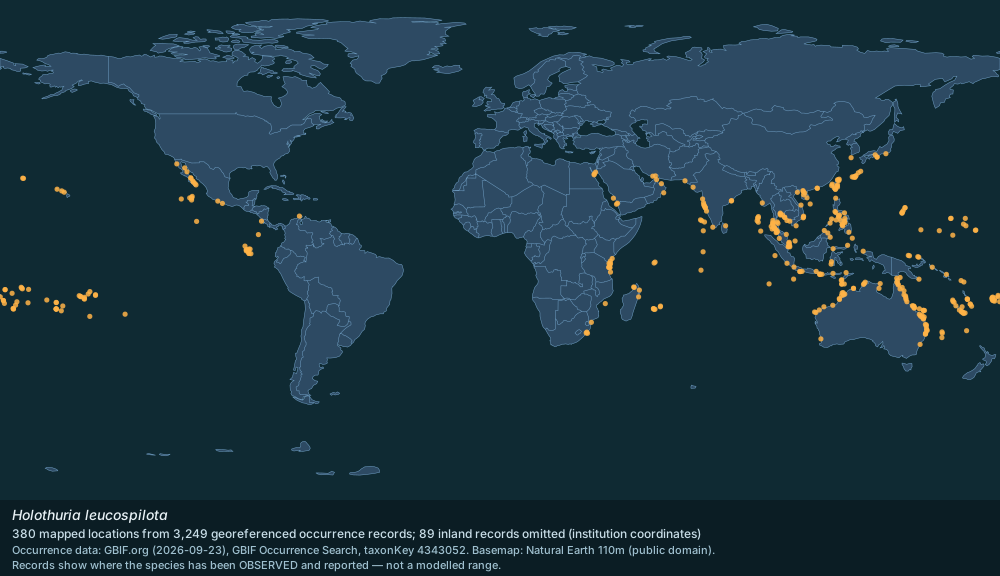
3,249 georeferenced occurrence records for Holothuria leucospilota are published through GBIF from 62 countries or marine areas. The map above plots 380 distinct locations from a sample of 3,000 records, omitting 89 inland records that carry an institution's coordinates rather than a collection site; it shows where the species has been observed and reported, not a modelled range.
Most records by country or area: Australia (876); Japan (379); Cook Islands (312); Singapore (210); New Caledonia (153).
The full country table, WoRMS marine regions and the sampling notes are on this species' Distribution page.
Source: GBIF Occurrence Search (taxonKey 4343052) — https://www.gbif.org/occurrence/search?taxon_key=4343052&has_coordinate=true (records CC0 / CC BY); WoRMS distribution records (MarineRegions) — https://www.marinespecies.org/aphia.php?p=taxdetails&id=1672774 (CC BY 4.0); Natural Earth 110m basemap — https://www.naturalearthdata.com/ (public domain). Accessed 2026-09-23.
Conservation status (IUCN Red List)
The IUCN Red List assesses Holothuria leucospilota (Brandt, 1835) as Least Concern (code LC). No trend, population estimate or threat analysis is given here, because none is available from this source without the Red List API; follow the source link for the full assessment, including its date.
Source: IUCN Red List of Threatened Species (taxon 180375) — https://www.iucnredlist.org/species/180375/0; GBIF IUCN Red List category endpoint (taxonKey 4343052) — https://api.gbif.org/v1/species/4343052/iucnRedListCategory. Accessed 2026-09-23.
Description and natural history (Wikipedia)
Holothuria leucospilota is a medium-sized sea cucumber reaching a length of up to 40 cm when relaxed but it can stretch to about a metre (yard) when extended. It is roughly cylindrical, tapering towards the posterior end. At the anterior end, there are twenty oral tentacles with branched tips. These surround the mouth which is on the under side of the body. The animal is soft and pliable and is covered with fleshy papillae. The usual colour is charcoal grey or reddish-black with pale grey tube feet on the underside but off the African coast it is described as being bright or dark brown with white patches which are larger towards the posterior end.
Holothuria leucospilota is found in shallow water along the east coast of Africa and in much of the Indo-Pacific region. It is a common species on the north east coast of Australia where it is found on reefs and rocky coasts, often partly concealed under a boulder.
A study done near Singapore found that Holothuria leucospilota was more common near boulders, corals and seaweed clumps than it was on the open seabed. It found that this species is relatively tolerant of changes in salinity and temperature and continued to thrive in the laboratory when these parameters were changed. Under the same conditions, the Japanese sea cucumber (Apostichopus japonicus) shrank in size, eviscerated, and died within three days. In Singapore, Apostichopus japonicus is consumed as food and is becoming increasingly rare as a result of overexploitation.
Holothuria leucospilota is a scavenger and when feeding it usually has its posterior end anchored underneath a rock or in a crevice so that it can contract back out of sight if disturbed. It feeds by using its tentacles to shovel organic debris lying on the seabed into its mouth. In the process it swallows a significant quantity of sand, which passes through the gut.
If threatened, Holothuria leucospilota can emit a mass of fine sticky Cuvierian tubules from its anus which ensnare the potential predator allowing the sea cucumber to escape. It can regenerate these tubules in fifteen to eighteen days.
The worm pearlfish (Encheliophis vermicularis) is a parasite of this species and each parasitised H. leucospilota will host a male and female pair of the fish which live inside its body.
Source: Wikipedia: Holothuria leucospilota — https://en.wikipedia.org/wiki/Holothuria_leucospilota (CC BY-SA 4.0). Accessed 2026-09-23.
Gallery
Related in White threads fish
Links follow this subject's own source article.
Elsewhere in White threads fish
Spotted an error? Know more?
Reader corrections go straight into our review queue. Suggest an edit · How this site is sourced