
Black sea cucumber (Holothuria forskali)
Source-cited species reference: taxonomy from WoRMS, biology from SeaLifeBase, occurrence map from GBIF, conservation from IUCN Red List, description from Wikipedia.
Holothuria forskali, the black sea cucumber or cotton-spinner is a species of sea cucumber in the family Holothuriidae. It is found at shallow depths in the eastern Atlantic Ocean and the Mediterranean Sea. It was placed in the subgenus Panningothuria by Rowe in 1969 and is the type taxon of the subgenus.
- Scientific name
- Holothuria forskali
- Authority
- Delle Chiaje, 1824
- Family
- Holothuriidae
- Order
- Holothuriida
- Maximum length
- 25 cm
- Depth range
- 1–125 m
- Habitat zone
- benthic
- Iucn red list
- Least Concern
- Gbif occurrence records
- 9,976
Classification (WoRMS)
Full classification as recorded by WoRMS: Kingdom: Animalia · Phylum: Echinodermata · Class: Holothuroidea · Order: Holothuriida · Family: Holothuriidae · Genus: Holothuria.
Accepted name: Holothuria forskali · Authority: Delle Chiaje, 1824 · Taxonomic status: accepted · AphiaID: 1670329.
Synonyms and superseded combinations recorded for this taxon: Holothuria (Panningothuria) forskali Delle Chiaje, 1823; Holothuria catanensis Grube, 1840; Holothuria forskahli Delle Chiaje, 1824; Holothuria nigra Gray, 1848; Holothuria nigra Peach, 1845; Stichopus selenkae Barrois, 1882.
Source: World Register of Marine Species (WoRMS) — https://www.marinespecies.org/aphia.php?p=taxdetails&id=1670329 (CC BY 4.0). Accessed 2026-09-23.
Biology and life history (SeaLifeBase)
Measured values published by SeaLifeBase for Holothuria forskali. Only fields the database actually holds for this species are shown; these are database values, not aquarium guidance.
Maximum length: 25 cm · Depth range: 1–125 m · Habitat zone: benthic · Vulnerability index: 18.9 of 100.
SeaLifeBase notes: Maximum size: 25 cm. Species presents at all depths. In the event of stimulus by contact, defends itself by expelling its tubes of Vat. Very adherent, they discourage frequently inclinations of the possible attackers or predatory. When the stimulus persist, the animal can go until excreting the whole of its digestive tract. The tubes of Vat and the bodies assigned to digestion are regenerated in the span of a few weeks if the conditions are favorable (Ref. 358). habitat: Hard funds of primary education types and secondary, more rarely in herbarium; very commune in the Mediterranean basin. Nourishes various organic fragments, (charging) literally the elements of the ground in its oral opening; located at the back of the body, using its tentacles oral of flattened form. The animal sorts and introduces the edible organic substances, and rejects the elements not metabolized, particularly sand, in the form of lengthened excrements (Ref. 358).
Source: SeaLifeBase species summary (SpecCode 50286) — https://www.sealifebase.se/summary/Holothuria-forskali.html (CC BY-NC 3.0 — non-commercial use only). Accessed 2026-09-23.
Distribution and occurrence records (GBIF)
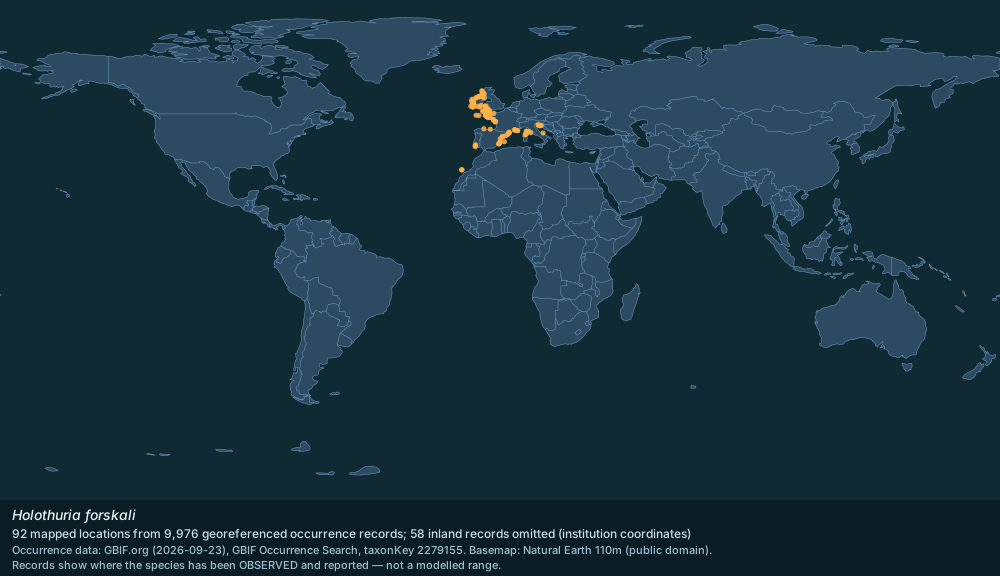
9,976 georeferenced occurrence records for Holothuria forskali are published through GBIF from 24 countries or marine areas. The map above plots 92 distinct locations from a sample of 3,000 records, omitting 58 inland records that carry an institution's coordinates rather than a collection site; it shows where the species has been observed and reported, not a modelled range.
Most records by country or area: United Kingdom of Great Britain and Northern Ireland (3,743); France (2,441); Ireland (1,760); Spain (1,294); Portugal (562).
The full country table, WoRMS marine regions and the sampling notes are on this species' Distribution page.
Source: GBIF Occurrence Search (taxonKey 2279155) — https://www.gbif.org/occurrence/search?taxon_key=2279155&has_coordinate=true (records CC0 / CC BY); WoRMS distribution records (MarineRegions) — https://www.marinespecies.org/aphia.php?p=taxdetails&id=1670329 (CC BY 4.0); Natural Earth 110m basemap — https://www.naturalearthdata.com/ (public domain). Accessed 2026-09-23.
Conservation status (IUCN Red List)
The IUCN Red List assesses Holothuria forskali Delle Chiaje, 1823 as Least Concern (code LC). No trend, population estimate or threat analysis is given here, because none is available from this source without the Red List API; follow the source link for the full assessment, including its date.
Source: IUCN Red List of Threatened Species (taxon 180297) — https://www.iucnredlist.org/species/180297/0; GBIF IUCN Red List category endpoint (taxonKey 2279155) — https://api.gbif.org/v1/species/2279155/iucnRedListCategory. Accessed 2026-09-23.
Description and natural history (Wikipedia)
Sea cucumbers are marine invertebrates and are closely related to the sea urchins and starfish. All these groups tend to be radially symmetric and have a water vascular system that operates by hydrostatic pressure, enabling them to move around by use of many suckers known as tube feet. Sea cucumbers are usually leathery, gherkin-shaped animals with a cluster of short tentacles at one end.
This sea cucumber has a cylindrical body and can grow to thirty centimetres long. It is usually deep brown or black but sometimes has an underlying yellowish mottling, especially on the underside. The skin is soft yet coarse and tough and is covered with fleshy papillae which are often tipped with white. The papillae are believed to be sensory organs sensitive to touch and possibly to chemicals dissolved in the water. The underside has three rows of tube feet for walking and climbing while the upper side has two rows of rudimentary suckers. The anterior end has a bunch of twenty yellowish short, retractable tentacles encircling the mouth. At the posterior, inside the body cavity, there are a bundle of Cuvierian tubules or cotton glands which can be ejected as a tangle of sticky white threads to confuse or enmesh predators.
The black sea cucumber occurs around the Atlantic coasts of northwest Europe, the Canary Islands, the Azores and in the Mediterranean Sea. It is found on boulders and rocks, particularly vertical surfaces, from the intertidal zone down to a depth of about fifty metres.
The black sea cucumber is a detritivore and feeds mostly at night. When feeding, it bends its body down towards the substrate, presses the ring of oral papillae against the surface and opens its mouth wide. It then extends and retracts its short tentacles repeatedly and "vacuums" up sediment, extracts the nutritious part and deposits the unmetabolised portion as a sausage-like string of droppings. When not feeding, the mouth is closed and the tentacles retracted and it is difficult to tell which is the head end of the animal.
Adult black sea cucumbers are normally either male or female. The gonads take a long time to mature and gametes are released synchronously into the water column in early spring, probably as a result of a rise in water temperatures. The larvae become part of the zooplankton. After several moults they grow tentacles and settle out onto the sea floor. Juveniles are seldom seen so it is surmised that they live by day in crevices and under rocks for protection from predators whereas the adults take no particular care to remain hidden.
The parasitic copepod Asterocheres boecki is an endoparasite of the black sea cucumber.
It has been found that twenty-six saponins (triterpene glycosides) are present in the Cuvierian tubules and twelve in the animal's body wall. During stressful times, such as the presence of a predator, saponins are released into the surrounding water. It is thought that, though these are insufficient to harm a potential predator, they may serve as a warning that the cucumber is unpalatable.
Source: Wikipedia: Holothuria forskali — https://en.wikipedia.org/wiki/Holothuria_forskali (CC BY-SA 4.0). Accessed 2026-09-23.
Gallery
Related in Black sea cucumber
Links follow this subject's own source article.
Elsewhere in Black sea cucumber
Spotted an error? Know more?
Reader corrections go straight into our review queue. Suggest an edit · How this site is sourced