
Prostrate sea cactus (Halimeda opuntia)
Source-cited species reference: taxonomy from WoRMS, biology from SeaLifeBase, occurrence map from GBIF, description from Wikipedia.
Halimeda opuntia, sometimes known as the watercress alga, is a species of calcareous green seaweed in the order Bryopsidales. It is native to reefs in the Indo-Pacific region, the Atlantic Ocean and the Mediterranean Sea.
- Scientific name
- Halimeda opuntia
- Authority
- (Linnaeus) J.V.Lamouroux, 1816
- Family
- Halimedaceae
- Order
- Bryopsidales
- Depth range
- 0–25 m
- Habitat zone
- sessile
- Gbif occurrence records
- 4,901
Classification (WoRMS)
Full classification as recorded by WoRMS: Kingdom: Plantae · Phylum: Chlorophyta · Class: Ulvophyceae · Order: Bryopsidales · Family: Halimedaceae · Genus: Halimeda.
Accepted name: Halimeda opuntia · Authority: (Linnaeus) J.V.Lamouroux, 1816 · Taxonomic status: accepted · AphiaID: 144482.
Synonyms and superseded combinations recorded for this taxon: Corallina opuntia Linnaeus, 1758; Flabellaria multicaulis Lamarck, 1813; Fucus prolifer M.Blanco, 1837; Halimeda cordata J.Agardh, 1887; Halimeda multicaulis (Lamarck) J.V.Lamouroux, 1816; Halimeda opuntia f. cordata (J.Agardh) E.S.Barton, 1901; Halimeda opuntia f. triloba (Decaisne) J.Agardh, 1887; Halimeda opuntia f. typica (Linnaeus) J.Agardh; Halimeda opuntia var. triloba (Decaisne) Barton; Halimeda opuntia var. typica W.R.Taylor, 1928; Halimeda triloba Decaisne, 1842.
Source: World Register of Marine Species (WoRMS) — https://www.marinespecies.org/aphia.php?p=taxdetails&id=144482 (CC BY 4.0). Accessed 2026-09-23.
Biology and life history (SeaLifeBase)
Measured values published by SeaLifeBase for Halimeda opuntia. Only fields the database actually holds for this species are shown; these are database values, not aquarium guidance.
Depth range: 0–25 m · Habitat zone: sessile.
SeaLifeBase notes: Not utilized commercially, although found to be a source of growth regulators such as auxin, gibberellin, cytokinin; has antibacterial and antifungal properties (Ref. 80758). Grows in the lower intertidal zone of coral reefs or on dead corals below the low-tide mark in calm shallow waters (Ref. 80758).
Source: SeaLifeBase species summary (SpecCode 118194) — https://www.sealifebase.se/summary/Halimeda-opuntia.html (CC BY-NC 3.0 — non-commercial use only). Accessed 2026-09-23.
Distribution and occurrence records (GBIF)
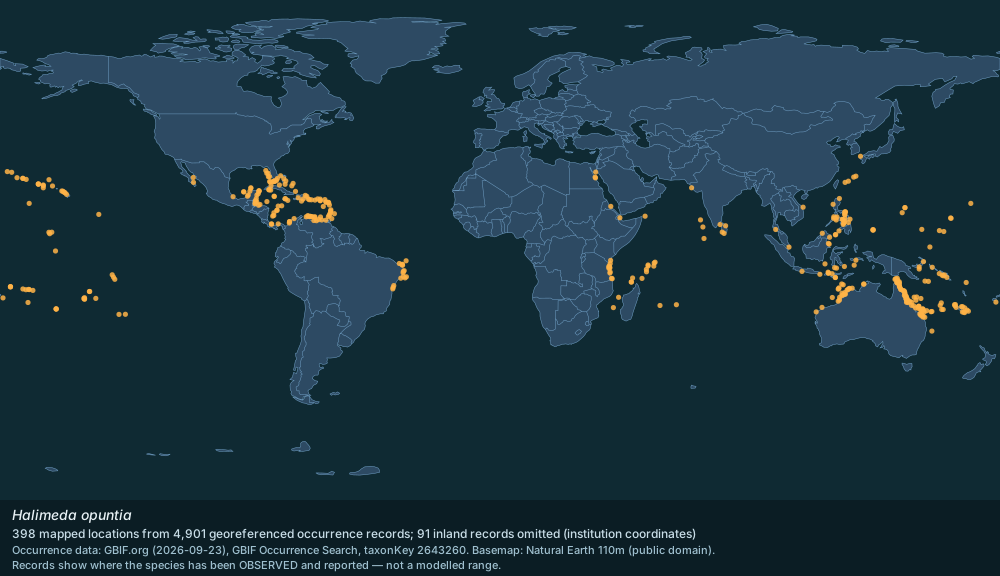
4,901 georeferenced occurrence records for Halimeda opuntia are published through GBIF from 87 countries or marine areas. The map above plots 398 distinct locations from a sample of 3,000 records, omitting 91 inland records that carry an institution's coordinates rather than a collection site; it shows where the species has been observed and reported, not a modelled range.
Most records by country or area: United States of America (552); Australia (501); Brazil (374); Micronesia (Federated States of) (329); Philippines (311).
The full country table, WoRMS marine regions and the sampling notes are on this species' Distribution page.
Source: GBIF Occurrence Search (taxonKey 2643260) — https://www.gbif.org/occurrence/search?taxon_key=2643260&has_coordinate=true (records CC0 / CC BY); WoRMS distribution records (MarineRegions) — https://www.marinespecies.org/aphia.php?p=taxdetails&id=144482 (CC BY 4.0); Natural Earth 110m basemap — https://www.naturalearthdata.com/ (public domain). Accessed 2026-09-23.
Description and natural history (Wikipedia)
Halimeda opuntia forms thick, frequently-branched clumps of calcified, leaf-like segments up to 25 cm high. The segments are flat and kidney- or fan-shaped, up to 8 mm high and 10 mm broad. They have a distinct central rib and a smooth, sinuous, or lobe-shaped, upper margin. Rhizoids grow where the segments touch the substrate. The plants are often crammed closely together forming a dense mat of herbage in which the individual plants are not easily discernible.
Halimeda opuntia is found in the Indo-Pacific Ocean, the Atlantic Ocean, the Mediterranean Sea, and the Caribbean Sea and around the coasts of Florida and the Bahamas. It grows in grooves, depressions and cracks in rocks and between coral heads in moderately protected parts of the reef, at depths down to about 55 m.
Where degraded coral reefs have abundant macroalgae, it has been shown experimentally that the coral larvae will settle in as great quantities on the seaweed as it will on the rubble substrate. Researchers found that the larvae of Favia fragum readily settled on Halimeda opuntia, however the alga was ephemeral and therefore unsuitable for long-term survival of the coral. This settlement practice may have significant consequences for the recruitment of corals on degraded reefs.
The secondary metabolites include growth regulators such as auxins, gibberellins and cytokinins, and substances with antibacterial and antifungal properties, but these are not being harvested for commercial use.
Source: Wikipedia: Halimeda opuntia — https://en.wikipedia.org/wiki/Halimeda_opuntia (CC BY-SA 4.0). Accessed 2026-09-23.
Gallery
Related in Prostrate sea cactus
Links follow this subject's own source article.
Elsewhere in Prostrate sea cactus
Spotted an error? Know more?
Reader corrections go straight into our review queue. Suggest an edit · How this site is sourced