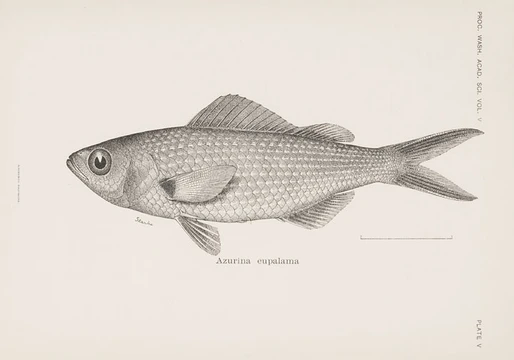
Galapagos damsel (Azurina eupalama)
Source-cited species reference: taxonomy from WoRMS, biology from FishBase, occurrence map from GBIF, conservation from IUCN Red List, description from Wikipedia.

Edmund Heller and Robert E. Snodgrass · Public domain
The Galápagos damsel (Azurina eupalama), also known as the blackspot chromis, is a possibly extinct fish species from the family Pomacentridae. It is endemic to the waters near the Galápagos Islands and Cocos Island.
- Scientific name
- Azurina eupalama
- Authority
- Heller & Snodgrass, 1903
- Family
- Pomacentridae
- Order
- Ovalentaria incertae sedis
- Maximum length
- 15 cm
- Depth range
- 5–30 m
- Habitat zone
- reef-associated
- Iucn red list
- Critically Endangered
- Gbif occurrence records
- 33
Taxonomy and Physical Form
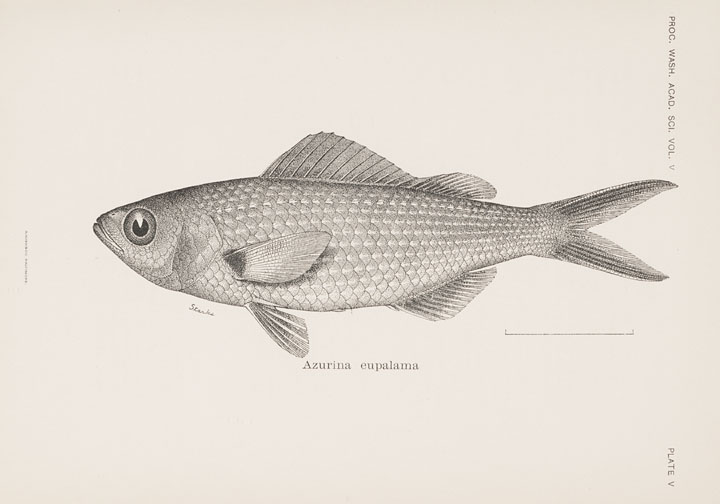
The Galápagos damsel, classified within the family Pomacentridae, carries an alternative common name that highlights one of its most distinctive markings: the blackspot chromis. This small reef fish grows to a maximum length of fifteen centimeters, giving it a modest profile among its damselfish relatives. Its coloration is understated yet striking — an overall olive-gray body washed with a subtle blue tinge, while the flanks shimmer with a silvery sheen. Two diagnostic features set it apart from look-alike species: a distinct black spot positioned at the base of each pectoral fin, and a prominent lateral line running along the body. The species is strictly endemic, meaning its known range is confined to the waters surrounding the Galápagos archipelago and, in one documented instance, the vicinity of Cocos Island. No populations have been confirmed anywhere else in the world's oceans, making it a true island-endemic species whose entire evolutionary story is tied to this remote Pacific setting.
Range, Feeding, and the Cocos Island Record
Historical records place the Galápagos damsel across a surprisingly wide spread of the archipelago. Documented localities include Floreana, Gardiner Bay, Española, Tagus Cove, Isabela, Marchena, James Bay, Sullivan Bay, Santiago, Wreck Bay, San Cristóbal, Academy Bay, Santa Cruz, and Santa Fe — a distribution that spans multiple islands and bays. Beyond the main chain, a single specimen collected many years ago near Cocos Island now resides in the fish collection at the American Museum of Natural History, representing the only known record from outside the Galápagos proper. Ecologically, the species is a plankton feeder, filtering tiny drifting organisms from the water column rather than grazing on algae or hunting larger prey. This dietary specialization makes it particularly vulnerable to any disruption in plankton productivity, a vulnerability that would prove catastrophic during the climatic upheaval of the early 1980s.
The 1982–83 El Niño and Population Collapse
The El Niño–Southern Oscillation event of 1982 and 1983 delivered a devastating blow to marine life around the Galápagos. Sea temperatures near the islands rose sharply, and plankton production plummeted, remaining depressed for at least a full year. Because the Galápagos damsel depends entirely on plankton as its food source, its populations suffered severe declines alongside other planktivorous fish in the region. What made the situation especially alarming was the total absence of the species in all subsequent surveys. Despite intensive searching efforts carried out over the following decade, no individual of Azurina eupalama was ever sighted again. Researchers have noted that global climate change may be accelerating the frequency and severity of extreme El Niño events, raising the specter that similar climatic shocks could eliminate other vulnerable plankton-feeding species in the future. The 1982–83 episode thus stands as a cautionary case study in how a single climatic anomaly can erase an entire endemic fish population.
Conservation Status and the Question of Survival
The International Union for Conservation of Nature classifies the Galápagos damsel as critically endangered and flags it as possibly extinct — one of the most severe designations a species can receive. The IUCN acknowledges a lingering, unverified hope: speculation that small, unconfirmed populations might persist on islands off the coast of Peru, specifically the Lobos Islands, which offer warm temperate conditions that could theoretically support the species. However, no untargeted survey data to date has produced any evidence of Azurina eupalama in those waters, leaving the speculation entirely unsubstantiated. The only physical record outside the Galápagos remains the single Cocos Island specimen held at the American Museum of Natural History. Early descriptions of the species appear in the 1903 Hopkins Stanford Galapagos Expedition papers by Snodgrass and Heller, while a comprehensive treatment of Galápagos fishes was later published by Grove and Lavenberg in 1997. The damsel's story is ultimately one of a species known from a narrow set of historical collections, a single climatic catastrophe, and a silence that has persisted for well over a decade.
Gallery
Spotted an error? Know more?
Reader corrections go straight into our review queue. Suggest an edit · How this site is sourced