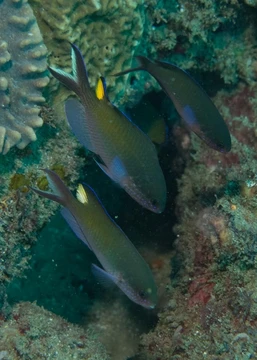
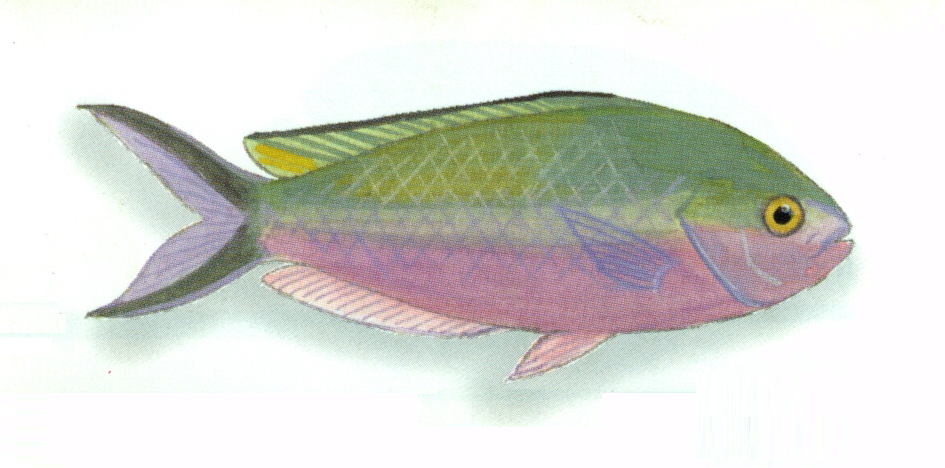
Fusilier damselfish (Lepidozygus tapeinosoma)
Source-cited species reference: taxonomy from WoRMS, biology from FishBase, occurrence map from GBIF, conservation from IUCN Red List, description from Wikipedia, aquarium from Wikipedia (cited section).

NOAA Fisheries/Jan Willem Staman · Public domain
The fusilier damselfish (Lepidozygus tapeinosoma) is a species of damselfish in the Pomacentridae family. It occurs in the Indo-Pacific. They are fond to aquarists. Adults can grow up to a maximum length of up to 10.5 cm. It is the only species in the monotypic genus, Lepidozygus which sits in its own subfamily, the Lepidozyginae.
- Scientific name
- Lepidozygus tapeinosoma
- Authority
- (Bleeker, 1856)
- Family
- Pomacentridae
- Order
- Ovalentaria incertae sedis
- Maximum length
- 10.5 cm
- Depth range
- 1–30 m
- Habitat zone
- reef-associated
- Iucn red list
- Least Concern
- Gbif occurrence records
- 1,948
Taxonomic Singularity
The fusilier damselfish occupies a remarkably isolated position in the tree of life. Within the Pomacentridae family, it stands as the sole representative of the genus Lepidozygus, and that genus in turn anchors its own subfamily, the Lepidozyginae. This triple uniqueness—single species, single genus, single subfamily—makes it a taxonomic one-of-a-kind among all damselfishes. Adults reach a modest maximum of 10.5 centimetres (about 4.1 inches), with a fin architecture of twelve dorsal spines, fourteen to fifteen dorsal soft rays, two anal spines, and fifteen to sixteen anal soft rays. Despite its small size and solitary taxonomic lineage, the species thrives across a vast tropical expanse, suggesting that its evolutionary isolation did not constrain its geographic success. In a family crowded with dozens of genera, Lepidozygus tapeinosoma stands alone as both a biological curiosity and a living reminder that even the smallest lineages can carve out a wide ecological niche.
Range and Habitat
The fusilier damselfish commands one of the broadest tropical distributions of any member of its family. In the Indian Ocean, populations stretch from eastern Africa through the Gulf of Aden, Oman, India, the Maldives, and Sri Lanka, continuing on to the Similan Islands in the Andaman Sea, Indonesia, and Australia. Across the Pacific, the species appears in Cambodia, Indonesia, the Philippines, Vietnam, Taiwan, the Great Barrier Reef, and scattered Pacific islands reaching as far as Hawaii, with a western extension into the Gulf of California and southward to northern Peru. All of these habitats share a common thread: tropical coral reefs and lagoons. The fish occupies depths from just one metre down to thirty metres (roughly three to ninety-eight feet), placing it firmly in the sunlit, reef-building zone where the zooplankton it depends on for food are most abundant.
Color, Behavior, and Feeding
Perhaps the most visually striking aspect of the fusilier damselfish is its dramatic color shifting. The fish is not locked into a single palette; instead, its appearance changes with its activity. While actively feeding, it takes on a silvery-green hue, and in the Maldives, adults tending their eggs display a distinctive banded pattern. When at rest, the body darkens noticeably. In the aquarium setting, the fish has been observed flashing vivid red and green during feeding bouts, adding yet another layer to this chromatic repertoire. Behaviorally, the species is a social shoaler that assembles in loose groups rather than defending solitary territories. Its diet is straightforward—zooplankton—and it is a fast, active swimmer that readily accepts a wide variety of offered foods. This combination of color dynamism and gregarious feeding behavior makes it a visually engaging subject for both field observers and hobbyists.
Life in the Aquarium
Among the many damselfishes available to hobbyists, the fusilier damselfish holds a special niche as a peaceful, social shoaler that is occasionally encountered in the aquarium trade. Its temperament is notably gentle; unlike many other species that school, it does not single out the weakest tankmate for persistent aggression. Its social behavior has been compared to that of Anthias, though it is considerably hardier and less delicate to maintain. The fish thrives best in groups of its own kind, reinforcing its identity as a truly social animal. It is a fast, active swimmer that will readily accept most foods offered, making it relatively easy to feed. Its color displays—flashing red and green during meals—provide a dynamic visual element in a community tank. For aquarists seeking a damselfish that prioritizes group harmony over territorial dominance, the fusilier damselfish offers a uniquely cooperative alternative.
Gallery
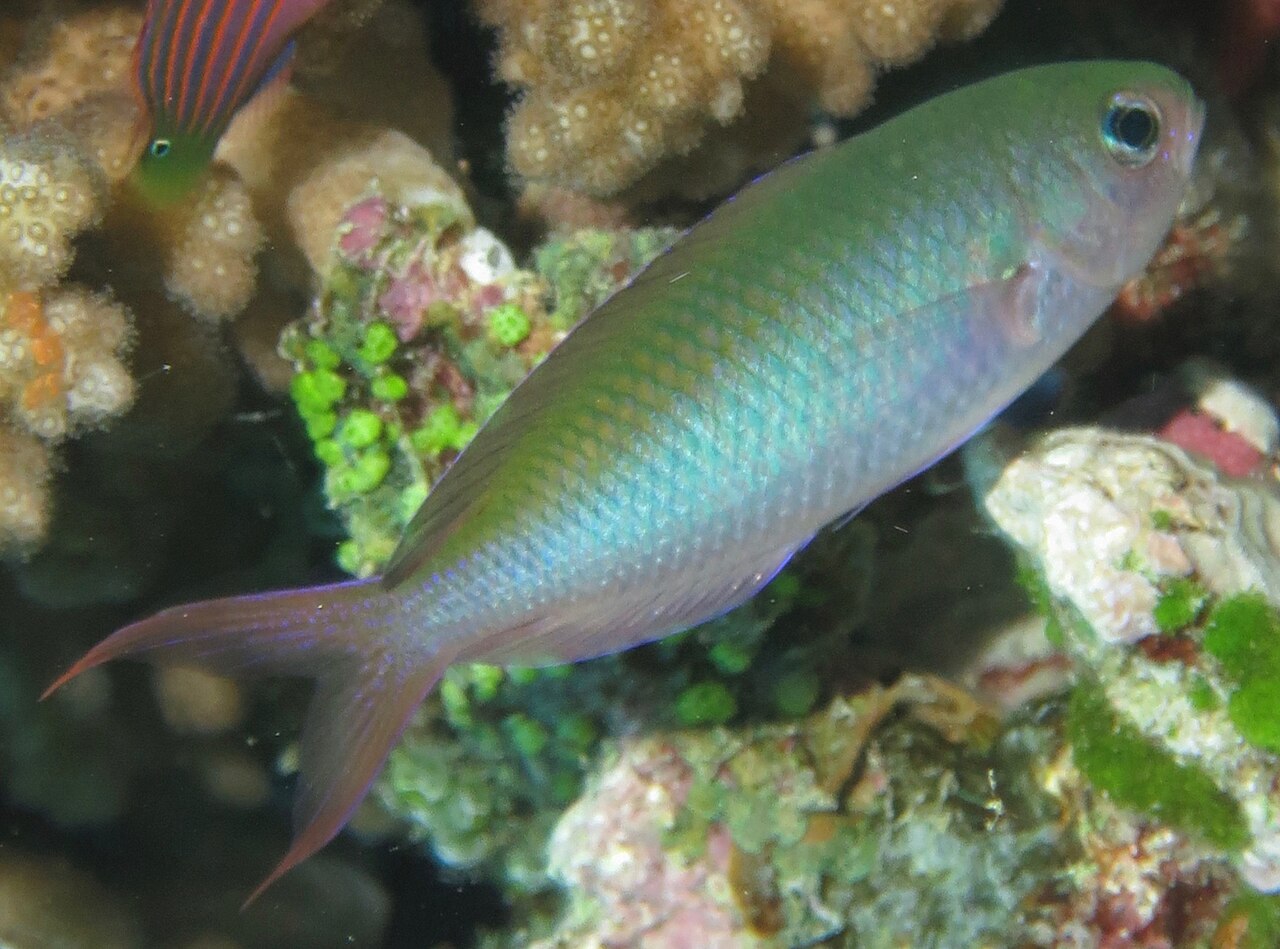
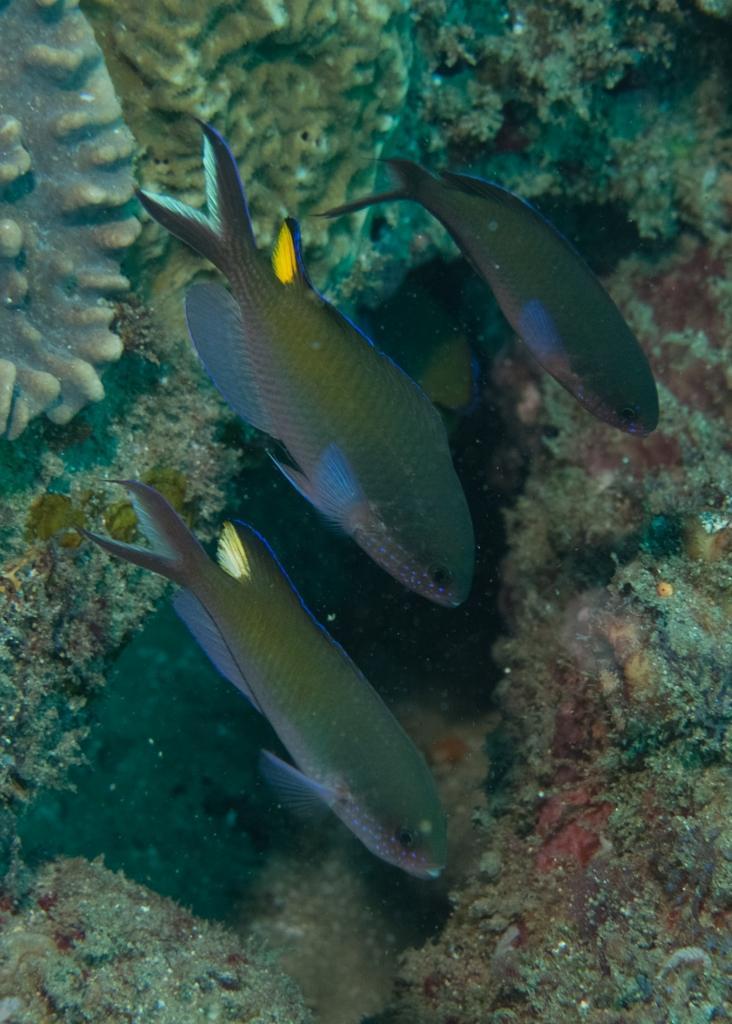
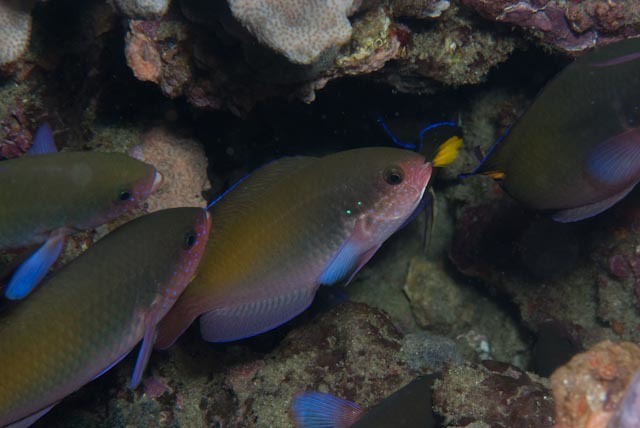

Related in Fusilier damselfish
Links follow this subject's own source article.
Elsewhere in Fusilier damselfish
Spotted an error? Know more?
Reader corrections go straight into our review queue. Suggest an edit · How this site is sourced