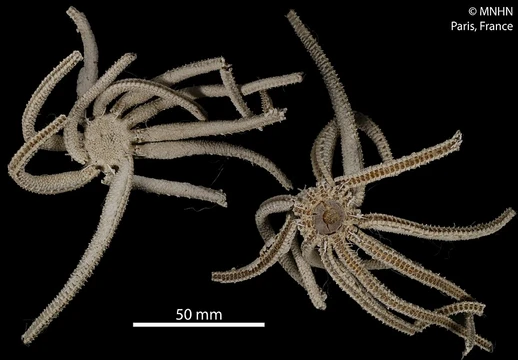
Freyella elegans
Source-cited species reference: taxonomy from WoRMS, biology from SeaLifeBase, occurrence map from GBIF, description from Wikipedia.

Freyella elegans is a species of deep-water starfish in the family Freyellidae in the order Brisingida, living at abyssal depths in the northwestern Atlantic Ocean.
- Scientific name
- Freyella elegans
- Authority
- (Verrill, 1884)
- Family
- Freyellidae
- Order
- Brisingida
- Habitat zone
- bathydemersal
- Gbif occurrence records
- 248
Classification (WoRMS)
Full classification as recorded by WoRMS: Kingdom: Animalia · Phylum: Echinodermata · Class: Asteroidea · Order: Brisingida · Family: Freyellidae · Genus: Freyella.
Accepted name: Freyella elegans · Authority: (Verrill, 1884) · Taxonomic status: accepted · AphiaID: 123692.
Synonyms and superseded combinations recorded for this taxon: Brisinga elegans Verrill, 1884; Freyella aspera Verrill, 1895; Freyella bracteata Sladen, 1889; Freyella laubieri Cherbonnier & Sibuet, 1972; Freyella spinosa Perrier, 1885; Freyella spinosa var. abyssicola Perrier, 1894.
Source: World Register of Marine Species (WoRMS) — https://www.marinespecies.org/aphia.php?p=taxdetails&id=123692 (CC BY 4.0). Accessed 2026-09-23.
Biology and life history (SeaLifeBase)
Measured values published by SeaLifeBase for Freyella elegans. Only fields the database actually holds for this species are shown; these are database values, not aquarium guidance.
Habitat zone: bathydemersal · Aquarium trade: never/rarely.
Source: SeaLifeBase species summary (SpecCode 81399) — https://www.sealifebase.se/summary/Freyella-elegans.html (CC BY-NC 3.0 — non-commercial use only). Accessed 2026-09-23.
Distribution and occurrence records (GBIF)
248 georeferenced occurrence records for Freyella elegans are published through GBIF from 14 countries or marine areas. The map above plots 89 distinct locations from a sample of 248 records; it shows where the species has been observed and reported, not a modelled range.
Most records by country or area: United States of America (74); Mauritania (23); Namibia (14); Spain (10); France (10); Portugal (7); Bahamas (6); Ireland (6); Canada (4); Sao Tome and Principe (4); Panama (3); Angola (1); Cuba (1); Ghana (1).
Marine regions with a valid WoRMS distribution record: European waters (ERMS scope); North American Basin; West European Basin; Iberian Basin; West Africa Coast; Greenland; Angolan Exclusive Economic Zone; South Carolina; North Carolina; Canary Basin; Newfoundland Basin; Rockall Trough.
Source: GBIF Occurrence Search (taxonKey 2273308) — https://www.gbif.org/occurrence/search?taxon_key=2273308&has_coordinate=true (records CC0 / CC BY); WoRMS distribution records (MarineRegions) — https://www.marinespecies.org/aphia.php?p=taxdetails&id=123692 (CC BY 4.0); Natural Earth 110m basemap — https://www.naturalearthdata.com/ (public domain). Accessed 2026-09-23.
Description and natural history (Wikipedia)
All Freyella species occur in very deep water, and are gathered only occasionally from isolated locations, almost exclusively by dredging or using a beam trawl. Targeted collection is virtually impossible and the material that is brought up is almost never intact. That makes the description and naming of species complicated. In 1986, Maureen Downey published the results of a study she had done on the deep sea starfish from the Atlantic that had been described at that time. One of her findings was that the species described by Verrill in 1884 and named by him as Brisinga elegans, had later been redefined by several authors under different names, and she reduced these names to synonyms of Freyella elegans.
This starfish has a small disc and normally twelve long, rather rigid arms, about 210 mm long. The hexagonal plates on the aboral (upper surface) of the disc bear one to three spinelets and are covered by a membrane with no pedicellariae. The madreporite is near the margin of the disc and the anus is quite distinct and near the centre of the disc. The spines on the lateral plates are short and robust. The arms are long, narrow and cylindrical at the proximal end near the disc, widening slightly and becoming cigar-shaped distally and tapering near the tips. Here, the membrane covering them is semi-transparent, and there are saddle-like bands, and many small pedicellariae. Underneath the arms, the ambulacral groove occupies more than half the width of each arm. The outer spines around the mouth on the oral (lower surface) of the disc form a bar across the ambulacral grooves.
This starfish is a bathydemersal species living in the northwestern Atlantic Ocean, at depths of around 3000 m. It has been detected between Cape Hatteras and the Georges Bank, as well as near Greenland and in the Gulf of Guinea.
Little is known of the feeding habits of this species. Although some members of the Brisingida have been photographed with their arms raised, apparently filter feeding, those in the genus Freyella have only been observed lying flat on the sediment and are therefore probably not suspension feeders; some have been found to have the exoskeletons of small crustaceans within their buccal cavities.
Source: Wikipedia: Freyella elegans — https://en.wikipedia.org/wiki/Freyella_elegans (CC BY-SA 4.0). Accessed 2026-09-23.
Spotted an error? Know more?
Reader corrections go straight into our review queue. Suggest an edit · How this site is sourced