
Freshwater whipray (Urogymnus dalyensis)
Source-cited species reference: taxonomy from WoRMS, biology from FishBase, occurrence map from GBIF, conservation from IUCN Red List, description from Wikipedia.
The freshwater whipray (Urogymnus dalyensis) is a little-known species of stingray in the family Dasyatidae, found in a number of large rivers and associated estuaries in northern Australia. Until recently, this species was regarded as a regional subpopulation of the similar-looking but much larger giant freshwater stingray (U. polylepsis) of Southeast Asia. Typically reaching 1 m across, the freshwater whipray has a distinctively shaped, rounded pectoral fin disc, a projecting snout, and a thin tail without fin folds. It is plain brown above and white below with dark marginal bands. It may occasionally travel onto land and can "breathe" out of water for up to 7 minutes. The freshwater whipray is an active hunter of small fishes and shrimps, and does not currently face substantial conservation threats.
- Scientific name
- Urogymnus dalyensis
- Authority
- (Last & Manjaji-Matsumoto, 2008)
- Family
- Dasyatidae
- Order
- Myliobatiformes
- Maximum length
- 124 cm
- Depth range
- 1–4 m
- Habitat zone
- benthopelagic
- Iucn red list
- Least Concern
- Gbif occurrence records
- 1,837
Classification (WoRMS)
Full classification as recorded by WoRMS: Kingdom: Animalia · Phylum: Chordata · Class: Elasmobranchii · Order: Myliobatiformes · Family: Dasyatidae · Genus: Urogymnus.
Accepted name: Urogymnus dalyensis · Authority: (Last & Manjaji-Matsumoto, 2008) · Taxonomic status: accepted · AphiaID: 1043415.
Synonyms and superseded combinations recorded for this taxon: Himantura dalyensis Last & Manjaji-Matsumoto, 2008.
Source: World Register of Marine Species (WoRMS) — https://www.marinespecies.org/aphia.php?p=taxdetails&id=1043415 (CC BY 4.0). Accessed 2026-09-23.
Biology and life history (FishBase)
Measured values published by FishBase for Urogymnus dalyensis. Only fields the database actually holds for this species are shown; these are database values, not aquarium guidance.
Maximum length: 124 cm · Depth range: 1–4 m · Habitat zone: benthopelagic · Body shape: other · Vulnerability index: 90 of 100 · Aquarium trade: never/rarely.
FishBase notes: This benthic species is found mainly in rivers, estuaries and low salinity coastal environments. It feeds mainly on small fishes and prawns, which it actively pursues, even beaching itself to trap prey (Ref. 114953).
Source: FishBase species summary (SpecCode 64145) — https://www.fishbase.se/summary/Urogymnus-dalyensis.html (CC BY-NC 3.0 — non-commercial use only). Accessed 2026-09-23.
Distribution and occurrence records (GBIF)
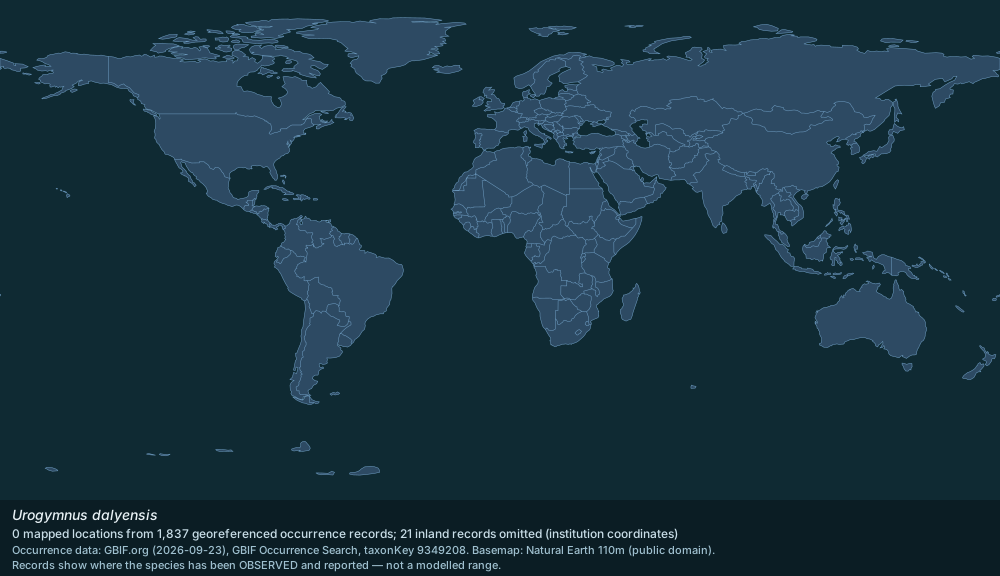
1,837 georeferenced occurrence records for Urogymnus dalyensis are published through GBIF from 1 countries or marine areas. The map above plots 0 distinct locations from a sample of 1,837 records, omitting 21 inland records that carry an institution's coordinates rather than a collection site; it shows where the species has been observed and reported, not a modelled range.
Most records by country or area: Australia (1,837).
The full country table, WoRMS marine regions and the sampling notes are on this species' Distribution page.
Source: GBIF Occurrence Search (taxonKey 9349208) — https://www.gbif.org/occurrence/search?taxon_key=9349208&has_coordinate=true (records CC0 / CC BY); WoRMS distribution records (MarineRegions) — https://www.marinespecies.org/aphia.php?p=taxdetails&id=1043415 (CC BY 4.0); Natural Earth 110m basemap — https://www.naturalearthdata.com/ (public domain). Accessed 2026-09-23.
Conservation status (IUCN Red List)
The IUCN Red List assesses Urogymnus dalyensis (Last & Manjaji-Matsumoto, 2008) as Least Concern (code LC). No trend, population estimate or threat analysis is given here, because none is available from this source without the Red List API; follow the source link for the full assessment, including its date.
Source: IUCN Red List of Threatened Species (taxon 195319) — https://www.iucnredlist.org/species/195319/0; GBIF IUCN Red List category endpoint (taxonKey 9349208) — https://api.gbif.org/v1/species/9349208/iucnRedListCategory. Accessed 2026-09-23.
Description and natural history (Wikipedia)
The first known specimen of the freshwater whipray was caught during a 1989 scientific expedition from the Daly River, after which it would eventually be named. Various authors have mistakenly referred to this ray as the estuary stingray (Hemitrygon fluviorium), or identified it with the similar U. polylepsis. Morphological and molecular phylogenetic studies have since found that this species is in fact distinct from U. polylepsis, and it was formally described by Peter Last and B. Mabel Manjaji-Matsumoto in a 2008 Commonwealth Scientific and Industrial Research Organisation (CSIRO) paper. The type specimen is a juvenile male 62 cm across, collected from the Pentecost River.
The only Australian stingray confined to fresh and brackish waters, the freshwater whipray has been thus far been reported from the Daly, Fitzroy, Gilbert, Mitchell, Normanby, Ord, Pentecost, Roper, South Alligator, and Wenlock Rivers in northern Australia, and may well inhabit most large, tropical Australian rivers. The stingrays in the Fly River, Papua New Guinea, may also belong to this species. This bottom-dwelling species occurs at a depth of 1 - 4 m. Most individuals are found in water with a salinity of under 10 ppt, but some have been caught from water with a salinity of up to 30 ppt.
The freshwater stingray has an apple-shaped pectoral fin disc approximately as wide as long, with the leading margins almost straight and transverse. The moderately long, obtuse snout is flattened with a pointed tip that projects from the disc. The eyes are small and immediately followed by much larger spiracles. There is a broad, somewhat rectangular curtain of skin between the nares, with a subtly fringed posterior margin. The mouth is gently arched and contains a pair of large papillae near the center and 2–3 much smaller papillae near the corners. There are around 37 upper tooth rows and 45 lower tooth rows; the teeth are small, each with a horizontal ridge and groove, and arranged with a quincunx pattern. The pelvic fins are small, no more than a fifth as long as the disc width. The tail tapers from a narrow base to become thin and whip-like, and measures more or less twice the disc length. There is a single serrated stinging spine on top of the tail; the fin folds are absent.
The entire upper surface of the disc is densely covered by small dermal denticles that are heart or oval-shaped around the "shoulders" and become tiny and granular towards the disc margins; there are also around 5 relatively large denticles at the center of the disc. The tail is roughened by denticles above and below, with the largest positioned in a midline row before the spine. The dorsal coloration is a uniform light brown to gray-brown, darkening to blackish past the tail spine. The underside of the disc and tail is white, with dark brown bands around the fin margins; the inner margin of the band is irregular, breaking up into small blotches that reach the belly. This species attains a disc width of 1.24 m, but most do not exceed 1 m across. The freshwater whipray is close in appearance to the much larger giant freshwater stingray, but has a shorter, more obtuse snout and narrower dark ventral bands. The two species also differ in several morphometric and meristic characters.
Little is known of the freshwater whipray's natural history. It feeds on small fishes and shrimps, and has been observed lunging up riverbanks and taking prey caught in its wash. There is a male specimen on record that was adolescent at a disc width of 88 cm.
The International Union for Conservation of Nature (IUCN) has noted that the prospects for freshwater whiprays in Australia are likely favorable. However, there is concern that the South Alligator River subpopulation in Kakadu National Park may be negatively affected by contaminants from exploratory uranium mines upstream.
Source: Wikipedia: Freshwater whipray — https://en.wikipedia.org/wiki/Freshwater_whipray (CC BY-SA 4.0). Accessed 2026-09-23.
Gallery
Related in Freshwater whipray
Links follow this subject's own source article.
Elsewhere in Freshwater whipray
Spotted an error? Know more?
Reader corrections go straight into our review queue. Suggest an edit · How this site is sourced