Fimbriate moray (Gymnothorax fimbriatus)
Source-cited species reference: taxonomy from WoRMS, biology from FishBase, occurrence map from GBIF, conservation from IUCN Red List.
Last updated

Jens Petersen · via Wikipedia: Fimbriated moray · CC BY 2.5
Fimbriate moray (Gymnothorax fimbriatus) is a marine species in the family Muraenidae (Chordata › Teleostei › Anguilliformes), recorded in the World Register of Marine Species as Gymnothorax fimbriatus (Bennett, 1832) under AphiaID 217499.
Scientific classification
- KingdomAnimalia
- PhylumChordata
- ClassActinopterygii
- DivisionTeleostei
- OrderAnguilliformes
- FamilyMuraenidae
- GenusGymnothorax
- SpeciesGymnothorax fimbriatus
Named by (E. T. Bennett, 1832)
Close relatives
Other species of Gymnothorax with a Codexery entry.
- Abbott's moray eel Gymnothorax eurostus
- Blackcheek moray eel Gymnothorax breedeni
- Brown speckled eel Gymnothorax steindachneri
- California moray Gymnothorax mordax
- Geometric moray Gymnothorax griseus
- Gymnothorax javanicus
- Gymnothorax funebris
- Gymnothorax melatremus
Sources: Wikipedia taxobox: Fimbriated moray (CC BY-SA 4.0) · order, family and genus agree with WoRMS AphiaID 217499 (CC BY 4.0)
Conservation status
Least Concern (LC)
- LC▲ this species
- NT
- VU
- EN
- CR
- EW
- EX
Source: IUCN Red List assessment · GBIF copy of the Red List category
How big is it?
Largest length in the source, 0.93 m, next to a 1.8 m person.
Diagram: drawn by Codexery, schematic shapes to scale (not a likeness). Length: FishBase species summary
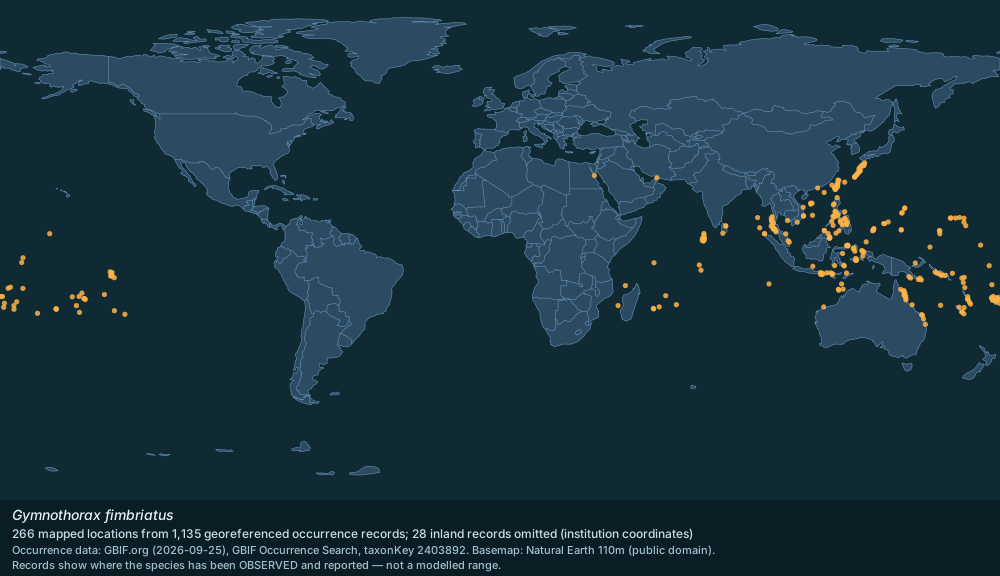
Where the fimbriate moray (gymnothorax fimbriatus) has been recorded
Each dot is a place where the species has been observed and reported (1,135 records, half-degree grid) — not a modelled range. 28 inland records left out (institution coordinates).
Map: drawn by Codexery. Data: GBIF occurrence search (records CC0 / CC BY) · Natural Earth basemap (public domain)
Classification (WoRMS)
Full classification as recorded by WoRMS: Kingdom: Animalia · Phylum: Chordata · Class: Teleostei · Order: Anguilliformes · Family: Muraenidae · Genus: Gymnothorax.
Accepted name: Gymnothorax fimbriatus · Authority: (Bennett, 1832) · Taxonomic status: accepted · AphiaID: 217499.
Synonyms and superseded combinations recorded for this taxon: Enchelycore tamarae Prokofiev, 2005; Gymnothorax fimbriata (Bennett, 1832); Muraena bullata Richardson, 1848; Muraena fimbriata Bennett, 1832; Muraena isingleenoides Bleeker, 1852; Muraena isingleenoïdes Bleeker, 1852; Thyrsoidea bullata (Richardson, 1848).
Source: World Register of Marine Species (WoRMS) — https://www.marinespecies.org/aphia.php?p=taxdetails&id=217499 (CC BY 4.0). Accessed 2026-09-25.
Biology and life history (FishBase)
Measured values published by FishBase for Gymnothorax fimbriatus. Only fields the database actually holds for this species are shown; these are database values, not aquarium guidance.
Maximum length: 93.4000015258789 cm · Depth range: 0–50 m · Habitat zone: reef-associated · Body shape: eel-like · Vulnerability index: 57.4 of 100 · Fishery importance: minor commercial · Aquarium trade: never/rarely.
FishBase notes: Occurs in lagoons, reef flats and seaward reefs (Ref. 1602, 48635). Prefers protected inshore waters among dead corals, common in harbors and small caves (Ref. 30404). Probably nocturnal (Ref. 1602). Feeds on fishes and crustaceans (Ref. 9710).
Possibly a protogynous hermaphrodite (Ref. 32169). Current age of a captive individual is 18 years, which exceeds 100 cm and approximately 10 lbs (owner Mark Palermo, pers. comm. 07/12). Minimum depth reported taken from Ref. 86942.
Source: FishBase species summary (SpecCode 6495) — https://www.fishbase.se/summary/Gymnothorax-fimbriatus.html (CC BY-NC 3.0 — non-commercial use only). Accessed 2026-09-25.
Distribution and occurrence records (GBIF)
1,135 georeferenced occurrence records for Gymnothorax fimbriatus are published through GBIF from 43 countries or marine areas. The map above plots 266 distinct locations from a sample of 1,135 records, omitting 28 inland records that carry an institution's coordinates rather than a collection site; it shows where the species has been observed and reported, not a modelled range.
Most records by country or area: Indonesia (277); Philippines (200); Chinese Taipei (77); Malaysia (57); Japan (55).
The full country table, WoRMS marine regions and the sampling notes are on this species' Distribution page.
Source: GBIF Occurrence Search (taxonKey 2403892) — https://www.gbif.org/occurrence/search?taxon_key=2403892&has_coordinate=true (records CC0 / CC BY); WoRMS distribution records (MarineRegions) — https://www.marinespecies.org/aphia.php?p=taxdetails&id=217499 (CC BY 4.0); Natural Earth 110m basemap — https://www.naturalearthdata.com/ (public domain). Accessed 2026-09-25.
Conservation status (IUCN Red List)
The IUCN Red List assesses Gymnothorax fimbriatus (Bennett, 1832) as Least Concern (code LC). No trend, population estimate or threat analysis is given here, because none is available from this source without the Red List API; follow the source link for the full assessment, including its date.
Source: IUCN Red List of Threatened Species (taxon 195727) — https://www.iucnredlist.org/species/195727/0; GBIF IUCN Red List category endpoint (taxonKey 2403892) — https://api.gbif.org/v1/species/2403892/iucnRedListCategory. Accessed 2026-09-25.
Related in Fimbriate moray
Links follow this subject's own source article.
Elsewhere in Fimbriate moray
Sources
Compiled from Wikipedia and the sources listed below. Text from Wikipedia is available under CC BY-SA 4.0; this entry is adapted from it.
- Wikipedia: Fimbriated moray (CC BY-SA 4.0).
- Classification: the source article's taxobox; order, family and genus checked against WoRMS, the World Register of Marine Species (CC BY 4.0).
- Conservation status: IUCN Red List assessment.
- Occurrence records: GBIF (CC0 / CC BY). Basemap: Natural Earth (public domain).
- Biology values: FishBase species summary (CC BY-NC 3.0, non-commercial).
- Word definitions: the , each quoted from its Wikipedia article.
Spotted an error? Know more?
Reader corrections go straight into our review queue. Suggest an edit · How this site is sourced