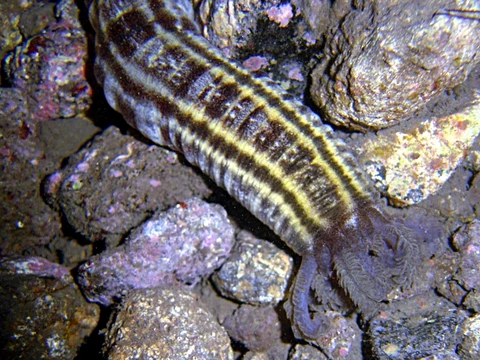
Beaded sea cucumber (Euapta lappa)
Source-cited species reference: taxonomy from WoRMS, biology from SeaLifeBase, occurrence map from GBIF, description from Wikipedia.

Euapta lappa, the beaded sea cucumber, is a species of sea cucumbers in the family Synaptidae in the phylum Echinodermata. It is found on coral reefs in the Caribbean region.
- Scientific name
- Euapta lappa
- Authority
- (J. Müller, 1850)
- Family
- Synaptidae
- Order
- Apodida
- Maximum length
- 100 cm
- Depth range
- 0–24 m
- Habitat zone
- reef-associated
- Gbif occurrence records
- 357
Classification (WoRMS)
Full classification as recorded by WoRMS: Kingdom: Animalia · Phylum: Echinodermata · Class: Holothuroidea · Order: Apodida · Family: Synaptidae · Genus: Euapta.
Accepted name: Euapta lappa · Authority: (J. Müller, 1850) · Taxonomic status: accepted · AphiaID: 124454.
Synonyms and superseded combinations recorded for this taxon: Euapta polii (Ludwig, 1875); Euapta tobagoensis Heding, 1928; Synapta lappa J. Müller, 1850; Synapta polii Ludwig, 1875.
Source: World Register of Marine Species (WoRMS) — https://www.marinespecies.org/aphia.php?p=taxdetails&id=124454 (CC BY 4.0). Accessed 2026-09-23.
Biology and life history (SeaLifeBase)
Measured values published by SeaLifeBase for Euapta lappa. Only fields the database actually holds for this species are shown; these are database values, not aquarium guidance.
Maximum length: 100 cm · Depth range: 0–24 m · Habitat zone: reef-associated · Vulnerability index: 60 of 100.
SeaLifeBase notes: Found on coral sand and turtle grass (Ref. 86832), in intertidal areas (Ref. 83942).
Source: SeaLifeBase species summary (SpecCode 49471) — https://www.sealifebase.se/summary/Euapta-lappa.html (CC BY-NC 3.0 — non-commercial use only). Accessed 2026-09-23.
Distribution and occurrence records (GBIF)
357 georeferenced occurrence records for Euapta lappa are published through GBIF from 36 countries or marine areas. The map above plots 84 distinct locations from a sample of 357 records, omitting 13 inland records that carry an institution's coordinates rather than a collection site; it shows where the species has been observed and reported, not a modelled range.
Most records by country or area: Spain (49); Guadeloupe (40); Mexico (38); Belize (35); Jamaica (29); United States of America (21); Cayman Islands (18); Cabo Verde (15); Martinique (13); Panama (13); Dominican Republic (9); Saint Martin (French part) (9); Colombia (7); Dominica (7); Honduras (6).
Marine regions with a valid WoRMS distribution record: European waters (ERMS scope); Gulf of Mexico; Puerto Rican Exclusive Economic Zone; Belizean Exclusive Economic Zone; Costa Rican part of the Caribbean Sea; Cuban Exclusive Economic Zone; Jamaican Exclusive Economic Zone; Lesser Antilles; Trinidad and Tobago; Dominican Republic Exclusive Economic Zone; Caribbean Sea; Mexico; Panamanian part of the Caribbean Sea; Mexican Exclusive Economic Zone [Caribbean part]; Eastern Caribbean.
Source: GBIF Occurrence Search (taxonKey 2279504) — https://www.gbif.org/occurrence/search?taxon_key=2279504&has_coordinate=true (records CC0 / CC BY); WoRMS distribution records (MarineRegions) — https://www.marinespecies.org/aphia.php?p=taxdetails&id=124454 (CC BY 4.0); Natural Earth 110m basemap — https://www.naturalearthdata.com/ (public domain). Accessed 2026-09-23.
Description and natural history (Wikipedia)
In appearance, the beaded sea cucumber resembles a long worm rather than a sea cucumber. It can reach up to a metre (yard) in length and has a diameter of up to 4 cm. It lengthens and shortens repeatedly and when disturbed, the normally flaccid body retracts vigorously to a fraction of its original length. It has no internal respiratory tree, nor does it have tube feet, and the body surface is covered by rounded ridges. The skeletal structure consists of many tiny calcareous plates embedded in the cuticle. Little hooks project from these ossicles and make the body feel sticky to the touch. At the anterior (front) of the animal there is a ring of fifteen branched feeding tentacles. The body colour is pale brown or grey, often with white flecks or darker, longitudinal streaks and transverse banding.
The beaded sea cucumber is found in the Caribbean Sea, the Bahamas, Jamaica, Cuba, the Gulf of Mexico, Mexico, Costa Rica, Panama and the Lesser Antilles. It is also known from the Canary Islands. It is found on reefs at depths down to about 30 m, hiding during the day among boulders and coral debris.
The beaded sea cucumber is a detritivore. It uses its tentacles to sift through sediment on the seabed, pushing it into its mouth aperture. The organic material in the sediment is digested and the inorganic matter is expelled through the cloacal vent.
Locomotion takes place as a result of contraction of muscles in the body wall. These consist of both longitudinal bands of muscle and continuous circular bands forming a tube. The contraction of different regions of musculature enables the sea cucumber to move around as waves of peristalsis pass along the body. The ossicles prevent slipping by providing friction with the substrate. In an aquarium, this sea cucumber can climb the vertical glass side by using peristalsis in this way, with the only point of attachment being the tentacles.
Source: Wikipedia: Euapta lappa — https://en.wikipedia.org/wiki/Euapta_lappa (CC BY-SA 4.0). Accessed 2026-09-23.
Spotted an error? Know more?
Reader corrections go straight into our review queue. Suggest an edit · How this site is sourced