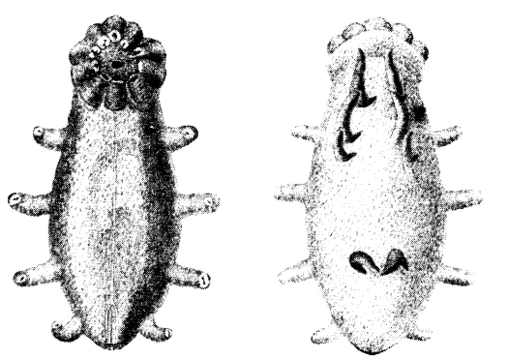
Elpidia glacialis
Source-cited species reference: taxonomy from WoRMS, biology from SeaLifeBase, occurrence map from GBIF, description from Wikipedia.

Elpidia glacialis is a species of sea cucumber in the family Elpidiidae. It is found at abyssal depths in the Arctic Ocean, the Barents Sea, the Kara Sea and the North Atlantic Ocean. It was first described in 1876 by the Swedish zoologist Johan Hjalmar Théel after he had collected specimens while accompanying the explorer Adolf Erik Nordenskiöld on an expedition attempting to find the Northeast Passage.
- Scientific name
- Elpidia glacialis
- Authority
- Théel, 1876
- Family
- Elpidiidae
- Order
- Elasipodida
- Habitat zone
- benthic
- Gbif occurrence records
- 191
Classification (WoRMS)
Full classification as recorded by WoRMS: Kingdom: Animalia · Phylum: Echinodermata · Class: Holothuroidea · Order: Elasipodida · Family: Elpidiidae · Genus: Elpidia.
Accepted name: Elpidia glacialis · Authority: Théel, 1876 · Taxonomic status: accepted · AphiaID: 124726.
Synonyms and superseded combinations recorded for this taxon: Elpidia glacialis glacialis Théel, 1876.
Source: World Register of Marine Species (WoRMS) — https://www.marinespecies.org/aphia.php?p=taxdetails&id=124726 (CC BY 4.0). Accessed 2026-09-23.
Biology and life history (SeaLifeBase)
Measured values published by SeaLifeBase for Elpidia glacialis. Only fields the database actually holds for this species are shown; these are database values, not aquarium guidance.
Habitat zone: benthic.
Source: SeaLifeBase species summary (SpecCode 49907) — https://www.sealifebase.se/summary/Elpidia-glacialis.html (CC BY-NC 3.0 — non-commercial use only). Accessed 2026-09-23.
Distribution and occurrence records (GBIF)
191 georeferenced occurrence records for Elpidia glacialis are published through GBIF from 14 countries or marine areas. The map above plots 100 distinct locations from a sample of 191 records, omitting 2 inland records that carry an institution's coordinates rather than a collection site; it shows where the species has been observed and reported, not a modelled range.
Most records by country or area: Svalbard and Jan Mayen (42); Antarctica (39); Norway (34); Russian Federation (26); Iceland (12); France (7); Greenland (7); Canada (3); New Zealand (3); South Georgia and the South Sandwich Islands (2); Indonesia (2); Papua New Guinea (2); Argentina (1); Faroe Islands (1).
Marine regions with a valid WoRMS distribution record: European waters (ERMS scope); Arctic Ocean; Barents Sea; Danish Exclusive Economic Zone (Greenland); Icelandic Exclusive Economic Zone; Kara Sea; North West Atlantic; Norwegian Exclusive Economic Zone; Spitsbergen.
Source: GBIF Occurrence Search (taxonKey 5188280) — https://www.gbif.org/occurrence/search?taxon_key=5188280&has_coordinate=true (records CC0 / CC BY); WoRMS distribution records (MarineRegions) — https://www.marinespecies.org/aphia.php?p=taxdetails&id=124726 (CC BY 4.0); Natural Earth 110m basemap — https://www.naturalearthdata.com/ (public domain). Accessed 2026-09-23.
Description and natural history (Wikipedia)
In a study in the Greenland Sea, E. glacialis occurred on the lower slopes of the continental shelf at depths of about 2700 m. Other organisms occupying the same habitat included the sea lily Bathycrinus sp., the sea spider Ascorhynchus abyssi, the brachiopod Waldheimia cranium and the zoanthid Epizoanthus sp. The sea lily and the sea cucumber were the dominant species present, perhaps because echinoderms can adopt various foraging strategies to suit the availability of food supplies.
In another study, in the central Arctic Ocean, it was found that most of the megafauna was only found within a certain range of depths, the only exceptions to this being E. glacialis and the predatory swimming snail Limacina helicina. The depth of the seabed in the study area of the Canada Basin was about 3800 m. A further study, this time in a canyon in the western part of the Greenland Sea at a depth of about 3200 m, found E. glacialis was sometimes present with an abundance of up to sixty individuals per 1 m2. It is a deposit feeder and its abundance may reflect differences in the availability of food in the sediment.
Source: Wikipedia: Elpidia glacialis — https://en.wikipedia.org/wiki/Elpidia_glacialis (CC BY-SA 4.0). Accessed 2026-09-23.
Spotted an error? Know more?
Reader corrections go straight into our review queue. Suggest an edit · How this site is sourced