
Purple sand dollar (Echinarachnius parma)
Source-cited species reference: taxonomy from WoRMS, biology from SeaLifeBase, occurrence map from GBIF, description from Wikipedia.

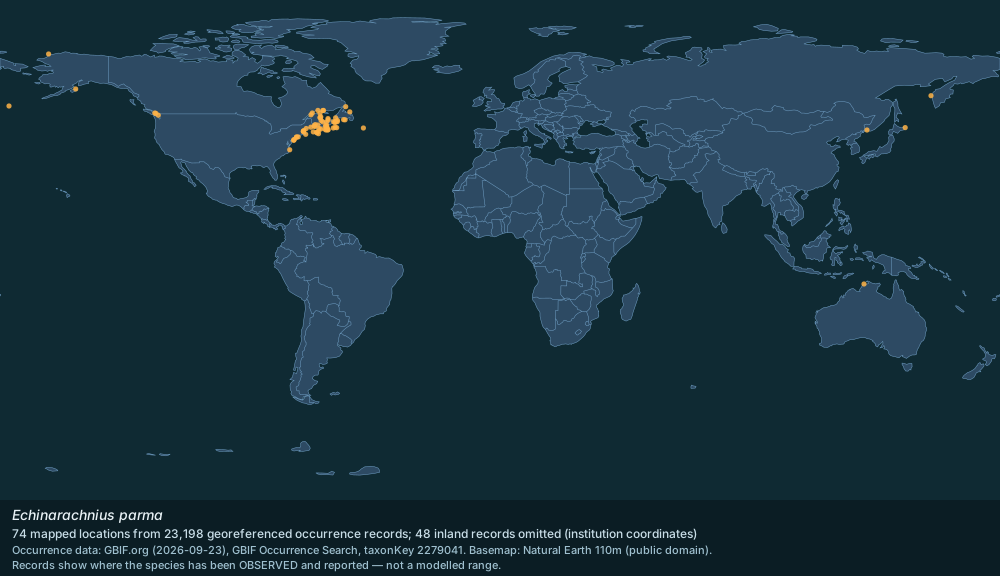
Distribution map plotted from GBIF.org occurrence records; basemap Natural Earth 110m · GBIF records CC0 / CC BY; Natural Earth public domain
Echinarachnius parma, the common sand dollar, is a species of sand dollar native to the Northern Hemisphere.
- Scientific name
- Echinarachnius parma
- Authority
- (Lamarck, 1816)
- Family
- Echinarachniidae
- Order
- Echinolampadacea
- Depth range
- 0–150 m
- Habitat zone
- benthic
- Gbif occurrence records
- 23,198
Classification (WoRMS)
Full classification as recorded by WoRMS: Kingdom: Animalia · Phylum: Echinodermata · Class: Echinoidea · Order: Echinolampadacea · Family: Echinarachniidae · Genus: Echinarachnius.
Accepted name: Echinarachnius parma · Authority: (Lamarck, 1816) · Taxonomic status: accepted · AphiaID: 158062.
Synonyms and superseded combinations recorded for this taxon: Echinarachinus parma (Lamarck, 1816); Echinarachnius atlanticus L. Agassiz, 1841; Echinarachnius australiae Michelin, 1859; Echinarachnius rumphii L. Agassiz, 1841; Echinarachnius undulatus Michelin, 1859; Echinodiscus parma (Lamarck, 1816); Phelsumaster parma (Lamarck, 1816); Phelsumia parma (Lamarck, 1816); Scutella parma Lamarck, 1816; Scutella trifara Say, 1826.
Source: World Register of Marine Species (WoRMS) — https://www.marinespecies.org/aphia.php?p=taxdetails&id=158062 (CC BY 4.0). Accessed 2026-09-23.
Biology and life history (SeaLifeBase)
Measured values published by SeaLifeBase for Echinarachnius parma. Only fields the database actually holds for this species are shown; these are database values, not aquarium guidance.
Depth range: 0–150 m · Habitat zone: benthic.
Source: SeaLifeBase species summary (SpecCode 49345) — https://www.sealifebase.se/summary/Echinarachnius-parma.html (CC BY-NC 3.0 — non-commercial use only). Accessed 2026-09-23.
Distribution and occurrence records (GBIF)
23,198 georeferenced occurrence records for Echinarachnius parma are published through GBIF from 11 countries or marine areas. The map above plots 74 distinct locations from a sample of 3,000 records, omitting 48 inland records that carry an institution's coordinates rather than a collection site; it shows where the species has been observed and reported, not a modelled range.
Most records by country or area: Canada (21,068); United States of America (1,945); Russian Federation (153); Madagascar (11); New Caledonia (6).
The full country table, WoRMS marine regions and the sampling notes are on this species' Distribution page.
Source: GBIF Occurrence Search (taxonKey 2279041) — https://www.gbif.org/occurrence/search?taxon_key=2279041&has_coordinate=true (records CC0 / CC BY); WoRMS distribution records (MarineRegions) — https://www.marinespecies.org/aphia.php?p=taxdetails&id=158062 (CC BY 4.0); Natural Earth 110m basemap — https://www.naturalearthdata.com/ (public domain). Accessed 2026-09-23.
Description and natural history (Wikipedia)
Echinarachnius parma obesus H.L.
It is found in the North Pacific and Northwest Atlantic, on the North American east coast from New Jersey north, as well as in Alaska, Siberia, British Columbia, and Japan. It inhabits isolated areas on sandy bottoms below the low tide level down to a depth of 5000 ft.
The tests (shells) of these sand dollars are round, flat and disc-like, typically measuring 3 in in diameter. The growth rate for this animal is between 3.5 and 6 mm/yr in the latter 5 years of their lifespan, and the lifespan is typically around 8 years. The entire shell is also covered with maroon-colored moveable spines. The color is a purplish brown, becoming bleached white when deceased and washed ashore. This color occurs due to only the hard, calcified exoskeleton remaining, with further bleaching by sun and saltwater as it reaches the shore. As in other echinoderms, they have five-fold radial symmetry, with a petal-shaped structure, or petalidium, on the aboral surface. The feet containing small hair-like structures (cilia) are located on this surface. The mouth, food grooves, and anus are located on the bottom side of the animal.
This and other species of Echinarachnius have been around since the Pliocene epoch.
In terms of feeding, sand dollars have suspension feeders that rely on a specialized structure called Aristotle's Lantern. Their cilia create grooves on the underside of their body that funnel food particles like plankton, detritus, and microscopic organisms toward their central mouth. Their interlocking teeth, known as "doves," work together to grind and process food. This feeding strategy allows them to extract nutrients from the surrounding sediment and water. They are opportunistic feeders.
The reproductive strategy of the common sand dollar includes both sexual and asexual methods, with the latter being particularly fascinating. Sand dollars typically reproduce sexually through external fertilization, where eggs and sperm are released into the water column. However, under certain conditions, particularly in the larval stage, sand dollars exhibit a form of asexual reproduction.
When faced with predation threats, sand dollar larvae can reproduce asexually through budding or fission. This response allows the larvae to split into smaller clones, which are less detectable by predators. The process not only increases the larvae's chances of survival but also enhances the population's ability to persist in predator-rich environments. This strategy is thought to be an evolutionary adaptation to reduce predation pressure on vulnerable larvae.
Source: Wikipedia: Echinarachnius parma — https://en.wikipedia.org/wiki/Echinarachnius_parma (CC BY-SA 4.0). Accessed 2026-09-23.
Gallery
Related in Purple sand dollar
Links follow this subject's own source article.
Elsewhere in Purple sand dollar
Spotted an error? Know more?
Reader corrections go straight into our review queue. Suggest an edit · How this site is sourced