
Dusky shark (Carcharhinus obscurus)
Source-cited species reference: taxonomy from WoRMS, biology from FishBase, occurrence map from GBIF, conservation from IUCN Red List, description from Wikipedia.
The dusky shark (Carcharhinus obscurus) is a species of requiem shark, in the family Carcharhinidae, occurring in tropical and warm-temperate continental seas worldwide. A generalist apex predator, the dusky shark can be found from the coast to the outer continental shelf and adjacent pelagic waters, and has been recorded from a depth of 400 m (1,300 ft). Populations migrate seasonally towards the poles in the summer and towards the equator in the winter, traveling hundreds to thousands of kilometers. One of the largest members of its genus, the dusky shark reaches more than 4 m in length and 350 kg in weight. It has a slender, streamlined body and can be identified by its short round snout, long sickle-shaped pectoral fins, ridge between the first and second dorsal fins, and faintly marked fins.
- Scientific name
- Carcharhinus obscurus
- Authority
- (Lesueur, 1818)
- Family
- Carcharhinidae
- Order
- Carcharhiniformes
- Maximum length
- 420 cm
- Depth range
- 0–400 m
- Habitat zone
- reef-associated
- Iucn red list
- Endangered
- Gbif occurrence records
- 27,744
Classification (WoRMS)
Full classification as recorded by WoRMS: Kingdom: Animalia · Phylum: Chordata · Class: Elasmobranchii · Order: Carcharhiniformes · Family: Carcharhinidae · Genus: Carcharhinus.
Accepted name: Carcharhinus obscurus · Authority: (Lesueur, 1818) · Taxonomic status: accepted · AphiaID: 105796.
Synonyms and superseded combinations recorded for this taxon: Carcharhinus iranzae Fourmanoir, 1961; Carcharhinus obscurella Deng, Xiong & Zhan, 1981; Carcharias macrurus Ramsay & Ogilby, 1887; Carcharinus iranzae Fourmanoir, 1961; Carcharinus obscurus (Lesueur, 1818); Eulamia obscura (Lesueur, 1818); Galeolamna eblis Whitley, 1944; Galeolamna greyi Owen, 1853; Galeolamna macrurus (Ramsay & Ogilby, 1887); Prionodon obvelatus Valenciennes, 1844; Squalus obscurus Lesueur, 1818.
Source: World Register of Marine Species (WoRMS) — https://www.marinespecies.org/aphia.php?p=taxdetails&id=105796 (CC BY 4.0). Accessed 2026-09-23.
Biology and life history (FishBase)
Measured values published by FishBase for Carcharhinus obscurus. Only fields the database actually holds for this species are shown; these are database values, not aquarium guidance.
Maximum length: 420 cm · Common length: 250 cm · Depth range: 0–400 m · Habitat zone: reef-associated · Body shape: fusiform / normal · Vulnerability index: 87.7 of 100 · Fishery importance: commercial · Aquarium trade: never/rarely.
FishBase notes: Found in coastal and offshore waters but not oceanic (Ref. 5578). Adults are commonly found at depths of 200-400 m, young in shallower waters (Ref. 5485). A highly and seasonal migratory species over parts of its range (Ref. 6871). Common component of the catch of the shark longline fishery (Ref.58048). Feeds on bottom and pelagic bony fish, sharks, skates, rays, cephalopods, gastropods, crustaceans, sometimes mammalian carrion and inorganic objects (Ref. 5578). Viviparous (Ref. 50449); with litter size number from 3-14 (Ref. 27549). Large adults are potentially dangerous (Ref. 4716, 6871). Utilized fresh, dried-salted, frozen and smoked for human consumption; hides for leather; fins for sharks-fin soup; and liver oil extracted for vitamins (Ref. 244).
Source: FishBase species summary (SpecCode 878) — https://www.fishbase.se/summary/Carcharhinus-obscurus.html (CC BY-NC 3.0 — non-commercial use only). Accessed 2026-09-23.
Distribution and occurrence records (GBIF)
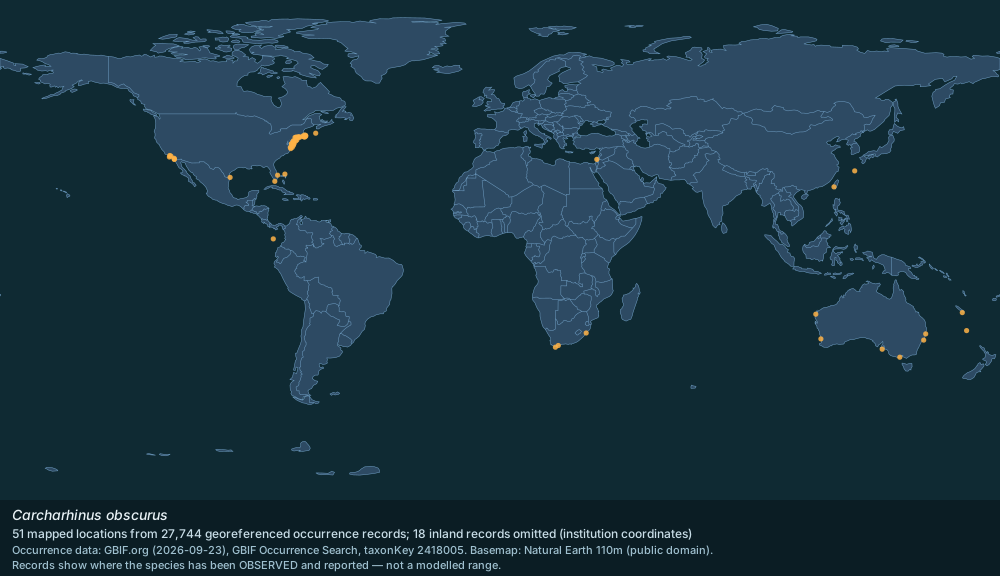
27,744 georeferenced occurrence records for Carcharhinus obscurus are published through GBIF from 47 countries or marine areas. The map above plots 51 distinct locations from a sample of 3,000 records, omitting 18 inland records that carry an institution's coordinates rather than a collection site; it shows where the species has been observed and reported, not a modelled range.
Most records by country or area: United States of America (21,055); Australia (4,630); Puerto Rico (443); Brazil (387); United Kingdom of Great Britain and Northern Ireland (376).
The full country table, WoRMS marine regions and the sampling notes are on this species' Distribution page.
Source: GBIF Occurrence Search (taxonKey 2418005) — https://www.gbif.org/occurrence/search?taxon_key=2418005&has_coordinate=true (records CC0 / CC BY); WoRMS distribution records (MarineRegions) — https://www.marinespecies.org/aphia.php?p=taxdetails&id=105796 (CC BY 4.0); Natural Earth 110m basemap — https://www.naturalearthdata.com/ (public domain). Accessed 2026-09-23.
Conservation status (IUCN Red List)
The IUCN Red List assesses Carcharhinus obscurus (Lesueur, 1818) as Endangered (code EN). No trend, population estimate or threat analysis is given here, because none is available from this source without the Red List API; follow the source link for the full assessment, including its date.
Source: IUCN Red List of Threatened Species (taxon 3852) — https://www.iucnredlist.org/species/3852/0; GBIF IUCN Red List category endpoint (taxonKey 2418005) — https://api.gbif.org/v1/species/2418005/iucnRedListCategory. Accessed 2026-09-23.
Description and natural history (Wikipedia)
Adult dusky sharks have a broad and varied diet, consisting mostly of bony fishes, sharks and rays, and cephalopods, but also occasionally crustaceans, sea stars, bryozoans, sea turtles, marine mammals, carrion, and humans. This species is viviparous with a three-year reproductive cycle; females bear litters of 3–14 young after a gestation period of 22–24 months, after which there is a year of rest before they become pregnant again. This shark, tied with the Spiny dogfish as a result is the animal with the longest gestation period. Females are capable of storing sperm for long periods, as their encounters with suitable mates may be few and far between due to their nomadic lifestyle and low overall abundance. Dusky sharks are one of the slowest-growing and latest-maturing sharks, not reaching adulthood until around 20 years of age.
Because of its slow reproductive rate, the dusky shark is very vulnerable to human-caused population depletion. This species is highly valued by commercial fisheries for its fins, used in shark fin soup, and for its meat, skin, and liver oil. It is also esteemed by recreational fishers. The International Union for Conservation of Nature (IUCN) has assessed this species as Endangered worldwide and Vulnerable off the eastern United States, where populations have dropped to 15–20% of 1970s levels. The dusky shark is regarded as potentially dangerous to humans due to its large size, but there are few attacks attributable to it.
French naturalist Charles Alexandre Lesueur published the first scientific description of the dusky shark in an 1818 issue of Journal of the Academy of Natural Sciences of Philadelphia. He placed it in the genus Squalus and gave it the specific epithet obscurus (Latin for "dark" or "dim"), referring to its coloration. Subsequent authors have recognized this species as belonging to the genus Carcharhinus. Lesueur did not designate a type specimen, though he was presumably working from a shark caught in North American waters.
Many early sources gave the scientific name of the dusky shark as Carcharias (later Carcharhinus) lamiella, which originated from an 1882 account by David Starr Jordan and Charles Henry Gilbert. Although Jordan and Gilbert referred to a set of jaws that came from a dusky shark, the type specimen they designated was later discovered to be a copper shark (C. brachyurus). Therefore, C. lamiella is not considered a synonym of C. obscurus but rather of C. brachyurus. Other common names for this species include bay shark, black whaler, brown common gray shark, brown dusky shark, brown shark, common whaler, dusky ground shark, dusky whaler, river whaler, shovelnose, and slender whaler shark.
Teeth belonging to the dusky shark are fairly well represented in the fossil record, though assigning Carcharhinus teeth to species can be problematic. Dusky shark teeth dating to the Miocene (23–5.3 Ma) have been recovered from the Kendeace and Grand Bay formations in Carriacou, the Grenadines, the Moghra Formation in Egypt, Polk County, Florida, and possibly Cerro La Cruz in northern Venezuela. Teeth dating to the Late Miocene or Early Pliocene (11.6–3.6 Ma) are abundant in the Yorktown Formation and the Pungo River, North Carolina, and from the Chesapeake Bay region; these teeth differ slightly from the modern dusky shark, and have often been misidentified as belonging to the oceanic whitetip shark (C. longimanus). Dusky shark teeth have also been recovered from the vicinity of two baleen whales in North Carolina, one preserved in Goose Creek Limestone dating to the Late Pliocene (c. 3.5 Ma), and the other in mud dating to the Pleistocene-Holocene (c. 12,000 years ago).
In 1982, Jack Garrick published a phylogenetic analysis of Carcharhinus based on morphology, in which he placed the dusky shark and the Galapagos shark (C. galapagensis) at the center of the "obscurus group". The group consisted of large, triangular-toothed sharks with a ridge between the dorsal fins, and also included the bignose shark (C. altimus), the Caribbean reef shark (C. perezi), the sandbar shark (C. plumbeus), and the oceanic whitetip shark. This interpretation was largely upheld by Leonard Compagno in his 1988 phenetic study, and by Gavin Naylor in his 1992 allozyme sequence study. Naylor was able to further resolve the interrelationships of the "ridge-backed" branch of Carcharhinus, finding that the dusky shark, Galapagos shark, oceanic whitetip shark, and blue shark (Prionace glauca) comprise its most derived clade.
The range of the dusky shark extends worldwide, albeit discontinuously, in tropical and warm-temperate waters. In the western Atlantic Ocean, it is found from Massachusetts and the Georges Bank to southern Brazil, including the Bahamas and Cuba. In the eastern Atlantic Ocean, it has been reported from the western and central Mediterranean Sea, the Canary Islands, Cape Verde, Senegal, Sierra Leone, and possibly elsewhere including Portugal, Spain, Morocco, and Madeira. In the Indian Ocean, it is found off South Africa, Mozambique, and Madagascar, with sporadic records in the Arabian Sea, the Bay of Bengal, and perhaps the Red Sea. In the Pacific Ocean, it occurs off Japan, mainland China and Taiwan, Vietnam, Australia, and New Caledonia in the west, and from southern California to the Gulf of California, around Revillagigedo, and possibly off northern Chile in the east. Records of dusky sharks from the northeastern and eastern central Atlantic, and around tropical islands, may in fact be of Galapagos sharks. Mitochondrial DNA and microsatellite evidence suggest that Indonesian and Australian sharks represent distinct populations.
Residing off continental coastlines from the surf zone to the outer continental shelf and adjacent oceanic waters, the dusky shark occupies an intermediate habitat that overlaps with its more specialized relatives, such as the inshore sandbar shark, the pelagic silky shark (C. falciformis) and oceanic whitetip shark, the deepwater bignose shark, and the islandic Galapagos shark and silvertip shark (C. albimarginatus). One tracking study in the northern Gulf of Mexico found that it spends most of its time at depths of 10 - 80 m, while making occasional forays below 200 m; this species has been known to dive as deep as 400 m. It prefers water temperatures of 19 - 28 C, and avoids areas of low salinity such as estuaries.
The dusky shark is nomadic and strongly migratory, undertaking recorded movements of up to 3800 km; adults generally move longer distances than juveniles. Sharks along both coasts of North America shift northward with warmer summer temperatures, and retreat back towards the equator in winter. Off South Africa, young males and females over 0.9 m long disperse southward and northward respectively (with some overlap) from the nursery area off KwaZulu-Natal; they join the adults several years later by a yet-unidentified route. In addition, juveniles spend spring and summer in the surf zone and fall and winter in offshore waters, and as they approach 2.2 m in length begin to conduct a north–south migration between KwaZulu-Natal in the winter and the Western Cape in summer. Still-larger sharks, over 2.8 m long, migrate as far as southern Mozambique. Off Western Australia, adult and juvenile dusky sharks migrate towards the coast in summer and fall, though not to the inshore nurseries occupied by newborns.
Alongside the bull shark, the dusky shark is the largest members of its genus, commonly reaching a length of 3.2 m and a weight of 160 - 180 kg; the maximum recorded length and weight are 4.2 m and 372 kg respectively. However, the maximum reported size of the species is 4.5 m, while the maximum weight is reported to reach up to 500 kg. Females grow larger than males.
Source: Wikipedia: Dusky shark — https://en.wikipedia.org/wiki/Dusky_shark (CC BY-SA 4.0). Accessed 2026-09-23.
Gallery
Related in Dusky shark
Links follow this subject's own source article.
Elsewhere in Dusky shark
Spotted an error? Know more?
Reader corrections go straight into our review queue. Suggest an edit · How this site is sourced