
Whitespotted hermit (Dardanus megistos)
Source-cited species reference: taxonomy from WoRMS, biology from SeaLifeBase, occurrence map from GBIF, description from Wikipedia.
Dardanus megistos, the white-spotted hermit crab or spotted hermit crab, is a species of hermit crab belonging to the family Diogenidae.
- Scientific name
- Dardanus megistos
- Authority
- (Herbst, 1804)
- Family
- Diogenidae
- Order
- Decapoda
- Maximum length
- 20 cm
- Depth range
- 0–50 m
- Habitat zone
- reef-associated
- Gbif occurrence records
- 1,587
Classification (WoRMS)
Full classification as recorded by WoRMS: Kingdom: Animalia · Phylum: Arthropoda · Class: Malacostraca · Order: Decapoda · Family: Diogenidae · Genus: Dardanus.
Accepted name: Dardanus megistos · Authority: (Herbst, 1804) · Taxonomic status: accepted · AphiaID: 208700.
Synonyms and superseded combinations recorded for this taxon: Cancer megistes Herbst, 1804; Cancer megistos Herbst, 1804; Dardanus jordani Schmitt, 1921; Dardanus megsitos (Herbst, 1804); Dardanus spinimanus (H. Milne Edwards, 1848); Pagurus megistos (Herbst, 1804); Pagurus punctulatus Olivier, 1812; Pagurus spinimanus H. Milne Edwards, 1848.
Source: World Register of Marine Species (WoRMS) — https://www.marinespecies.org/aphia.php?p=taxdetails&id=208700 (CC BY 4.0). Accessed 2026-09-23.
Biology and life history (SeaLifeBase)
Measured values published by SeaLifeBase for Dardanus megistos. Only fields the database actually holds for this species are shown; these are database values, not aquarium guidance.
Maximum length: 20 cm · Depth range: 0–50 m · Habitat zone: reef-associated · Vulnerability index: 46.2 of 100 · Fishery importance: commercial.
SeaLifeBase notes: Maximum depth from Ref. 85195. Intertidal to 50 m (Ref. 85195). Also occurs from littoral and subtidal zones (Ref. 2884); associated with coral reef, reef flats, rocky platform, rubble, sand (Ref. 81753), seagrass bed and algal mat (Ref. 106227). On coral heads in lagoons (Ref. 74671). Reported to feed on holothurians (Ref. 106232). Opportunistic omnivore (Ref. 100471).
Source: SeaLifeBase species summary (SpecCode 21040) — https://www.sealifebase.se/summary/Dardanus-megistos.html (CC BY-NC 3.0 — non-commercial use only). Accessed 2026-09-23.
Distribution and occurrence records (GBIF)
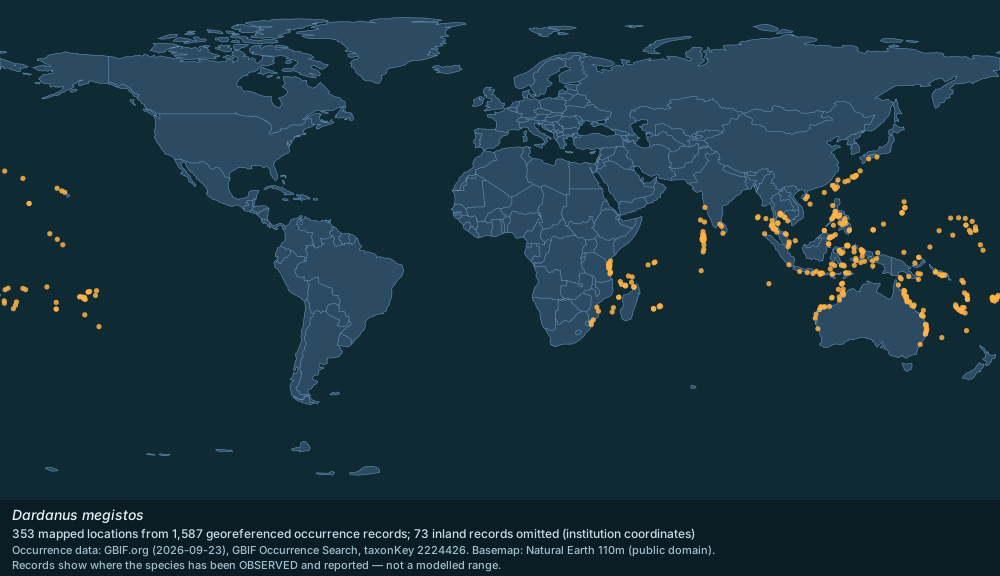
1,587 georeferenced occurrence records for Dardanus megistos are published through GBIF from 48 countries or marine areas. The map above plots 353 distinct locations from a sample of 1,587 records, omitting 73 inland records that carry an institution's coordinates rather than a collection site; it shows where the species has been observed and reported, not a modelled range.
Most records by country or area: Australia (380); Indonesia (212); Philippines (148); New Caledonia (107); French Polynesia (62).
The full country table, WoRMS marine regions and the sampling notes are on this species' Distribution page.
Source: GBIF Occurrence Search (taxonKey 2224426) — https://www.gbif.org/occurrence/search?taxon_key=2224426&has_coordinate=true (records CC0 / CC BY); WoRMS distribution records (MarineRegions) — https://www.marinespecies.org/aphia.php?p=taxdetails&id=208700 (CC BY 4.0); Natural Earth 110m basemap — https://www.naturalearthdata.com/ (public domain). Accessed 2026-09-23.
Description and natural history (Wikipedia)
The genus name Dardanus refers to the son of Zeus and Electra in Greek mythology, while the species name megistos is the superlative of the Greek word mega, therefore it means the largest.
This species is present in the Indo-Pacific region from East Africa to the South China Sea, Australia and east to Hawaii.
These tropical reef-associated crabs occur in coral reef, lagoons, rocky platforms, sand and seagrass beds, from littoral and subtidal zones to deep waters, at depths up to 50 m.
Dardanus megistos can reach a body length of about 20 cm. These large crabs have a bright red body with small white eyespots surrounded by black. Their bodies are covered with long erect coarse hairs of a dark red color. They have a pair of long white primary antennae or antennules, a pair of secondary antennae, stalked green brown eyes and three pairs of mouth appendages. The stalks of the eyes are reddish with a basal white spot. The soft, asymmetrical abdomen is spiral-shaped, useful in keeping in the shell, with a five-piece tail (telson and uropods). Like all decapod crustaceans, they have ten legs. The first pair of legs carries the pincers ( chelipeds). The left plier is bigger than the right one.
The white-spotted hermit crabs are gonochorics, the eggs are carried on the female's abdomen. They also are opportunistic omnivore, mainly feeding on small invertebrates (worms, molluscs, etc.) and they are also reported to feed on holothurians. Commonly these crabs perform a precopulatory courtship ritual. Usually the sperm transfer is indirect. They may live up to 30 years. These crustaceans usually inhabit a large shell of a gastropod, consequently only the cephalothorax and the first three pairs of legs are visible.
Source: Wikipedia: Dardanus megistos — https://en.wikipedia.org/wiki/Dardanus_megistos (CC BY-SA 4.0). Accessed 2026-09-23.
Gallery
Related in Whitespotted hermit
Links follow this subject's own source article.
Elsewhere in Whitespotted hermit
Spotted an error? Know more?
Reader corrections go straight into our review queue. Suggest an edit · How this site is sourced