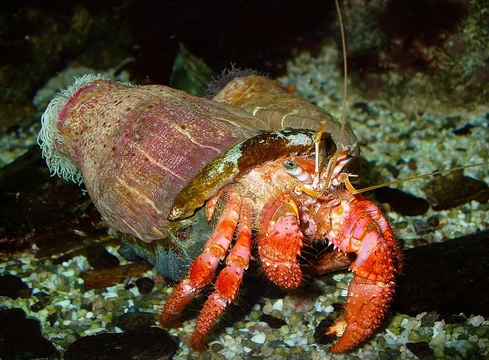
Dardanus venosus
A left-handed hermit crab with star-burst eyes and mauve claws.
Last updated

Ribeiro, F.B., Matthews-Cascon, H. & Bezerra, L.E.A. 2017. Predatory behavior of the paguroid Dardanus venosus (H. Milne-Edwards, 1848) (Anomura: Diogenidae) on · via Wikipedia: Dardanus venosus · CC BY 4.0
Dardanus venosus is a hermit crab species in the family Diogenidae, order Decapoda, class Malacostraca.[1][2] It is known as the starry-eyed hermit crab because its green or blue eyes have dark pupils that appear like star-bursts when viewed closely.[3][4] The carapace length of this hermit crab ranges from 7 to 12 cm.[4]
Scientific classification
- KingdomAnimalia
- PhylumArthropoda
- CladePancrustacea
- ClassMalacostraca
- OrderDecapoda
- SuborderPleocyemata
- InfraorderAnomura
- FamilyDiogenidae
- GenusDardanus
- SpeciesDardanus venosus
Named by (H. Milne Edwards, 1848)
Close relatives
Other species of Dardanus with a Codexery entry.
- Dardanus arrosor Dardanus arrosor
- Dardanus deformis Dardanus deformis
- Dardanus megistos Dardanus megistos
- Dardanus pedunculatus Dardanus pedunculatus
Sources: Wikipedia taxobox: Dardanus venosus (CC BY-SA 4.0) · order, family and genus agree with WoRMS AphiaID 367596 (CC BY 4.0)
Where the dardanus venosus has been recorded
Each dot is a place where the species has been observed and reported (328 records, half-degree grid) — not a modelled range. 20 inland records left out (institution coordinates).
Map: drawn by Codexery. Data: GBIF occurrence search (records CC0 / CC BY) · Natural Earth basemap (public domain)
Quick Facts
- Common names
- starry-eyed crab, stareye crab
- Family
- Diogenidae
- Depth range
- low tide mark down to about 40 metres (130 ft)
- Geographic range
- Florida, Caribbean Sea, Gulf of Mexico, Bahamas, Antilles, Venezuela, Brazil
Facts from the source article.
Biology and range
As a hermit crab, Dardanus venosus lives inside empty gastropod shells, with only its claws and legs projecting.[4] It is left-handed, meaning its main claw is on the left front limb, and it uses this claw to cover the shell opening when threatened.[4] It occurs from the low tide mark down to about 40 meters depth.[5] A covering of small, bluish bristle clusters gives the dactyls (claws) their mauve coloration.[4]
Rock, gravel, sand, mud, shell, coral, and seaweed are all substrate types where Dardanus venosus can be found.[5] Research on the life cycle is limited, yet it is thought that the female broods eggs on her abdomen.[6]
What the specialist sources record
GBIF holds 459 occurrence records for this taxon as of 7 October 2026.[2] Research conducted off Brazil's coast documented Dardanus venosus using eleven distinct gastropod shell types, among them three turban snail species (Astraea sp.).[5] A mutualistic relationship exists where the crab frequently carries the sea anemone Calliactis tricolor on its shell.[7] When moving to a larger shell, the crab actively retrieves the anemone from a rock or transfers it from the old shell.[7]
Initially, the anemone uses its tentacles to grip the new shell until its base can secure a firm attachment.[7] The crab benefits from the anemone's stinging cells for protection, while the anemone receives transportation and access to a greater food supply.[7]
References
- World Register of Marine Species, Dardanus venosus (AphiaID 367596). CC BY 4.0. marinespecies.org
- GBIF Backbone Taxonomy and occurrence index, Dardanus venosus (taxon key 2224418). CC BY 4.0 (backbone); counts are facts. gbif.org
- Hermit Crabs, Use in the Marine Aquarium Hobby WetWebMedia. Retrieved 2012-04-02.. facts only, no text reused. wetwebmedia.com
- Wikipedia, "Dardanus venosus" (CC BY-SA 4.0), which cites: Hermit Crabs, Use in the Marine Aquarium Hobby WetWebMedia. Retrieved 2012-04-02. (we also read that source) en.wikipedia.org
- Wikipedia, "Dardanus venosus" (CC BY-SA 4.0), which cites: "On a record of Dardanus venosus (H. Milne Edwards) (Crustacea, Anomura) from the Sao Paulo State, Brazil" (original not read by us) en.wikipedia.org
- Wikipedia, "Dardanus venosus" (CC BY-SA 4.0), which cites: "The Glaucothoë Stage of Dardanus venosus (H. Milne-Edwards) (Decapoda: Anomura)", Bulletin of Marine Science, 1963, p. 11–22 (original not read by us) en.wikipedia.org
- Wikipedia, "Dardanus venosus" (CC BY-SA 4.0), which cites: "The sea anemone Calliactis tricolor and its association with the Hermit crab Dardanus venosus", Journal of Zoology, 1969, p. 225–241 (original not read by us) en.wikipedia.org
Each numbered sentence above was checked against the source it cites before publication. Sentences citing Wikipedia adapt text from the English Wikipedia article Dardanus venosus (contributors), used under CC BY-SA 4.0; this entry is available under the same licence. Other sources were used for facts only; no text or images are copied from them.
More in Hermit Crabs
Sources
Compiled from Wikipedia and the sources listed below. Text from Wikipedia is available under CC BY-SA 4.0; this entry is adapted from it.
- Wikipedia: Dardanus venosus (CC BY-SA 4.0).
- Classification: the source article's taxobox; order, family and genus checked against WoRMS, the World Register of Marine Species (CC BY 4.0).
- Occurrence records: GBIF (CC0 / CC BY). Basemap: Natural Earth (public domain).
- Word definitions: the , each quoted from its Wikipedia article.
Spotted an error? Know more?
Reader corrections go straight into our review queue. Suggest an edit · How this site is sourced