
Pale anemone hermit (Dardanus deformis)
Source-cited species reference: taxonomy from WoRMS, biology from SeaLifeBase, occurrence map from GBIF, description from Wikipedia.
Dardanus deformis is a species of nocturnal hermit crab that is found in the Indo-Pacific. Its common name is pale anemone hermit. The species is known to transfer sea anemones from one shell to another when it moves to a different shell. It can be kept in an aquarium.
- Scientific name
- Dardanus deformis
- Authority
- (H. Milne Edwards, 1836)
- Family
- Diogenidae
- Order
- Decapoda
- Depth range
- 0–12 m
- Habitat zone
- reef-associated
- Gbif occurrence records
- 651
Classification (WoRMS)
Full classification as recorded by WoRMS: Kingdom: Animalia · Phylum: Arthropoda · Class: Malacostraca · Order: Decapoda · Family: Diogenidae · Genus: Dardanus.
Accepted name: Dardanus deformis · Authority: (H. Milne Edwards, 1836) · Taxonomic status: accepted · AphiaID: 208730.
Synonyms and superseded combinations recorded for this taxon: Pagurus bifermis H. Milne Edwards, 1836; Pagurus biformis H. Milne Edwards, 1836; Pagurus carinatus Randall, 1840; Pagurus cavipes White, 1847; Pagurus cultratus White, 1847; Pagurus cultrerus White, 1847; Pagurus deformis H. Milne Edwards, 1836.
Source: World Register of Marine Species (WoRMS) — https://www.marinespecies.org/aphia.php?p=taxdetails&id=208730 (CC BY 4.0). Accessed 2026-09-23.
Biology and life history (SeaLifeBase)
Measured values published by SeaLifeBase for Dardanus deformis. Only fields the database actually holds for this species are shown; these are database values, not aquarium guidance.
Depth range: 0–12 m · Habitat zone: reef-associated.
SeaLifeBase notes: Found under dead corals in lagoons, commonly with anemones (Ref. 8423); also in intertidal areas with reef platforms and on sand and coral rubble (Ref. 81753). Crushed juvenile Tridacna gigas (Ref. 114917).
Source: SeaLifeBase species summary (SpecCode 21036) — https://www.sealifebase.se/summary/Dardanus-deformis.html (CC BY-NC 3.0 — non-commercial use only). Accessed 2026-09-23.
Distribution and occurrence records (GBIF)
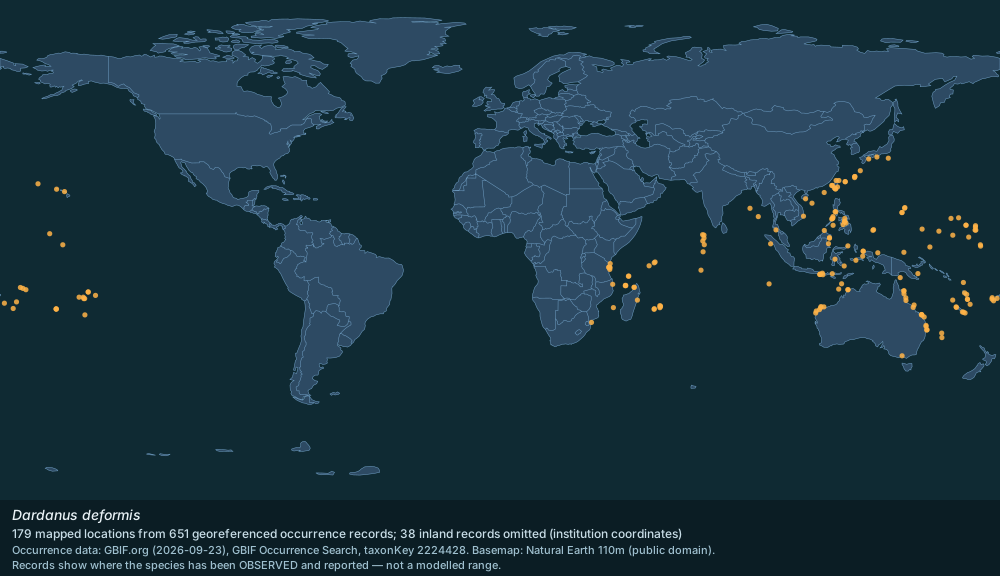
651 georeferenced occurrence records for Dardanus deformis are published through GBIF from 41 countries or marine areas. The map above plots 179 distinct locations from a sample of 651 records, omitting 38 inland records that carry an institution's coordinates rather than a collection site; it shows where the species has been observed and reported, not a modelled range.
Most records by country or area: Australia (119); United States of America (70); New Caledonia (57); Indonesia (48); Philippines (48); Chinese Taipei (42); French Polynesia (32); Tanzania, United Republic of (25); Japan (23); Marshall Islands (23); Vanuatu (17); Fiji (13); Madagascar (13); Mauritius (11); Réunion (11).
Marine regions with a valid WoRMS distribution record: Somali Exclusive Economic Zone; Kenyan Exclusive Economic Zone; Tanzanian Exclusive Economic Zone; Mozambican Exclusive Economic Zone; Seychellois Exclusive Economic Zone; Madagascar; Mauritian Exclusive Economic Zone; Mayotte Disputed area: France / Comoros; New Caledonian Exclusive Economic Zone; French Polynesian Exclusive Economic Zone; Réunion Exclusive Economic Zone; Halmahera; Maldives.
Source: GBIF Occurrence Search (taxonKey 2224428) — https://www.gbif.org/occurrence/search?taxon_key=2224428&has_coordinate=true (records CC0 / CC BY); WoRMS distribution records (MarineRegions) — https://www.marinespecies.org/aphia.php?p=taxdetails&id=208730 (CC BY 4.0); Natural Earth 110m basemap — https://www.naturalearthdata.com/ (public domain). Accessed 2026-09-23.
Description and natural history (Wikipedia)
The crab can be found under dead coral in a lagoon alongside sea anemones. It lives in the low intertidal zones or subtidal zones. Locations that the species can be found in include the Cocos (Keeling) Islands, the Tasman Sea, and the Indo-west Pacific Oceans.
The crab carries Calliactis anemones on the dorsal surface of its shell as well as the anemone Verrillactis paguri on the aperture of its shell. When the crab moves to a new shell, it transfers V. paguri from the old one to the new one on the same area as before, along with the Calliactis anemones. The hermit crab is one of at least 24 species that transfer over sea anemones to a new shell. The placement of the V. paguri might protect the crabs from having their chilepeds and legs eaten by predators such as fish and octopuses. This behavior was first studied in 1920, but with no specific anemones mentioned.
In a 2003 study of the species' breeding season at Maputo Bay, it was found that the crabs breed with peaks of spawning from August to October and a small decrease from May to July. The study concluded that rainfall is the main factor that controls its breeding activity.
The species can usually be kept in an aquarium with many other invertebrates, but it has been known to attack Caulerpa algae. The process of transferring anemones to another shell can also happen in an aquarium. While in captivity, the species does well in dim light and eats either frozen, flake, or tablet food.
Source: Wikipedia: Dardanus deformis — https://en.wikipedia.org/wiki/Dardanus_deformis (CC BY-SA 4.0). Accessed 2026-09-23.
Gallery
Spotted an error? Know more?
Reader corrections go straight into our review queue. Suggest an edit · How this site is sourced