
Striated hermit crab (Dardanus arrosor)
Source-cited species reference: taxonomy from WoRMS, biology from SeaLifeBase, occurrence map from GBIF, description from Wikipedia.
Dardanus arrosor, the red reef hermit or Mediterranean hermit crab, is a species of hermit crab.
- Scientific name
- Dardanus arrosor
- Authority
- (Herbst, 1796)
- Family
- Diogenidae
- Order
- Decapoda
- Depth range
- 5–750 m
- Habitat zone
- benthic
- Gbif occurrence records
- 3,712
Classification (WoRMS)
Full classification as recorded by WoRMS: Kingdom: Animalia · Phylum: Arthropoda · Class: Malacostraca · Order: Decapoda · Family: Diogenidae · Genus: Dardanus.
Accepted name: Dardanus arrosor · Authority: (Herbst, 1796) · Taxonomic status: accepted · AphiaID: 107197.
Synonyms and superseded combinations recorded for this taxon: Aniculus chiltoni Thompson, 1930; Cancer arrosor Herbst, 1796; Eupagurus striatus (Latreille, 1803); Pagurus arrosor (Herbst, 1796); Pagurus incisus Olivier, 1812; Pagurus striatus Latreille, 1803; Pagurus strigosus Bosc, 1801; Petrochirus arrosor (Herbst, 1796).
Source: World Register of Marine Species (WoRMS) — https://www.marinespecies.org/aphia.php?p=taxdetails&id=107197 (CC BY 4.0). Accessed 2026-09-23.
Biology and life history (SeaLifeBase)
Measured values published by SeaLifeBase for Dardanus arrosor. Only fields the database actually holds for this species are shown; these are database values, not aquarium guidance.
Depth range: 5–750 m · Habitat zone: benthic · Aquarium trade: never/rarely.
SeaLifeBase notes: Minimum depth from Ref. 82060. Bathyal. Inhabits continental shelf and slope (Ref. 2782). It is eurybathic, on coastal detritic bottoms to bathyal muds (Ref. 105665). Uses shells of Bittium latreilli (Ref. 105639). Opportunistic scavenger and predator. Feeds on live crabs, dead shells and fishes (Ref. 106108). Other isotope data (δ15N=9.66±0.25, Ref. 106518).
Source: SeaLifeBase species summary (SpecCode 92437) — https://www.sealifebase.se/summary/Dardanus-arrosor.html (CC BY-NC 3.0 — non-commercial use only). Accessed 2026-09-23.
Distribution and occurrence records (GBIF)
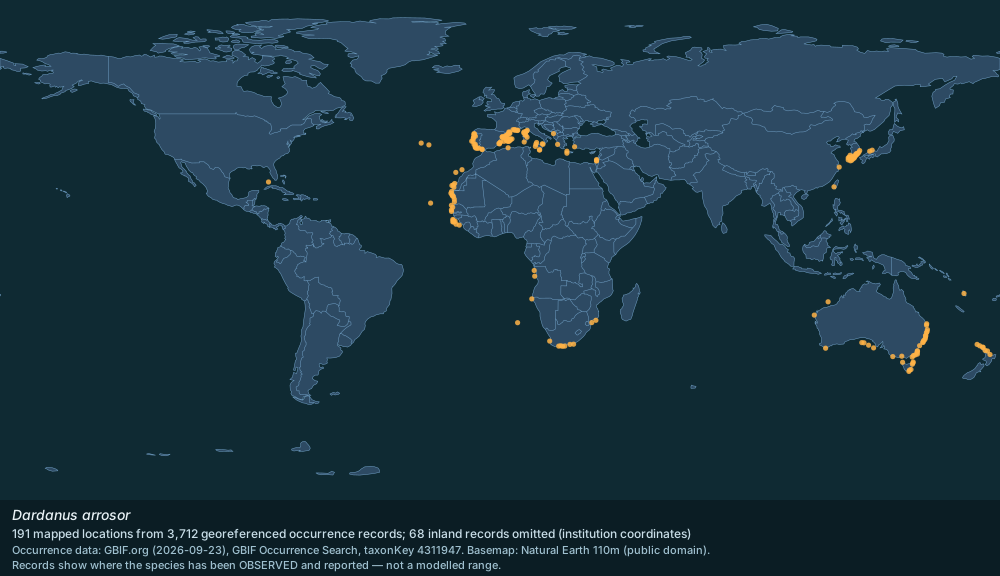
3,712 georeferenced occurrence records for Dardanus arrosor are published through GBIF from 53 countries or marine areas. The map above plots 191 distinct locations from a sample of 3,000 records, omitting 68 inland records that carry an institution's coordinates rather than a collection site; it shows where the species has been observed and reported, not a modelled range.
Most records by country or area: Spain (1,415); Portugal (949); France (387); Australia (282); Korea, Republic of (178).
The full country table, WoRMS marine regions and the sampling notes are on this species' Distribution page.
Source: GBIF Occurrence Search (taxonKey 4311947) — https://www.gbif.org/occurrence/search?taxon_key=4311947&has_coordinate=true (records CC0 / CC BY); WoRMS distribution records (MarineRegions) — https://www.marinespecies.org/aphia.php?p=taxdetails&id=107197 (CC BY 4.0); Natural Earth 110m basemap — https://www.naturalearthdata.com/ (public domain). Accessed 2026-09-23.
Description and natural history (Wikipedia)
Carapace of Dardanus arrosor can reach a length of 6 - 8 cm. The color varies from bright red to bright orange. The eyestalks are robust, not very long, dilated at the tip and alternately streaked with red and white. The eyes are bluish. Claws show hair-like spines and warty tubercles. The left claw is more developed than the right one, but in both claws the tip is black or yellowish. The abdomen is asymmetrical, bare and hidden within a shell.
This species breed between July and August. These crabs show the striking behavior of living within empty shells of conches (usually shells of Bittium latreillii), often decorated with sea anemones (usually Calliactis parasitica). The larvae have a symmetrical shape, but gradually they develop an asymmetrical abdomen that this crustacean will hide in a periodically replaced shell.
The relationship with the anemone is truly symbiotic, since the anemone gains scraps of food from the hermit crab, while the crab benefits from the anemone's stinging tentacles deterring predators.
This crab is an opportunistic scavenger and predator. It feeds on decaying matter, on live crabs and small fishes.
This widespread species can be found in the Atlantic coasts, in the Mediterranean Sea, in the Red Sea, in the Indo-West Pacific (Japan, New Zealand and Philippines).
This species inhabits continental shelf and slope. It usually lives on sandy substrate, on coastal detritic bottoms and on bathyal muds, from a few meters up to depths of 750 m.
Source: Wikipedia: Dardanus arrosor — https://en.wikipedia.org/wiki/Dardanus_arrosor (CC BY-SA 4.0). Accessed 2026-09-23.
Gallery
Related in Striated hermit crab
Links follow this subject's own source article.
Elsewhere in Striated hermit crab
Spotted an error? Know more?
Reader corrections go straight into our review queue. Suggest an edit · How this site is sourced