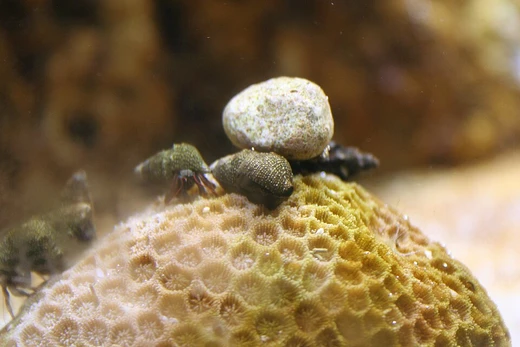
Blue eyed crab (Cymo melanodactylus)
Source-cited species reference: taxonomy from WoRMS, biology from SeaLifeBase, occurrence map from GBIF, description from Wikipedia.

Cymo melanodactylus, also known as the furry coral crab, is a species of small crab in the family Xanthidae. It is found in the Indo-Pacific Ocean and lives in crevices and on the surface of corals in the genus Acropora.
- Scientific name
- Cymo melanodactylus
- Authority
- Dana, 1852
- Family
- Xanthidae
- Order
- Decapoda
- Depth range
- 1–10 m
- Habitat zone
- benthic
- Gbif occurrence records
- 175
Classification (WoRMS)
Full classification as recorded by WoRMS: Kingdom: Animalia · Phylum: Arthropoda · Class: Malacostraca · Order: Decapoda · Family: Xanthidae · Genus: Cymo.
Accepted name: Cymo melanodactylus · Authority: Dana, 1852 · Taxonomic status: accepted · AphiaID: 208969.
Synonyms and superseded combinations recorded for this taxon: Cancer (Cymo) meladactylus De Haan, 1833; Cymo melanodactylus savaiiensis Ward, 1939; Cymo melanodactylus var. purus Chen, 1933.
Source: World Register of Marine Species (WoRMS) — https://www.marinespecies.org/aphia.php?p=taxdetails&id=208969 (CC BY 4.0). Accessed 2026-09-23.
Biology and life history (SeaLifeBase)
Measured values published by SeaLifeBase for Cymo melanodactylus. Only fields the database actually holds for this species are shown; these are database values, not aquarium guidance.
Depth range: 1–10 m · Habitat zone: benthic · Aquarium trade: never/rarely.
SeaLifeBase notes: Subtidal (Ref. 106854). Feeds on corals (Ref. 129713).
Source: SeaLifeBase species summary (SpecCode 103066) — https://www.sealifebase.se/summary/Cymo-melanodactylus.html (CC BY-NC 3.0 — non-commercial use only). Accessed 2026-09-23.
Distribution and occurrence records (GBIF)
175 georeferenced occurrence records for Cymo melanodactylus are published through GBIF from 33 countries or marine areas. The map above plots 56 distinct locations from a sample of 175 records, omitting 16 inland records that carry an institution's coordinates rather than a collection site; it shows where the species has been observed and reported, not a modelled range.
Most records by country or area: Papua New Guinea (30); Philippines (19); Australia (17); New Caledonia (17); Réunion (11); Oman (8); Guam (7); Samoa (7); Northern Mariana Islands (6); Indonesia (5); French Polynesia (5); Chinese Taipei (5); Hong Kong (4); Mayotte (4); Marshall Islands (3).
Marine regions with a valid WoRMS distribution record: Madagascar; Mauritian Exclusive Economic Zone; Comoran Exclusive Economic Zone; Mayotte Disputed area: France / Comoros; New Caledonian Exclusive Economic Zone; Wallis and Futuna Exclusive Economic Zone; French Polynesian Exclusive Economic Zone; Réunion Exclusive Economic Zone; East China Sea.
Source: GBIF Occurrence Search (taxonKey 4377686) — https://www.gbif.org/occurrence/search?taxon_key=4377686&has_coordinate=true (records CC0 / CC BY); WoRMS distribution records (MarineRegions) — https://www.marinespecies.org/aphia.php?p=taxdetails&id=208969 (CC BY 4.0); Natural Earth 110m basemap — https://www.naturalearthdata.com/ (public domain). Accessed 2026-09-23.
Description and natural history (Wikipedia)
The carapace and limbs of Cymo melanodactylus have the appearance of being covered with short fur. It has large pale blue, stalked eyes, a spiny carapace with a shallow groove down the middle and grows to about 1.3 cm wide. It typically has black fingers to its claws but is difficult to distinguish from the rather similar Cymo andreossyi on claw colour alone as some individuals have white finger tips and others have white fingers with black bases. A more reliable feature to distinguish between the two is the orange granulations on the carapace of Cymo melanodactylus.
Cymo melanodactylus is found in the Indo-Pacific Ocean. Its range extends from the Red Sea and Madagascar to New Caledonia, French Polynesia and Wallis and Futuna.
Cymo melanodactylus is an obligate commensal of Acropora spp. corals. On the large table coral Acropora cytherea, there are usually just one or two of these crabs per head of coral. The crabs feed mostly on mucus secreted by the coral, but also consume zooplankton and suspended particles and nibble the living tissue, though the coral seems little harmed by this. In 2010 in the Chagos Archipelago, infestations of as many as 47 of these crabs were found on individual heads of coral and these corals exhibited dead and dying tissue. The crabs were near the damaged tissues but it was unclear whether the crabs were the original cause of the damage or whether they had moved in to exploit the already dying tissues. A more recent study has shown that Cymo melanodactylus is attracted to acroporid corals suffering from white band disease and that the disease advances at a much slower rate when the crabs are present than it does when they are absent.
In the Seychelles, this crab was found living on a different species of coral, Acropora formosa. A single coral head supported a mated pair, a single female and some juveniles.
Source: Wikipedia: Cymo melanodactylus — https://en.wikipedia.org/wiki/Cymo_melanodactylus (CC BY-SA 4.0). Accessed 2026-09-23.
Spotted an error? Know more?
Reader corrections go straight into our review queue. Suggest an edit · How this site is sourced