Sevenspine bay shrimp (Crangon septemspinosa)
Source-cited species reference: taxonomy from WoRMS, biology from SeaLifeBase, occurrence map from GBIF, description from Wikipedia.
Last updated

Eric A. Lazo-Wasem · via Wikipedia: Crangon septemspinosa · CC0
Crangon septemspinosa (sand shrimp), also known as seven-spined bay shrimp, is a species of shrimp commonly found along the Atlantic coast of North America, with a wide range spanning from Newfoundland to eastern Florida. Sand shrimp is often found in eelgrass beds, salt marshes, and estuaries and can be found at depths to 450 m. At maturity, they can reach about 7 to 7.5 cm in length. Its name derives from the sand-like coloration that helps camouflage the species with its environment.
Scientific classification
- KingdomAnimalia
- PhylumArthropoda
- CladePancrustacea
- ClassMalacostraca
- OrderDecapoda
- SuborderPleocyemata
- InfraorderCaridea
- FamilyCrangonidae
- GenusCrangon
- SpeciesCrangon septemspinosa
Named by Say, 1818
Close relatives
Other species of Crangon with a Codexery entry.
- Crangon allmani Crangon allmani
- Crangon crangon Crangon crangon
- Crangon franciscorum Crangon franciscorum
Sources: Wikipedia taxobox: Crangon septemspinosa (CC BY-SA 4.0) · order, family and genus agree with WoRMS AphiaID 158355 (CC BY 4.0)
Where the sevenspine bay shrimp (crangon septemspinosa) has been recorded
Each dot is a place where the species has been observed and reported (6,890 records, half-degree grid) — not a modelled range. 90 inland records left out (institution coordinates).
Map: drawn by Codexery. Data: GBIF occurrence search (records CC0 / CC BY) · Natural Earth basemap (public domain) · place coordinates: Wikipedia (CC BY-SA 4.0)
Classification (WoRMS)
Full classification as recorded by WoRMS: Kingdom: Animalia · Phylum: Arthropoda · Class: Malacostraca · Order: Decapoda · Family: Crangonidae · Genus: Crangon.
Accepted name: Crangon septemspinosa · Authority: Say, 1818 · Taxonomic status: accepted · AphiaID: 158355.
Synonyms and superseded combinations recorded for this taxon: Crago septemspinosus (Say, 1818); Crangon septemspinosus Say, 1818.
Source: World Register of Marine Species (WoRMS) — https://www.marinespecies.org/aphia.php?p=taxdetails&id=158355 (CC BY 4.0). Accessed 2026-09-25.
Biology and life history (SeaLifeBase)
Measured values published by SeaLifeBase for Crangon septemspinosa. Only fields the database actually holds for this species are shown; these are database values, not aquarium guidance.
Habitat zone: benthic.
Source: SeaLifeBase species summary (SpecCode 25946) — https://www.sealifebase.se/summary/Crangon-septemspinosa.html (CC BY-NC 3.0 — non-commercial use only). Accessed 2026-09-25.
Distribution and occurrence records (GBIF)
6,890 georeferenced occurrence records for Crangon septemspinosa are published through GBIF from 6 countries or marine areas. The map above plots 125 distinct locations from a sample of 3,000 records, omitting 96 inland records that carry an institution's coordinates rather than a collection site; it shows where the species has been observed and reported, not a modelled range.
Most records by country or area: United States of America (4,263); Canada (2,620); Saint Pierre and Miquelon (3); Russian Federation (2); United Kingdom of Great Britain and Northern Ireland (1).
The full country table, WoRMS marine regions and the sampling notes are on this species' Distribution page.
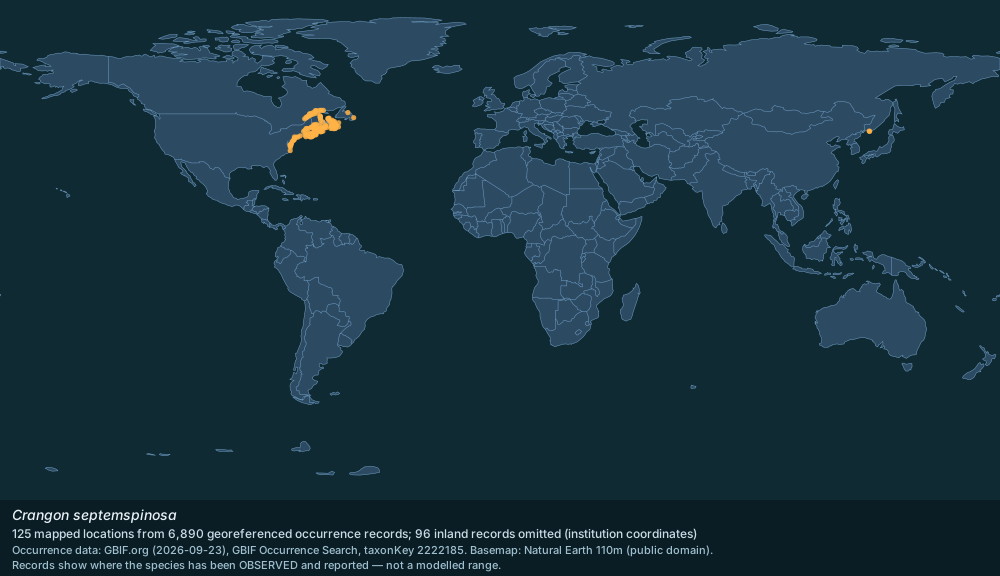
Source: GBIF Occurrence Search (taxonKey 2222185) — https://www.gbif.org/occurrence/search?taxon_key=2222185&has_coordinate=true (records CC0 / CC BY); WoRMS distribution records (MarineRegions) — https://www.marinespecies.org/aphia.php?p=taxdetails&id=158355 (CC BY 4.0); Natural Earth 110m basemap — https://www.naturalearthdata.com/ (public domain). Accessed 2026-09-25.
Description and natural history (Wikipedia)
Sand shrimp is a nocturnal species, which means that it is much more active in dark environments rather than light ones. This increased rate of activity is also more prominent in high temperature environments, as indicated by an increase in respiration rate. At 20 °C, the species is observed to adopt a bimodal pattern rather than a uni-modal one.
As a prey resource to many predators, the sand shrimp has a limited prey availability. Fortunately, the species is an unspecialized feeder with an incredibly diverse diet. As such, in the case of a more active lifestyle, the sand shrimp may compensate by altering its diet into a more carnivorous feeding and selectively consume animal tissues, which provide higher energy content.
Reproduction
Sand shrimp appears to have two major reproductive periods. According to an observation of the populations in Mystic River estuary, this is categorized into one in early spring and one in late autumn.
Another observation on the species, which was based on the populations of in the Southern Gulf of St. Lawrence estuary, however, categorizes this into spring and late summer instead, followed by smaller portion of reproductive rates in around summer and early fall. It also shows a more continuous reproductive period throughout spring and summer rather than having two separate spawning events in spring and autumn, suggesting a reproduction cycle more distinct than its northerly populations. Hence, the species' mating seasons may vary depending on the species' habitats and locations.
In early spring, mature sand shrimps that are two or three year old immigrate from its regular habitat offshore and into shallow shorelines, where they will then mate and reproduce. This immigration pattern works as a recruitment mechanism within the life history of mature sand shrimps.
Autumn reproduction period averages up to about 1,600 eggs. However, eggs found in spring reproductive period are noted to be most abundant, with about twice as many eggs produced.
Temperatures on Population Growth
Sand shrimps eggs hatch when the water temperatures are optimal in temperature (Modlin, 1976). Temperatures play a crucial factor as it not only determines the length of larval life, but also the species' growth in differing habitats.
The populations within the Gulf of Maine suggest that shrimp hatched in warmer season experience faster rates of growth (0.42 - 1.25 mm/week) than those hatched in a colder season (0.31 - 0.83 mm/week). However, in places like Rhode Island, where summer averages about 20 °C, growth rates are reported to be as much as four times higher than in Delaware Bay, where summer averages about 27° instead. This implies that optimal temperature may vary depending on the habitat.
Diets and Feeding Habits
In nature, sand shrimp's primary diets consist of mostly organic debris and decaying organic matter. They have an incredibly versatile diet that utilizes a variety of foods. However, they have a preference that includes brine shrimp, clam, and hard-boiled egg or Baker's yeast—although it's mostly animal tissues of marine origins—and grow best on these diets.
Hydration
Hydration levels in sand shrimp seems to be inversely proportional to the species' satiety level. It is thus safe to assume that water replaces the tissues lost to metabolic processes.
Source: Wikipedia: Crangon septemspinosa — https://en.wikipedia.org/wiki/Crangon_septemspinosa (CC BY-SA 4.0). Accessed 2026-09-25.
Related in Sevenspine bay shrimp
Links follow this subject's own source article.
Elsewhere in Sevenspine bay shrimp
Sources
Compiled from Wikipedia and the sources listed below. Text from Wikipedia is available under CC BY-SA 4.0; this entry is adapted from it.
- Wikipedia: Crangon septemspinosa (CC BY-SA 4.0).
- Classification: the source article's taxobox; order, family and genus checked against WoRMS, the World Register of Marine Species (CC BY 4.0).
- Occurrence records: GBIF (CC0 / CC BY). Basemap: Natural Earth (public domain).
- Biology values: SeaLifeBase species summary (CC BY-NC 3.0, non-commercial).
- Word definitions: the , each quoted from its Wikipedia article.
Spotted an error? Know more?
Reader corrections go straight into our review queue. Suggest an edit · How this site is sourced