
Common shrimp (Crangon crangon)
Source-cited species reference: taxonomy from WoRMS, biology from SeaLifeBase, occurrence map from GBIF, description from Wikipedia.

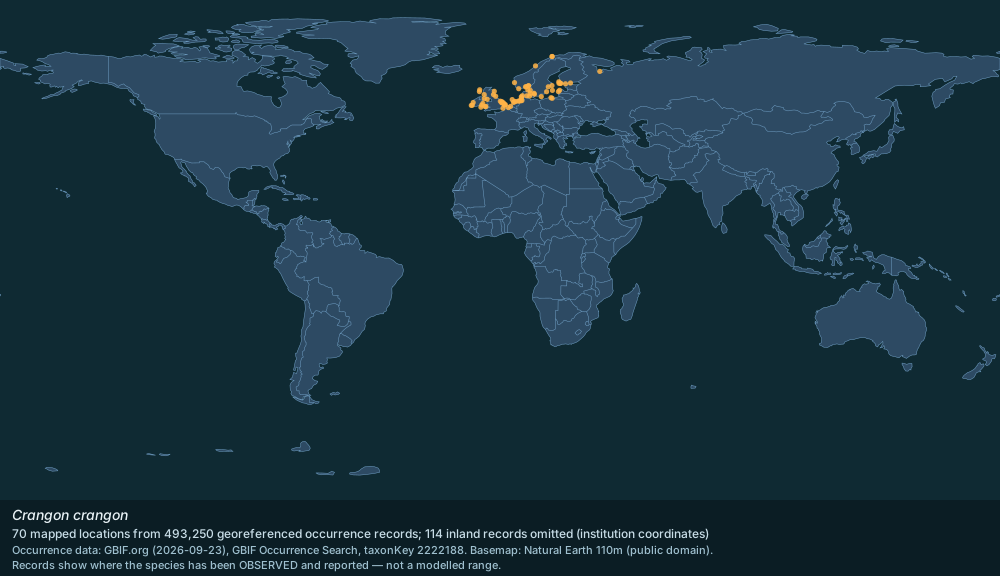
Distribution map plotted from GBIF.org occurrence records; basemap Natural Earth 110m · GBIF records CC0 / CC BY; Natural Earth public domain
Crangon crangon is a species of caridean shrimp found across the northeastern Atlantic Ocean. Its range extends from the White Sea in the north of Russia to the coast of Morocco, including the Baltic Sea, and appears also throughout the Mediterranean and Black Seas. Commercially important, it is fished mainly in the southern North Sea. Common names include brown shrimp, common shrimp, bay shrimp, and sand shrimp, while translation of its French name (or its Dutch equivalent) sometimes leads to the English version grey shrimp. The generic and specific names derive from krangṓn (κραγγών), an Ancient Greek word for shrimp.
- Scientific name
- Crangon crangon
- Authority
- (Linnaeus, 1758)
- Family
- Crangonidae
- Order
- Decapoda
- Maximum length
- 8.9 cm
- Depth range
- 0–50 m
- Habitat zone
- benthic
- Gbif occurrence records
- 493,250
Classification (WoRMS)
Full classification as recorded by WoRMS: Kingdom: Animalia · Phylum: Arthropoda · Class: Malacostraca · Order: Decapoda · Family: Crangonidae · Genus: Crangon.
Accepted name: Crangon crangon · Authority: (Linnaeus, 1758) · Taxonomic status: accepted · AphiaID: 107552.
Synonyms and superseded combinations recorded for this taxon: Cancer crangon Linnaeus, 1758; Cancer schillinus Nardo, 1847; Crangon crangon f. mediterranea Bražnikov, 1907; Crangon crangon f. typica Bražnikov, 1907; Crangon crangon typicus Doflein, 1900; Crangon maculosus Rathke, 1836; Crangon maculosus f. brevirostris Czerniavsky, 1884; Crangon maculosus f. typica Czerniavsky, 1884; Crangon maculosus var. suchumica Czerniavsky, 1884; Crangon rubro punctatus Risso, 1816; Crangon rubropunctatus Risso, 1816; Crangon schillinus Nardo, 1847; Crangon vulgaris Fabricius, 1798; Steiracrangon orientalis Czerniavsky, 1884; Steiracrangon orientalis var. brevicauda Czerniavsky, 1884; Steiracrangon orientalis var. longicauda Czerniavsky, 1884; Steiracrangon orientalis var. longicauda f. intermedia Czerniavsky, 1884.
Source: World Register of Marine Species (WoRMS) — https://www.marinespecies.org/aphia.php?p=taxdetails&id=107552 (CC BY 4.0). Accessed 2026-09-23.
Biology and life history (SeaLifeBase)
Measured values published by SeaLifeBase for Crangon crangon. Only fields the database actually holds for this species are shown; these are database values, not aquarium guidance.
Maximum length: 8.9 cm · Depth range: 0–50 m · Habitat zone: benthic · Vulnerability index: 42.7 of 100 · Fishery importance: commercial.
SeaLifeBase notes: Found in both marine and oligohaline waters (Ref. 95752). Also inhabits brackish lagoons (Ref. 2779). Found on fine sand or slightly muddy sand (Ref. 434); also over coarse sand (Ref. 96391). Juveniles are epifaunal on seagrass and bare sand flats (Ref. 106879). Mobile (Refs. 95752, 96470). Free-living (Ref. 3123). Able to occupy areas with high exposure and low salinity (Ref. 95730). Carnivorous (Refs. 95752, 96470). Feeds on small benthic organisms (small crustaceans, annelids and mollusks) and fishery discards (Ref. 434).
Source: SeaLifeBase species summary (SpecCode 24957) — https://www.sealifebase.se/summary/Crangon-crangon.html (CC BY-NC 3.0 — non-commercial use only). Accessed 2026-09-23.
Distribution and occurrence records (GBIF)
493,250 georeferenced occurrence records for Crangon crangon are published through GBIF from 35 countries or marine areas. The map above plots 70 distinct locations from a sample of 3,000 records, omitting 114 inland records that carry an institution's coordinates rather than a collection site; it shows where the species has been observed and reported, not a modelled range.
Most records by country or area: Germany (261,023); Netherlands (181,234); Belgium (28,155); Denmark (7,239); United Kingdom of Great Britain and Northern Ireland (5,776).
The full country table, WoRMS marine regions and the sampling notes are on this species' Distribution page.
Source: GBIF Occurrence Search (taxonKey 2222188) — https://www.gbif.org/occurrence/search?taxon_key=2222188&has_coordinate=true (records CC0 / CC BY); WoRMS distribution records (MarineRegions) — https://www.marinespecies.org/aphia.php?p=taxdetails&id=107552 (CC BY 4.0); Natural Earth 110m basemap — https://www.naturalearthdata.com/ (public domain). Accessed 2026-09-23.
Description and natural history (Wikipedia)
Adults are typically 30 - 50 mm long, although individuals up to 90 mm have been recorded. The animals have cryptic colouration, being a sandy brown colour, which can be changed to match the environment.
Crangon is classified in the family Crangonidae, and shares the family's characteristic subchelate first pereiopods (where the movable finger closes onto a short projection rather than a similarly sized, fixed "finger") and short rostrum.
They live in shallow water, which can also be slightly brackish, and feed nocturnally. During the day, they remain buried in the sand to escape predatory birds and fish, with only their antennae protruding.
C. crangon has a wide range, extending across the northeastern Atlantic Ocean from the White Sea in the north of Russia to the coast of Morocco, including the Baltic Sea, as well as occurring throughout the Mediterranean and Black Seas. Despite its wide range, however, little gene flow occurs across certain natural barriers, such as the Strait of Gibraltar or the Bosphorus. The populations in the western Mediterranean Sea are thought to be the oldest, with the species' spread across the north Atlantic thought to postdate the Pleistocene.
Adults live epibenthically (on or near the sea floor) especially in the shallow waters of estuaries or near the coast. It is generally highly abundant, and has a significant effect on the ecosystems where it lives.
Females reach sexual maturity at a length around 22 - 43 mm, while males are mature at 30 - 45 mm. The young hatch from their eggs into planktonic larvae. These pass through five moults before reaching the postlarval stage, when they settle to the sea-floor.
Historically, the commercial fishery was accomplished by horse-drawn beam trawls on both sides of the Dover straits. In the sandy shallows of Morecambe Bay (Lancashire, UK) horses have been replaced by tractors. Some small fishing vessels also use beam trawls for brown shrimp. A few artisanal fishermen use hand-pushed nets. In all UK shrimp fisheries, the catch is first 'riddled' to release the young of shrimps and fish. The shrimps are then traditionally boiled on board before landing.
Over 37,000 t of C. crangon were caught in 1999, with Germany and the Netherlands taking over 80% of this total.
The UK lands an annual average of 1000 tonnes of brown shrimp, but the catch is highly variable between 500 and 1500 tonnes. In the Lancashire fishery for brown shrimp it has been shown that landings in any year are related to the annual catch, average annual air temperature (inverse) and total rainfall in the previous year. That has enabled a good prediction of annual landings one year in advance. Moreover, for the port of Lytham, the abundance of shrimp (annual catch per unit effort) was found to be closely correlated with the mean annual Zürich sunspot number for the period 1965-1975. Given that sunspot numbers are predictable, this provides another tool for the prediction of annual shrimp catch. Sunspot cycle No. 23 (1997–2008) is a good example of the correlation between UK annual brown shrimp catch and mean annual sunspot number.
Greenpeace Germany classifies the brown shrimp as an "unsustainable" choice that should be avoided. Brown shrimp have been documented to contain microplastics.
The consumption of brown shrimp is popular in Belgium, the Netherlands, northern Germany, and Denmark.
Shrimp in general are known as garnalen in Dutch. It is the basis of the dish tomate-crevettes, where the shrimp are mixed with mayonnaise and fresh parsley, and served in a hollowed-out uncooked tomato. The shrimp croquette is another Belgian speciality; the shrimp are in the interior of the battered croquette along with béchamel sauce. Freshly cooked, unpeeled brown shrimp are often served as a snack accompanying beer, typically a sour ale or Flemish red such as Rodenbach.
In Lancashire, England, the peeled brown shrimps are mixed with butter and spices (including nutmeg or mace) to make potted shrimps, a dish traditionally eaten with bread.
Source: Wikipedia: Crangon crangon — https://en.wikipedia.org/wiki/Crangon_crangon (CC BY-SA 4.0). Accessed 2026-09-23.
Gallery
Related in Common shrimp
Links follow this subject's own source article.
Elsewhere in Common shrimp
Spotted an error? Know more?
Reader corrections go straight into our review queue. Suggest an edit · How this site is sourced