
Copper shark (Carcharhinus brachyurus)
Source-cited species reference: taxonomy from WoRMS, biology from FishBase, occurrence map from GBIF, conservation from IUCN Red List, description from Wikipedia.
The copper shark (Carcharhinus brachyurus), bronze whaler, or narrowtooth shark is a species of requiem shark found mostly in temperate latitudes. It is distributed in a number of separate populations in the northeastern and southwestern Atlantic, off southern Africa, in the northwestern and eastern Pacific, and around Australia and New Zealand, with scattered reports from equatorial regions. The species can be found from brackish rivers and estuaries to shallow bays and harbors, to offshore waters 100 m deep or more. Females are found apart from males for most of the year, and conduct seasonal migrations. A large species reaching 3.3 m long, the copper shark is difficult to distinguish from other large requiem sharks. It is characterized by its narrow, hook-shaped upper teeth, lack of a prominent ridge between the dorsal fins, and plain bronze coloration.
- Scientific name
- Carcharhinus brachyurus
- Authority
- (Günther, 1870)
- Family
- Carcharhinidae
- Order
- Carcharhiniformes
- Maximum length
- 325 cm
- Depth range
- 0–360 m
- Habitat zone
- reef-associated
- Iucn red list
- Vulnerable
- Gbif occurrence records
- 12,317
Classification (WoRMS)
Full classification as recorded by WoRMS: Kingdom: Animalia · Phylum: Chordata · Class: Elasmobranchii · Order: Carcharhiniformes · Family: Carcharhinidae · Genus: Carcharhinus.
Accepted name: Carcharhinus brachyurus · Authority: (Günther, 1870) · Taxonomic status: accepted · AphiaID: 217341.
Synonyms and superseded combinations recorded for this taxon: Carcharhinus ahenea (Stead, 1938); Carcharhinus improvisus Smith, 1952; Carcharhinus lamiella (Jordan & Gilbert, 1882); Carcharhinus remotoides Deng, Xiong & Zhan, 1981; Carcharhinus remotus (Duméril, 1865); Carcharhinus rochensis Abella, 1972; Carcharias brachyurus Günther, 1870; Carcharias lamiella Jordan & Gilbert, 1882; Carcharias remotus Duméril, 1865; Carcharinus improvisus Smith, 1952; Eulamia ahenea Stead, 1938; Galeolamna ahenea (Stead, 1938).
Source: World Register of Marine Species (WoRMS) — https://www.marinespecies.org/aphia.php?p=taxdetails&id=217341 (CC BY 4.0). Accessed 2026-09-23.
Biology and life history (FishBase)
Measured values published by FishBase for Carcharhinus brachyurus. Only fields the database actually holds for this species are shown; these are database values, not aquarium guidance.
Maximum length: 325 cm · Depth range: 0–360 m · Habitat zone: reef-associated · Body shape: fusiform / normal · Vulnerability index: 86.7 of 100 · Fishery importance: minor commercial · Aquarium trade: never/rarely.
FishBase notes: A coastal and offshore shark (Ref. 9997) found along continental margins in most tropical and temperate seas. Occasionally enters large coastal bays and inshore areas (Ref. 6390). Occasionally found near the bottom (Ref. 6808). Migratory in the northern part of its range, moving northward in spring and summer and southward in autumn and winter (Ref. 244). Feeds on pelagic and bottom bony fishes, cephalopods, and small sharks and rays (Ref. 5578). Viviparous (Ref. 50449). Undoubtedly utilized for human consumption where it occurs (Ref. 244). Implicated in shark attacks on people (Ref. 9997).
Source: FishBase species summary (SpecCode 864) — https://www.fishbase.se/summary/Carcharhinus-brachyurus.html (CC BY-NC 3.0 — non-commercial use only). Accessed 2026-09-23.
Distribution and occurrence records (GBIF)
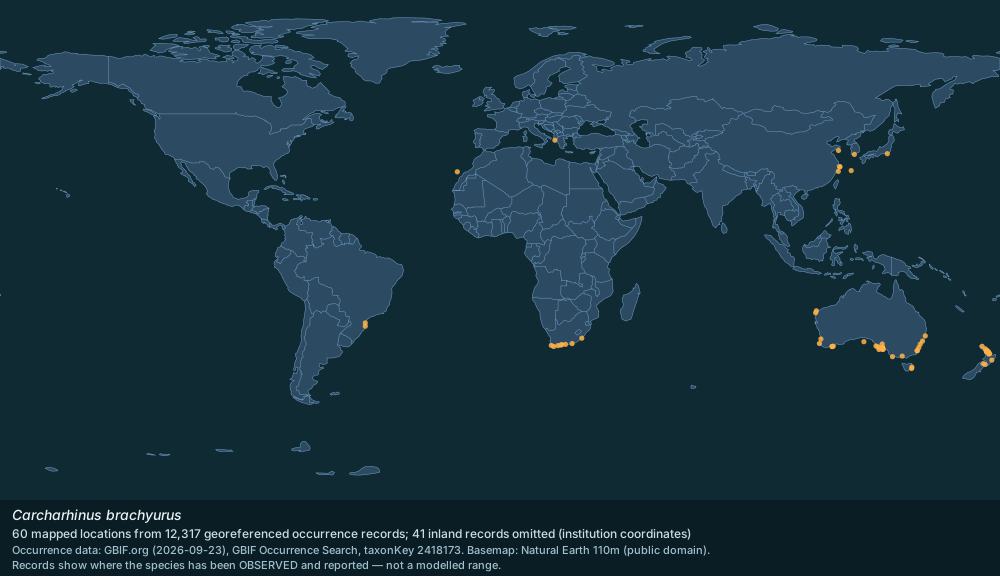
12,317 georeferenced occurrence records for Carcharhinus brachyurus are published through GBIF from 24 countries or marine areas. The map above plots 60 distinct locations from a sample of 3,000 records, omitting 41 inland records that carry an institution's coordinates rather than a collection site; it shows where the species has been observed and reported, not a modelled range.
Most records by country or area: Australia (11,120); Brazil (379); New Zealand (342); United States of America (211); South Africa (175).
The full country table, WoRMS marine regions and the sampling notes are on this species' Distribution page.
Source: GBIF Occurrence Search (taxonKey 2418173) — https://www.gbif.org/occurrence/search?taxon_key=2418173&has_coordinate=true (records CC0 / CC BY); WoRMS distribution records (MarineRegions) — https://www.marinespecies.org/aphia.php?p=taxdetails&id=217341 (CC BY 4.0); Natural Earth 110m basemap — https://www.naturalearthdata.com/ (public domain). Accessed 2026-09-23.
Conservation status (IUCN Red List)
The IUCN Red List assesses Carcharhinus brachyurus (Günther, 1870) as Vulnerable (code VU). No trend, population estimate or threat analysis is given here, because none is available from this source without the Red List API; follow the source link for the full assessment, including its date.
Source: IUCN Red List of Threatened Species (taxon 41741) — https://www.iucnredlist.org/species/41741/0; GBIF IUCN Red List category endpoint (taxonKey 2418173) — https://api.gbif.org/v1/species/2418173/iucnRedListCategory. Accessed 2026-09-23.
Description and natural history (Wikipedia)
Feeding mainly on cephalopods, bony fishes, and other cartilaginous fishes, the copper shark is a fast-swimming predator that has been known to hunt in large groups, using their numbers to their advantage; however, for most of the time they remain solitary. Off South Africa, this species associates closely with the annual sardine run, involving millions of southern African pilchard (Sardinops sagax). Like other requiem sharks, it is viviparous, with the developing embryos mainly nourished through a placental connection formed from the depleted yolk sac. Females bear litters of 7 to 24 pups every other year in coastal nursery areas, after a gestation period of 12 or perhaps as long as 21 months. It is extremely slow-growing, with males and females not reaching maturity until 13–19 and 19–20 years of age respectively.
This species is valued by commercial and recreational fisheries throughout its range, and utilized as food. The species population size is unknown, but the IUCN's Red List assesses the species as vulnerable because it is very susceptible to population depletion due to its low growth and reproductive rates and because its numbers are believed to have declined in some areas.
Copper sharks attack humans infrequently, but the species places tenth in the number of unprovoked attacks on people. However, the actual number of recorded shark attacks is low – 15 non-fatal, unprovoked attacks and only one fatal unprovoked attack.
Because of its very patchy range, the copper shark has been scientifically described several times from different locales. The earliest valid description is presently considered to be British zoologist Albert Günther's account of Carcharias brachyurus in the 1870 eighth volume of Catalogue of the fishes in the British Museum. The earliest name was once thought to be Auguste Duméril's 1865 Carcharias remotus, until it was found that the type specimen associated with that name is actually a blacknose shark (C. acronotus). Thus, this shark was often referred to as C. remotus in older literature. An even earlier name, Richard Owen's 1853 Galeolamna greyi, is of questionable taxonomic status as it was based solely on a set of now-destroyed jaws that may or may not have belonged to a copper shark. Modern authors have assigned this species to the genus Carcharhinus.
The specific epithet brachyurus is derived from the Greek brachys ("short") and oura ("tail"). The name "whaler" originated in the 19th century, applied by the crews of whaling vessels in the Pacific who saw large sharks of various species congregating around harpooned whale carcasses. This species may also be referred to as black-tipped whaler, cocktail shark or cocktail whaler, or New Zealand whaler, as well as by the shortened "bronze", "bronzie", or "cocktail". Günther originally referred to four syntypes: a stuffed specimen from Antarctica and another from New Zealand, which have since been lost, and two fetuses from Australia that were later discovered to be bull sharks (C. leucas). In the interests of taxonomic stability, in 1982 Jack Garrick designated a 2.4 m long female caught off Whanganui, New Zealand, as a new type specimen.
The first efforts to determine the evolutionary relationships of the copper shark were based on morphology and returned inconclusive results: in 1982 Jack Garrick placed it by itself as a grouping within Carcharhinus, while in 1988 Leonard Compagno placed it in an informal "transitional group" that also contained the blacknose shark (C. acronotus), the blacktip reef shark (C. melanopterus), the nervous shark (C. cautus), the silky shark (C. falciformis), and the night shark (C. signatus). Gavin Naylor's 1992 allozyme study concluded that the closest relative of the copper shark is the spinner shark (C. brevipinna), but could not resolve their wider relationships with the rest of the genus. Fossilized teeth from the copper shark have been recovered from the Chilcatay Formation in Peru dating to the Early Miocene, Pungo River in North Carolina, dating to the Miocene (23–5.3 Ma), from Tuscany, dating to the Pliocene (5.3–2.6 Ma), and from Costa Mesa in California, dating to the Late Pleistocene (126,000–12,000 years ago). They may potentially date to the Early Oligocene.
The copper shark is the only member of its genus largely found in temperate rather than tropical waters, in temperatures above 12 C. It is widely distributed but as disjunct regional populations with little to no interchange between them. In the Atlantic, this shark occurs from the Mediterranean Sea to Morocco and the Canary Islands, off Argentina, and off Namibia and South Africa (where there may be two separate populations), with infrequent records from Mauritania, the Gulf of Guinea, and possibly the Gulf of Mexico. In the Indo-Pacific, it is found from the East China Sea to Japan (excluding Hokkaido) and southern Russia, off southern Australia (mostly between Sydney and Perth but occasionally further north), and around New Zealand but not as far as the Kermadec Islands; there are also unconfirmed reports from the Seychelles and the Gulf of Thailand. In the eastern Pacific, it occurs from northern Chile to Peru, and from Mexico to Point Conception, California, including the Gulf of California. The copper shark is common off parts of Argentina, South Africa, Australia, and New Zealand, and rare elsewhere; in many areas its range is ill-defined because of confusion with other species. The shark is one of the most commonly found in the waters of New Zealand.
Copper sharks can be found from the surf zone to slightly beyond the continental shelf in the open ocean, diving to depths of 100 m or more. This species commonly enters very shallow habitats, including bays, shoals, and harbors, and also inhabits rocky areas and offshore islands. It is tolerant of low and changing salinities, and has been reported from estuaries and the lower reaches of large rivers. Juveniles inhabit inshore waters less than 30 m deep throughout the year, while adults tend to be found further offshore and regularly approach the coast only in spring and summer, when large aggregations can be readily observed in shallow water.
Populations of copper sharks in both hemispheres perform seasonal migrations, in response to temperature changes, reproductive events, and/or prey availability; the movement patterns differ with sex and age. Adult females and juveniles spend winter in the subtropics and generally shift to higher latitudes as spring nears, with pregnant females also moving towards the coast to give birth in inshore nursery areas. Adult males remain in the subtropics for most of the year, except in late winter or spring when they also move into higher latitudes, in time to encounter and mate with post-partum females dispersing from the nurseries. During migrations, individual sharks have been recorded traveling up to 1320 km. It is philopatric, returning to the same areas year after year.
The oldest evidence for a copper shark nursery in the fossil record is known from the Pisco Basin of Peru, with its evidence being preserved in the Chilcatay and Pisco Formations, from the Early Miocene to the Late Miocene.
The copper shark has a slender, streamlined body with a slightly arched profile just behind the head. The snout is rather long and pointed, with the nostrils preceded by low flaps of skin. The round, moderately large eyes are equipped with nictitating membranes (protective third eyelids). The mouth has short, subtle furrows at the corners and contains 29–35 upper tooth rows and 29–33 lower tooth rows. The teeth are serrated with single narrow cusps; the upper teeth have a distinctive hooked shape and become more angled towards the corners of the jaw, while the lower teeth are upright. The upper teeth of adult males are longer, narrower, more curved, and more finely serrated than those of adult females and juveniles. The five pairs of gill slits are fairly long.
The pectoral fins are large, pointed, and falcate (sickle-shaped).
Source: Wikipedia: Copper shark — https://en.wikipedia.org/wiki/Copper_shark (CC BY-SA 4.0). Accessed 2026-09-23.
Gallery
Related in Copper shark
Links follow this subject's own source article.
Elsewhere in Copper shark
Spotted an error? Know more?
Reader corrections go straight into our review queue. Suggest an edit · How this site is sourced