
Rose seastar (Crossaster papposus)
Source-cited species reference: taxonomy from WoRMS, biology from SeaLifeBase, occurrence map from GBIF, description from Wikipedia.

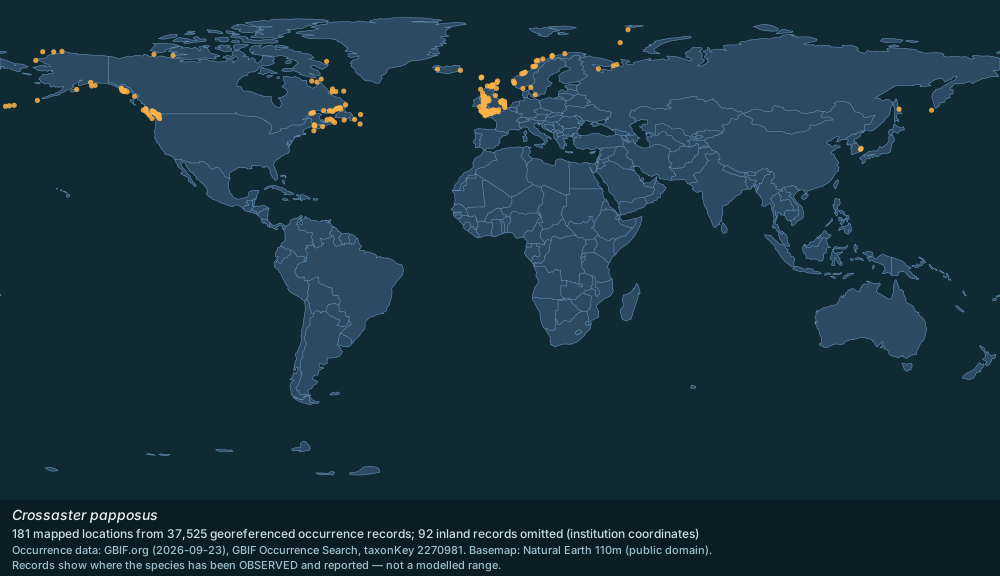
Distribution map plotted from GBIF.org occurrence records; basemap Natural Earth 110m · GBIF records CC0 / CC BY; Natural Earth public domain
The common sunstar (Crossaster papposus) is a species of sea star (aka starfish) belonging to the family Solasteridae. It is found in the northern parts of both the Atlantic and the Pacific Oceans.
- Scientific name
- Crossaster papposus
- Authority
- (Linnaeus, 1767)
- Family
- Solasteridae
- Order
- Valvatida
- Maximum length
- 30 cm
- Depth range
- 0–1200 m
- Habitat zone
- benthic
- Gbif occurrence records
- 37,525
Classification (WoRMS)
Full classification as recorded by WoRMS: Kingdom: Animalia · Phylum: Echinodermata · Class: Asteroidea · Order: Valvatida · Family: Solasteridae · Genus: Crossaster.
Accepted name: Crossaster papposus · Authority: (Linnaeus, 1767) · Taxonomic status: accepted · AphiaID: 124154.
Synonyms and superseded combinations recorded for this taxon: Asterias affinis Brandt, 1835; Asterias helianthemoides Pennant, 1777; Asterias papposus Linnaeus, 1767; Crossaster aboverrucosus (Brandt, 1835); Crossaster affinis (Brandt, 1835); Crossaster koreni Verrill, 1914; Crossaster neptuni Bell, 1881; Solaster affinis (Brandt, 1835); Solaster papposus (Linnaeus, 1767); Stellonia papposa (Linnaeus, 1767).
Source: World Register of Marine Species (WoRMS) — https://www.marinespecies.org/aphia.php?p=taxdetails&id=124154 (CC BY 4.0). Accessed 2026-09-23.
Biology and life history (SeaLifeBase)
Measured values published by SeaLifeBase for Crossaster papposus. Only fields the database actually holds for this species are shown; these are database values, not aquarium guidance.
Maximum length: 30 cm · Depth range: 0–1200 m · Habitat zone: benthic · Vulnerability index: 43.8 of 100.
SeaLifeBase notes: Minimum depth from Ref. 865.
Source: SeaLifeBase species summary (SpecCode 48745) — https://www.sealifebase.se/summary/Crossaster-papposus.html (CC BY-NC 3.0 — non-commercial use only). Accessed 2026-09-23.
Distribution and occurrence records (GBIF)
37,525 georeferenced occurrence records for Crossaster papposus are published through GBIF from 28 countries or marine areas. The map above plots 181 distinct locations from a sample of 3,000 records, omitting 92 inland records that carry an institution's coordinates rather than a collection site; it shows where the species has been observed and reported, not a modelled range.
Most records by country or area: Canada (20,591); United Kingdom of Great Britain and Northern Ireland (13,076); United States of America (965); Sweden (571); Isle of Man (516).
The full country table, WoRMS marine regions and the sampling notes are on this species' Distribution page.
Source: GBIF Occurrence Search (taxonKey 2270981) — https://www.gbif.org/occurrence/search?taxon_key=2270981&has_coordinate=true (records CC0 / CC BY); WoRMS distribution records (MarineRegions) — https://www.marinespecies.org/aphia.php?p=taxdetails&id=124154 (CC BY 4.0); Natural Earth 110m basemap — https://www.naturalearthdata.com/ (public domain). Accessed 2026-09-23.
Description and natural history (Wikipedia)
The common sunstar is distributed from the Arctic down to the English Channel, in the North Sea, also on both East (from the Arctic to the Gulf of Maine) and Pacific coasts (from Alaska to Puget Sound) of North America. It is also circumboreal, found in Greenland, Iceland, the Barents Sea, Kola Bay, Okhotsk Sea and the White Sea.
The common sunstar is commonly found on rocky bottoms, coarse sand and gravel in the bathyal, infralittoral and circalittoral zone (from low-tide line up to depths of 300 m). It seems to prefer areas of high water movement. Very small sunstars are sometimes found in rock pools.
It is reddish on top with concentric bands of white, pink, yellow, or dark red, and it is white on the underside. It is covered on top with brushlike spines, with the marginal spines somewhat larger. The thick, central disc is fairly large. This central disc has a netlike pattern of raised ridges. The mouth area is bare. It has relatively short arms which usually number eight to fourteen. Its radius can be up to 15 cm (6 inches). The madreporite plate stands out clearly.
The common sunstar is an omnivore. It will eat almost anything, including smaller starfish and sunstars, swallowing them whole. It is also a scavenger.
Source: Wikipedia: Common sunstar — https://en.wikipedia.org/wiki/Common_sunstar (CC BY-SA 4.0). Accessed 2026-09-23.
Gallery
Related in Rose seastar
Links follow this subject's own source article.
Elsewhere in Rose seastar
Spotted an error? Know more?
Reader corrections go straight into our review queue. Suggest an edit · How this site is sourced