
Velvet horn (Codium tomentosum)
Source-cited species reference: taxonomy from WoRMS, biology from SeaLifeBase, occurrence map from GBIF, description from Wikipedia.
Codium tomentosum is a species of green seaweed in the family Codiaceae. Its common names include velvet horn and spongeweed.
- Scientific name
- Codium tomentosum
- Authority
- Stackhouse, 1797
- Family
- Codiaceae
- Order
- Bryopsidales
- Habitat zone
- benthic
- Gbif occurrence records
- 1,426
Classification (WoRMS)
Full classification as recorded by WoRMS: Kingdom: Plantae · Phylum: Chlorophyta · Class: Ulvophyceae · Order: Bryopsidales · Family: Codiaceae · Genus: Codium.
Accepted name: Codium tomentosum · Authority: Stackhouse, 1797 · Taxonomic status: accepted · AphiaID: 145092.
Synonyms and superseded combinations recorded for this taxon: Agardhia dichotoma Ant.Cabrera, 1823; Codium dichotomum S.F.Gray, 1821; Codium dichotomum var. ß marginiferum S.F.Gray; Fucus tomentosus Hudson, 1778; Fucus tomentosus var. marginifer Turner, 1811; Spongia dichotoma Hudson, 1762.
Source: World Register of Marine Species (WoRMS) — https://www.marinespecies.org/aphia.php?p=taxdetails&id=145092 (CC BY 4.0). Accessed 2026-09-23.
Biology and life history (SeaLifeBase)
Measured values published by SeaLifeBase for Codium tomentosum. Only fields the database actually holds for this species are shown; these are database values, not aquarium guidance.
Habitat zone: benthic.
Source: SeaLifeBase species summary (SpecCode 112135) — https://www.sealifebase.se/summary/Codium-tomentosum.html (CC BY-NC 3.0 — non-commercial use only). Accessed 2026-09-23.
Distribution and occurrence records (GBIF)
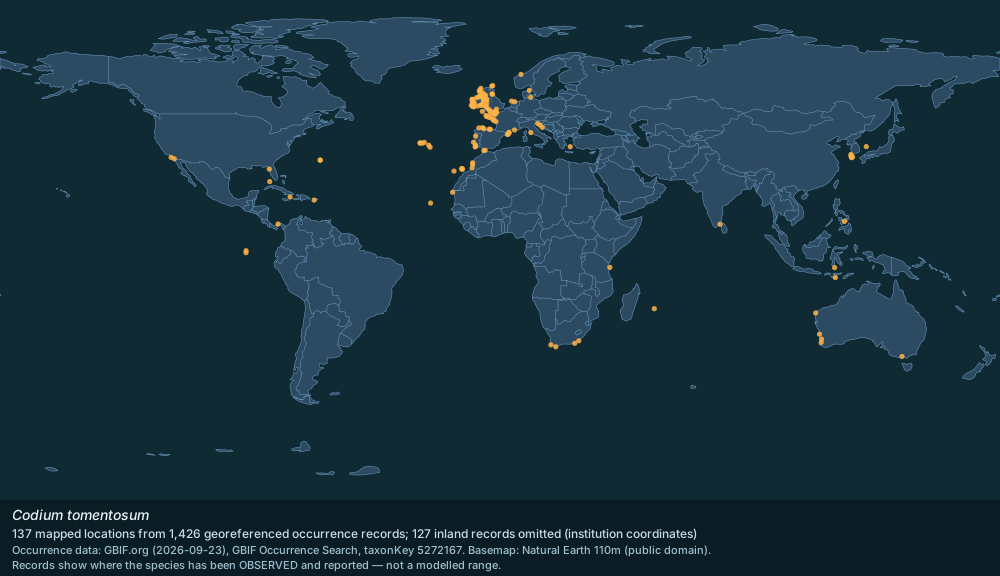
1,426 georeferenced occurrence records for Codium tomentosum are published through GBIF from 39 countries or marine areas. The map above plots 137 distinct locations from a sample of 1,426 records, omitting 127 inland records that carry an institution's coordinates rather than a collection site; it shows where the species has been observed and reported, not a modelled range.
Most records by country or area: Portugal (462); France (232); United Kingdom of Great Britain and Northern Ireland (195); Spain (135); Ireland (112).
The full country table, WoRMS marine regions and the sampling notes are on this species' Distribution page.
Source: GBIF Occurrence Search (taxonKey 5272167) — https://www.gbif.org/occurrence/search?taxon_key=5272167&has_coordinate=true (records CC0 / CC BY); WoRMS distribution records (MarineRegions) — https://www.marinespecies.org/aphia.php?p=taxdetails&id=145092 (CC BY 4.0); Natural Earth 110m basemap — https://www.naturalearthdata.com/ (public domain). Accessed 2026-09-23.
Description and natural history (Wikipedia)
The holdfast of C. tomentosum is saucer-shaped and has closely woven strands giving it a uniform appearance. The thallus or frond has a dichotomous, much branched structure with thin branches, each with a circular cross section. It grows to 30 cm (12 in) in length and is spongy, with the texture of felt. It is covered with colourless hairs which are visible when it is submerged. The cortex is composed of club-shaped vesicles forming a palisade-like layer.
C. tomentosum is native to the north east Atlantic Ocean from the Ireland southwards to the Azores and Cape Verde. It has also been recorded around the coasts of Africa and in various other parts of the world. The type locality is England. It is found on exposed rocks in deep rock pools on the lower shore.
The related taxon, C. fragile subsp. tomentosoides, has been spreading to various parts of the world, and a study was undertaken in 2003 in Guernsey to see whether it was displacing or even eliminating C. tomentosum from the island. It was found that, on the contrary, the native species was still thriving on the lower shore and that C. fragile subsp. tomentosoides was restricted to rock pools in the upper mid-littoral region.
A similar study undertaken in 2000 on exposed shores in western Ireland showed that, as compared to thirty years earlier, C. fragile subsp. tomentosoides had decreased while C. fragile subsp. atlanticum had increased. The native C. tomentosum had maintained its population size and not been displaced.
The sea slug Elysia viridis (the "sap-sucking slug") feeds on C. tomentosum and C. fragile and has a symbiotic relationship with them. When the fluids from the algae are ingested, the chloroplasts remain intact and photosynthetically active in the digestive diverticula of the slug for some days. They continue to synthesize sugars which the slug then metabolises. The activity of the chloroplasts degenerates over time and they need to be constantly replaced by further consumption of Codium spp.
A lectin named tomentine has been isolated by affinity chromatography from C. tomentosum. It shows N-acetylglucosamine-specific activity and has been found to be rich in glycine, threonine and valine.
Source: Wikipedia: Codium tomentosum — https://en.wikipedia.org/wiki/Codium_tomentosum (CC BY-SA 4.0). Accessed 2026-09-23.
Gallery
Related in Velvet horn
Links follow this subject's own source article.
Elsewhere in Velvet horn
Spotted an error? Know more?
Reader corrections go straight into our review queue. Suggest an edit · How this site is sourced