
Codium spongiosum
Source-cited species reference: taxonomy from WoRMS, biology from SeaLifeBase, occurrence map from GBIF, description from Wikipedia.
Codium spongiosum is a species of seaweed in the family Codiaceae.
- Scientific name
- Codium spongiosum
- Authority
- Harvey, 1855
- Family
- Codiaceae
- Order
- Bryopsidales
- Habitat zone
- sessile
- Gbif occurrence records
- 780
Classification (WoRMS)
Full classification as recorded by WoRMS: Kingdom: Plantae · Phylum: Chlorophyta · Class: Ulvophyceae · Order: Bryopsidales · Family: Codiaceae · Genus: Codium.
Accepted name: Codium spongiosum · Authority: Harvey, 1855 · Taxonomic status: accepted · AphiaID: 211729.
Synonyms and superseded combinations recorded for this taxon: Codium mauritianum (Børgesen) Børgesen, 1946; Codium pugniforme Okamura, 1915; Codium pungiforme Okamura, 1915; Codium spongiosum var. mauritianum Børgesen, 1940.
Source: World Register of Marine Species (WoRMS) — https://www.marinespecies.org/aphia.php?p=taxdetails&id=211729 (CC BY 4.0). Accessed 2026-09-23.
Biology and life history (SeaLifeBase)
Measured values published by SeaLifeBase for Codium spongiosum. Only fields the database actually holds for this species are shown; these are database values, not aquarium guidance.
Habitat zone: sessile.
SeaLifeBase notes: Found on rocky substrates in shallow subtidal areas (Ref. 106682).
Source: SeaLifeBase species summary (SpecCode 113384) — https://www.sealifebase.se/summary/Codium-spongiosum.html (CC BY-NC 3.0 — non-commercial use only). Accessed 2026-09-23.
Distribution and occurrence records (GBIF)
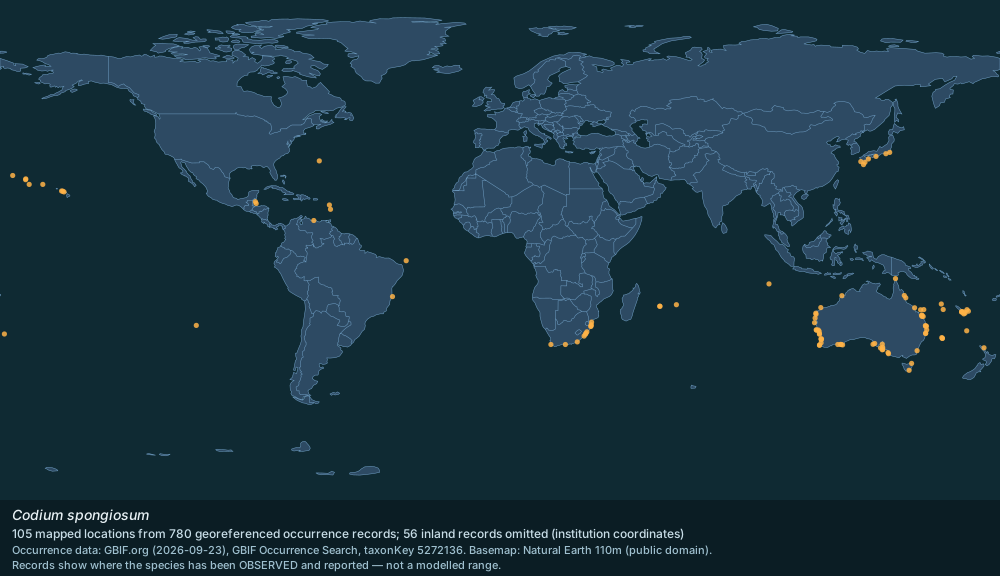
780 georeferenced occurrence records for Codium spongiosum are published through GBIF from 18 countries or marine areas. The map above plots 105 distinct locations from a sample of 780 records, omitting 56 inland records that carry an institution's coordinates rather than a collection site; it shows where the species has been observed and reported, not a modelled range.
Most records by country or area: Australia (593); South Africa (36); New Caledonia (30); Brazil (29); United States of America (21); Japan (19); New Zealand (9); United Kingdom of Great Britain and Northern Ireland (8); Chile (7); Mauritius (7); Bermuda (4); Mozambique (4); Martinique (3); Norfolk Island (3); Belize (2).
Marine regions with a valid WoRMS distribution record: Mauritian Exclusive Economic Zone; Mozambican Exclusive Economic Zone; South Africa (country).
Source: GBIF Occurrence Search (taxonKey 5272136) — https://www.gbif.org/occurrence/search?taxon_key=5272136&has_coordinate=true (records CC0 / CC BY); WoRMS distribution records (MarineRegions) — https://www.marinespecies.org/aphia.php?p=taxdetails&id=211729 (CC BY 4.0); Natural Earth 110m basemap — https://www.naturalearthdata.com/ (public domain). Accessed 2026-09-23.
Description and natural history (Wikipedia)
The light-green thallus has an applanate-to-pulvinate habit and is usually around 10 to 25 cm across and 20 mm thick. It has irregular lobes and moderately firm while alive, becoming more spongy once dead. The utricles form in large clusters and are 2 to 6 mm long and coated in many hairs.
The species is similar to Codium lucasii, which adheres more tightly to rock surfaces.
It is epilithic in the subtidal and intertidal zones. Mostly situated in calmer waters, from the low tide mark to several metres depth. It is often found in warmer waters but has a scattered distribution in colder waters.
The species was first formally described by the botanist William Henry Harvey in 1855 in Some Accounts of the Marine Botany of the Colony of Western Australia, published in the Transactions of the Royal Irish Academy. The type specimen was collected from King George Sound along the south coast of Western Australia.
In Western Australia, it is found along the coast in the Kimberley and as far south as the Recherche Archipelago. It is also found along the South Australian coasts on the Eyre Peninsula, Yorke Peninsula, Kangaroo Island, and Fleurieu Peninsula. It is common in all tropical and subtropical waters.
Source: Wikipedia: Codium spongiosum — https://en.wikipedia.org/wiki/Codium_spongiosum (CC BY-SA 4.0). Accessed 2026-09-23.
Gallery
Spotted an error? Know more?
Reader corrections go straight into our review queue. Suggest an edit · How this site is sourced