
Sponge seaweed (Codium fragile)
Source-cited species reference: taxonomy from WoRMS, biology from SeaLifeBase, occurrence map from GBIF, description from Wikipedia.
Codium fragile, known commonly as green sea fingers, dead man's fingers, felty fingers, forked felt-alga, stag seaweed, sponge seaweed, green sponge, green fleece, sea staghorn, and oyster thief, is a species of seaweed in the family Codiaceae. It originates in the Pacific Ocean near Japan and has become an invasive species on the coasts of the Northern Atlantic Ocean.
- Scientific name
- Codium fragile
- Authority
- (Suringar) Hariot, 1889
- Family
- Codiaceae
- Order
- Bryopsidales
- Habitat zone
- sessile
- Gbif occurrence records
- 20,326
Classification (WoRMS)
Full classification as recorded by WoRMS: Kingdom: Plantae · Phylum: Chlorophyta · Class: Ulvophyceae · Order: Bryopsidales · Family: Codiaceae · Genus: Codium.
Accepted name: Codium fragile · Authority: (Suringar) Hariot, 1889 · Taxonomic status: accepted · AphiaID: 145086.
Synonyms and superseded combinations recorded for this taxon: Acanthocodium fragile Suringar, 1867; Codium fragile var. typicum Schmidt, 1923.
Source: World Register of Marine Species (WoRMS) — https://www.marinespecies.org/aphia.php?p=taxdetails&id=145086 (CC BY 4.0). Accessed 2026-09-23.
Biology and life history (SeaLifeBase)
Measured values published by SeaLifeBase for Codium fragile. Only fields the database actually holds for this species are shown; these are database values, not aquarium guidance.
Habitat zone: sessile.
Source: SeaLifeBase species summary (SpecCode 125251) — https://www.sealifebase.se/summary/Codium-fragile.html (CC BY-NC 3.0 — non-commercial use only). Accessed 2026-09-23.
Distribution and occurrence records (GBIF)
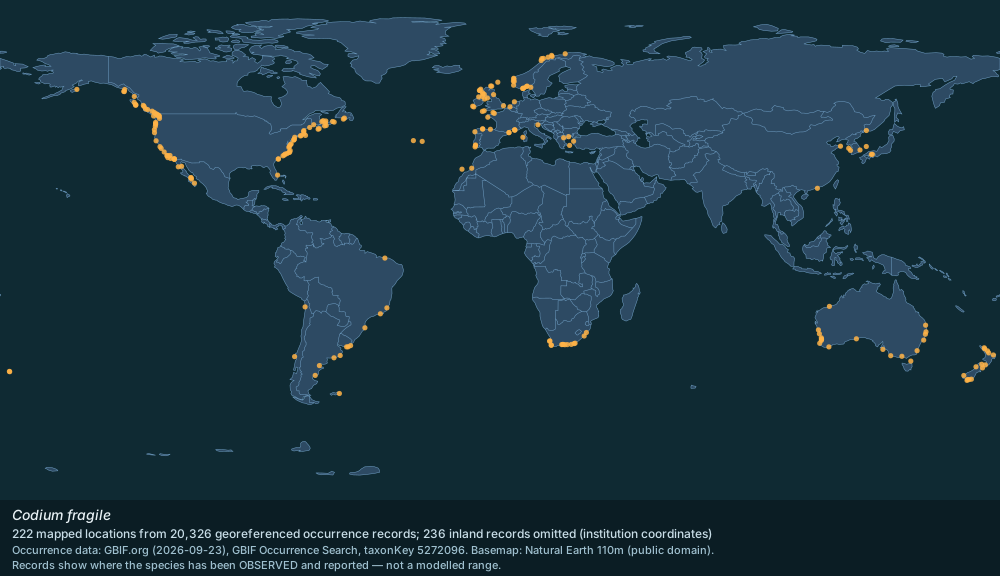
20,326 georeferenced occurrence records for Codium fragile are published through GBIF from 55 countries or marine areas. The map above plots 222 distinct locations from a sample of 3,000 records, omitting 236 inland records that carry an institution's coordinates rather than a collection site; it shows where the species has been observed and reported, not a modelled range.
Most records by country or area: United States of America (5,594); Chile (2,645); Canada (1,990); Korea, Republic of (1,279); Australia (1,151).
The full country table, WoRMS marine regions and the sampling notes are on this species' Distribution page.
Source: GBIF Occurrence Search (taxonKey 5272096) — https://www.gbif.org/occurrence/search?taxon_key=5272096&has_coordinate=true (records CC0 / CC BY); WoRMS distribution records (MarineRegions) — https://www.marinespecies.org/aphia.php?p=taxdetails&id=145086 (CC BY 4.0); Natural Earth 110m basemap — https://www.naturalearthdata.com/ (public domain). Accessed 2026-09-23.
Description and natural history (Wikipedia)
This siphonous green alga is of two subspecies in Ireland and Great Britain. They are similar, both are dark green in color. It forms long erect finger-like fronds. These grow to 40 cm or more long branching dichotomously. The cortex of the branches is formed by closely packed utricles, these are small cylindrical club-shaped structures formed from a single cell up to 1200 μm (micrometres) long. The rounded tips of these closely packed utricles give the frond a velvety texture. The fronds hang down from rocks during low tide, hence the nickname "dead man's fingers". The "fingers" are branches up to a centimeter wide and sometimes over 30 centimeters long.
Codium fragile occurs in the low intertidal zone, and subtidal on high-energy beaches.
It has no gametophyte stage, and male and female gametes are both produced on separate plants.
Subspecies of C. fragile can only be distinguished microscopically.
This subspecies can be distinguished by the mucron or tip of the utricles. In this subspecies the mucron is short, no more than 20 μm long.
The first European record of Codium fragile subsp. atlanticum is known to have arrived in the southwest of Ireland around 1808. From there it may have spread by rafting or floating in the sea. Approximately 30 years later, it was found in Scotland. It is thought to have originally come from the Pacific Ocean near Japan.
Since 1840, when it was first discovered in Scotland, it has spread the entire length of Britain, including Shetland. Between 1949 and 1955 it is known to have spread between Berwick-upon-Tweed and St. Andrews, Fife, a distance of 80 km. Populations of this algae occur mostly in northern Britain. Elsewhere in Europe it is found in several places, including Norway, Netherlands, France, Spain and the Azores.
This species displaces the native Codium tomentosum.
Codium fragile subsp. atlanticum is used as food in the Far East.
This subspecies is distinguished from C.fragile subsp. atlanticum by its very pointed mucron (the tip of the utricle) – up to μm 68 long.
The subspecies Codium fragile subsp. tomentosoides (syn. Codium mucronatum var. tomentosoides), occurs along nearly the whole coastline of the eastern United States, from the Gulf of St. Lawrence in Canada to North Carolina. It is a rapidly spreading invasive species. It originated in the Pacific Ocean around Japan, and was introduced into New York from Europe in 1957. Its presence was first recorded in 1964 in the Gulf of Maine at Boothbay. It is now recorded around Ireland. It has also been recorded from the Scilly Isles, the Channel Islands, and the south and west coasts of England and Scotland.
This is a dominant subspecies in the subtidal zone, attaching to almost any hard surface. This results in increased maintenance labor for aquaculturists and reduces the productivity of cultured marine life. In established shellfish beds, this species can become a nuisance; it may attach to shellfish and then float away, carrying the animals with it. This was the inspiration for the common name "oyster thief".
This subspecies was introduced from Asiatic coasts of the Pacific to Norway, and to Denmark in 1919.
Source: Wikipedia: Codium fragile — https://en.wikipedia.org/wiki/Codium_fragile (CC BY-SA 4.0). Accessed 2026-09-23.
Gallery
Related in Sponge seaweed
Links follow this subject's own source article.
Elsewhere in Sponge seaweed
Spotted an error? Know more?
Reader corrections go straight into our review queue. Suggest an edit · How this site is sourced