
Clelandella miliaris
Source-cited species reference: taxonomy from WoRMS, biology from SeaLifeBase, occurrence map from GBIF, description from Wikipedia.

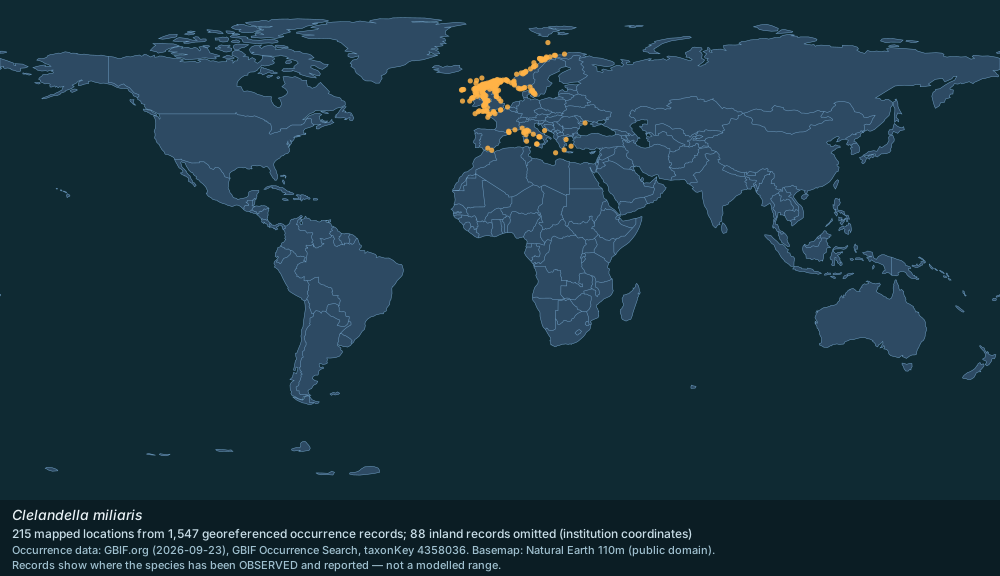
Distribution map plotted from GBIF.org occurrence records; basemap Natural Earth 110m · GBIF records CC0 / CC BY; Natural Earth public domain
Clelandella miliaris is a species of sea snail, a marine gastropod mollusk in the family Trochidae, the top snails.
- Scientific name
- Clelandella miliaris
- Authority
- (Brocchi, 1814)
- Family
- Trochidae
- Order
- Trochida
- Habitat zone
- benthic
- Gbif occurrence records
- 1,547
Classification (WoRMS)
Full classification as recorded by WoRMS: Kingdom: Animalia · Phylum: Mollusca · Class: Gastropoda · Order: Trochida · Family: Trochidae · Genus: Clelandella.
Accepted name: Clelandella miliaris · Authority: (Brocchi, 1814) · Taxonomic status: accepted · AphiaID: 141774.
Synonyms and superseded combinations recorded for this taxon: Calliostoma (Ampullotrochus) miliaris (Brocchi, 1814); Calliostoma miliaris (Brocchi, 1814); Clelandella clelandi (W. Wood, 1828); Jujubinus aureus Monterosato, 1890; Jujubinus clelandi (W. Wood, 1828); Jujubinus miliaris (Brocchi, 1814); Trochus clelandi W. Wood, 1828; Trochus martini T. Brown, 1839; Trochus miliaris Brocchi, 1814; Trochus millegranus R. A. Philippi, 1836; Trochus millegranus var. pyramidata Jeffreys, 1865.
Source: World Register of Marine Species (WoRMS) — https://www.marinespecies.org/aphia.php?p=taxdetails&id=141774 (CC BY 4.0). Accessed 2026-09-23.
Biology and life history (SeaLifeBase)
Measured values published by SeaLifeBase for Clelandella miliaris. Only fields the database actually holds for this species are shown; these are database values, not aquarium guidance.
Habitat zone: benthic.
Source: SeaLifeBase species summary (SpecCode 1295) — https://www.sealifebase.se/summary/Clelandella-miliaris.html (CC BY-NC 3.0 — non-commercial use only). Accessed 2026-09-23.
Distribution and occurrence records (GBIF)
1,547 georeferenced occurrence records for Clelandella miliaris are published through GBIF from 20 countries or marine areas. The map above plots 215 distinct locations from a sample of 1,547 records, omitting 88 inland records that carry an institution's coordinates rather than a collection site; it shows where the species has been observed and reported, not a modelled range.
Most records by country or area: United Kingdom of Great Britain and Northern Ireland (650); Norway (511); Sweden (214); France (77); Italy (34).
The full country table, WoRMS marine regions and the sampling notes are on this species' Distribution page.
Source: GBIF Occurrence Search (taxonKey 4358036) — https://www.gbif.org/occurrence/search?taxon_key=4358036&has_coordinate=true (records CC0 / CC BY); WoRMS distribution records (MarineRegions) — https://www.marinespecies.org/aphia.php?p=taxdetails&id=141774 (CC BY 4.0); Natural Earth 110m basemap — https://www.naturalearthdata.com/ (public domain). Accessed 2026-09-23.
Description and natural history (Wikipedia)
The size of the shell varies between 7 mm and 18 mm. The imperforate, rather thin, but pretty solid shell has a strictly conical shape. It is whitish or yellowish, with more or less obvious longitudinal flames, often reduced to a few spots on the ribs and a row of spots at the periphery of each whorl. The surface is densely finely sculptured by spiral lirae crossed by very regular oblique lamellae, producing a clathrate pattern. The spiral lirae number about 6 on each whorl, but often double as many, by the intercalation of riblets in the interstices. The periphery has a prominent keel, cord-like, with secondary spiral striae, or bifid, cut into compressed granules, somewhat prominent above the sutures. The base has about 8 concentric ribs. The interstices are radiately striate, sometimes with a central riblet. The spire has a conical shape with about 7 whorls. The periphery is acutely angled. The base of the shell is flat. The aperture is quadrangular. The short columella is nearly straight.
This marine species has a wide distribution. It occurs off Lofoten Islands, the North Sea (Norway to Gibraltar), off Cape Verde Islands, West Sahara and Mauritania; in the Mediterranean Sea and the Adriatic Sea. In the Baltic Sea it has become a vulnerable species.
Source: Wikipedia: Clelandella miliaris — https://en.wikipedia.org/wiki/Clelandella_miliaris (CC BY-SA 4.0). Accessed 2026-09-23.
Gallery
Related in Clelandella miliaris
Links follow this subject's own source article.
Elsewhere in Clelandella miliaris
Spotted an error? Know more?
Reader corrections go straight into our review queue. Suggest an edit · How this site is sourced