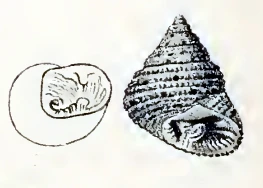
Beautiful Clanculus (Clanculus margaritarius)
Source-cited species reference: taxonomy from WoRMS, biology from SeaLifeBase, occurrence map from GBIF, description from Wikipedia.

Clanculus margaritarius, common name the beautiful clanculus, is a species of sea snail, a marine gastropod mollusk in the family Trochidae, the top snails.
- Scientific name
- Clanculus margaritarius
- Authority
- (R. A. Philippi, 1846)
- Family
- Trochidae
- Order
- Trochida
- Habitat zone
- benthic
- Gbif occurrence records
- 243
Classification (WoRMS)
Full classification as recorded by WoRMS: Kingdom: Animalia · Phylum: Mollusca · Class: Gastropoda · Order: Trochida · Family: Trochidae · Genus: Clanculus.
Accepted name: Clanculus margaritarius · Authority: (R. A. Philippi, 1846) · Taxonomic status: accepted · AphiaID: 211262.
Synonyms and superseded combinations recorded for this taxon: Clanculus margaritarius margaritarius (R. A. Philippi, 1846); Clanculus unedo A. Adams, 1853; Monodonta margaritaria R. A. Philippi, 1846; Trochus (Clanculus) gordonis Yokoyama, 1924; Trochus margaritarius (R. A. Philippi, 1846).
Source: World Register of Marine Species (WoRMS) — https://www.marinespecies.org/aphia.php?p=taxdetails&id=211262 (CC BY 4.0). Accessed 2026-09-23.
Biology and life history (SeaLifeBase)
Measured values published by SeaLifeBase for Clanculus margaritarius. Only fields the database actually holds for this species are shown; these are database values, not aquarium guidance.
Habitat zone: benthic.
SeaLifeBase notes: Found in subtidal to 20 m (Ref. 75835), under rocks (Ref. 799).
Source: SeaLifeBase species summary (SpecCode 105278) — https://www.sealifebase.se/summary/Clanculus-margaritarius.html (CC BY-NC 3.0 — non-commercial use only). Accessed 2026-09-23.
Distribution and occurrence records (GBIF)
243 georeferenced occurrence records for Clanculus margaritarius are published through GBIF from 23 countries or marine areas. The map above plots 82 distinct locations from a sample of 243 records, omitting 29 inland records that carry an institution's coordinates rather than a collection site; it shows where the species has been observed and reported, not a modelled range.
Most records by country or area: Japan (78); Australia (57); Korea, Republic of (16); Philippines (13); Fiji (12); Papua New Guinea (10); Marshall Islands (8); New Caledonia (7); Singapore (7); Chinese Taipei (7); Hong Kong (5); China (4); Indonesia (3); Solomon Islands (3); Timor-Leste (3).
Marine regions with a valid WoRMS distribution record: Fiji Islands; Japanese Exclusive Economic Zone; Philippine Exclusive Economic Zone; Gulf of Mannar.
Source: GBIF Occurrence Search (taxonKey 4358084) — https://www.gbif.org/occurrence/search?taxon_key=4358084&has_coordinate=true (records CC0 / CC BY); WoRMS distribution records (MarineRegions) — https://www.marinespecies.org/aphia.php?p=taxdetails&id=211262 (CC BY 4.0); Natural Earth 110m basemap — https://www.naturalearthdata.com/ (public domain). Accessed 2026-09-23.
Description and natural history (Wikipedia)
Clanculus margaritarius multipunctatus Jansen, 1995: synonym of Clanculus multipunctatus Jansen, 1995
The size of the shell varies between 9 mm and 20 mm. The very solid shell has an elate-conic shape. It is narrowly false-umbilicate, red or reddish brown, dotted with black; rosy at the apex. The outlines of the spire are a little concave toward the apex. The spire contains about 7 whorls. These are nearly flat above, with linear, impressed sutures. The body whorl descends anteriorly and is encircled by about 13 or 14 granose lirae every second one, or on some specimens every one articulated with black dots. The interstices are finely spirally and obliquely striate. The base of the shell is convex. The aperture is tetragonal. The outer lip bears within a strong tubercle above, and a few plicae on the outer and lower part. The short columella is oblique, with a very slight fold above, very deeply entering the profound, extremely narrow axial pit, and at the base terminating in a large squarish trifid tooth. The parietal tract is finely wrinkled. The umbilicus is bounded by a plicate rib.
The phylum Mollusca is a highly diverse and rich species, with an abundant amount of color variations that is beneficial to learn from. From this family of Mollusca, studies are done to try to have a better understanding of pigmentation evolution, which can answer some bigger questions about color evolutions in the natural world.
Coloring in shells can result from a multitude of factors, such as behavioral characteristics and the environment mollusks live in. Coloring in their shells can be associated with mating displays, diet, heritable traits and defense mechanisms. The coloring in Clanculus margaritarius is normally reddish brown, pinkish-red and yellowish-brown with black spots. Scientist have an advantage when using the phylum Mollusca to study color variations, they are able to use the visible coloring to search for genes that are involved in color synthesis.
This marine species has a wide distribution. It occurs in the Central and East Indian Ocean, China, East India, Indo-China, Indo-Malaysia, Japan, Loyalty Islands, Malaysia, New Caledonia, New Zealand, Oceania, Papua New Guinea, Solomon Islands, Taiwan and Queensland, and Australia.
Source: Wikipedia: Clanculus margaritarius — https://en.wikipedia.org/wiki/Clanculus_margaritarius (CC BY-SA 4.0). Accessed 2026-09-23.
Spotted an error? Know more?
Reader corrections go straight into our review queue. Suggest an edit · How this site is sourced