Clanculus euchelioides
Source-cited species reference: taxonomy from WoRMS, biology from SeaLifeBase, occurrence map from GBIF, description from Wikipedia.
Last updated

R. Tate · via Wikipedia: Clanculus euchelioides · Public domain
Clanculus euchelioides, common name the small top shell, is a species of sea snail, a marine gastropod mollusk in the family Trochidae, the top snails.
Scientific classification
- KingdomAnimalia
- PhylumMollusca
- ClassGastropoda
- SubclassVetigastropoda
- OrderTrochida
- FamilyTrochidae
- GenusClanculus
- SpeciesClanculus euchelioides
Named by Tate, 1893
Close relatives
Other species of Clanculus with a Codexery entry.
- Clanculus albanyensis Clanculus albanyensis
- Clanculus albugo Clanculus albugo
- Clanculus aloysii
- Clanculus atypicus
- Clanculus berthelotii
- Clanculus bronni
- Clanculus brunneus
- Clanculus clanguloides
Sources: Wikipedia taxobox: Clanculus euchelioides (CC BY-SA 4.0) · order, family and genus agree with WoRMS AphiaID 594194 (CC BY 4.0)
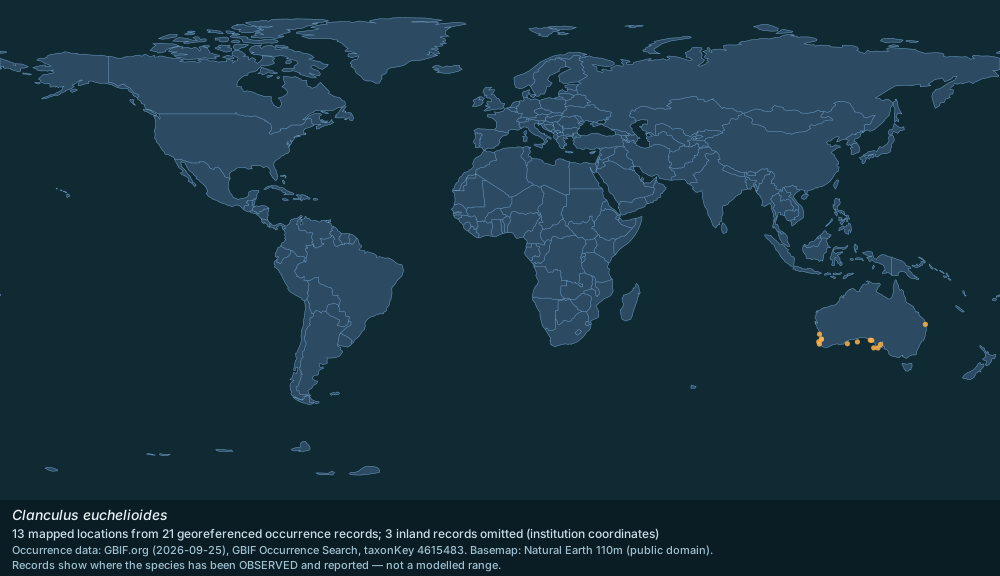
Where the clanculus euchelioides has been recorded
Each dot is a place where the species has been observed and reported (21 records, half-degree grid) — not a modelled range. 3 inland records left out (institution coordinates).
Map: drawn by Codexery. Data: GBIF occurrence search (records CC0 / CC BY) · Natural Earth basemap (public domain) · place coordinates: Wikipedia (CC BY-SA 4.0)
Quick Facts
- Authority
- Tate, 1893
- Family
- Trochidae
- Order
- Trochida
- Habitat zone
- benthic
- Gbif occurrence records
- 21
Facts from the source article.
Classification (WoRMS)
Full classification as recorded by WoRMS: Kingdom: Animalia · Phylum: Mollusca · Class: Gastropoda · Order: Trochida · Family: Trochidae · Genus: Clanculus.
Accepted name: Clanculus euchelioides · Authority: Tate, 1893 · Taxonomic status: accepted · AphiaID: 594194.
Synonyms and superseded combinations recorded for this taxon: Clanculus gatliffi Tomlin, 1924; Microclanculus euchelioides (Tate, 1893); Microclanculus gatliffi (Tomlin, 1924).
Source: World Register of Marine Species (WoRMS) — https://www.marinespecies.org/aphia.php?p=taxdetails&id=594194 (CC BY 4.0). Accessed 2026-09-25.
Biology and life history (SeaLifeBase)
Measured values published by SeaLifeBase for Clanculus euchelioides. Only fields the database actually holds for this species are shown; these are database values, not aquarium guidance.
Habitat zone: benthic · Aquarium trade: never/rarely.
Source: SeaLifeBase species summary (SpecCode 168020) — https://www.sealifebase.se/summary/Clanculus-euchelioides.html (CC BY-NC 3.0 — non-commercial use only). Accessed 2026-09-25.
Distribution and occurrence records (GBIF)
21 georeferenced occurrence records for Clanculus euchelioides are published through GBIF from 1 countries or marine areas. The map above plots 13 distinct locations from a sample of 21 records, omitting 3 inland records that carry an institution's coordinates rather than a collection site; it shows where the species has been observed and reported, not a modelled range.
Most records by country or area: Australia (21).
Source: GBIF Occurrence Search (taxonKey 4615483) — https://www.gbif.org/occurrence/search?taxon_key=4615483&has_coordinate=true (records CC0 / CC BY); WoRMS distribution records (MarineRegions) — https://www.marinespecies.org/aphia.php?p=taxdetails&id=594194 (CC BY 4.0); Natural Earth 110m basemap — https://www.naturalearthdata.com/ (public domain). Accessed 2026-09-25.
Description and natural history (Wikipedia)
(Original description by R. Tate) The size of the shell varies between 6 mm and 9 mm.
The somewhat solid shell has a turbinately conchoid shape. It is opaque, concolorous (reddish). It contains about six whorls. The ordinary spire whorls are separated by a canaliculate suture and are flattened posteriorly.
The body whorl is convex in the anterior-third. The base of the shell is flatly convex and falsely umbilicated. The columella enters the umbilical depression, which is shallow and moderately narrow. The aperture is oblique and rhomboidoval.
The outer lip is slightly depressed at the suture. The outer and basal margins are thin, lirate, and iridescent within (the lirae not extending to the margin). The oblique columella is straight, rib-like, with an attenuated keel elevated into a tooth-like prominence at the base, and separated from the basal margin of the aperture by a deep gemmulated ribs of about equal magnitude. At the suture there is a double smaller rib, and there is a finer one posterior to the periphery.
closer together. And thus the fenestrated ornament is somewhat obscured on the front part of the body whorl. Below the periphery there are about five revolving equal-sized ribs, more or less gemmulated at the intersections of transverse sigmoidal threads, the one margining the umbilicus most conspicuously so. The umbilical wall has about five flat threads crossed by lamella-like striae.
The conspicuous oblique ribbing and very wide umbilicus are characters which separate this species from the majority of its congeners.
This marine species is endemic to Australia and occurs off Queensland, South Australia and Western Australia.
Source: Wikipedia: Clanculus euchelioides — https://en.wikipedia.org/wiki/Clanculus_euchelioides (CC BY-SA 4.0). Accessed 2026-09-25.
Sources
Compiled from Wikipedia and the sources listed below. Text from Wikipedia is available under CC BY-SA 4.0; this entry is adapted from it.
- Wikipedia: Clanculus euchelioides (CC BY-SA 4.0).
- Classification: the source article's taxobox; order, family and genus checked against WoRMS, the World Register of Marine Species (CC BY 4.0).
- Occurrence records: GBIF (CC0 / CC BY). Basemap: Natural Earth (public domain).
- Biology values: SeaLifeBase species summary (CC BY-NC 3.0, non-commercial).
- Word definitions: the , each quoted from its Wikipedia article.
Spotted an error? Know more?
Reader corrections go straight into our review queue. Suggest an edit · How this site is sourced