Clanculus cruciatus
Source-cited species reference: taxonomy from WoRMS, biology from SeaLifeBase, occurrence map from GBIF, description from Wikipedia.
Last updated

H. Zell · via Wikipedia: Clanculus cruciatus · CC BY-SA 3.0
Clanculus cruciatus is a species of sea snail, a marine gastropod mollusk in the family Trochidae, the top snails.
Scientific classification
- KingdomAnimalia
- PhylumMollusca
- ClassGastropoda
- SubclassVetigastropoda
- OrderTrochida
- FamilyTrochidae
- GenusClanculus
- SpeciesClanculus cruciatus
Named by (Linnaeus, 1758)
Close relatives
Other species of Clanculus with a Codexery entry.
- Clanculus albanyensis Clanculus albanyensis
- Clanculus albugo Clanculus albugo
- Clanculus aloysii
- Clanculus atypicus
- Clanculus berthelotii
- Clanculus bronni
- Clanculus brunneus
- Clanculus clanguloides
Sources: Wikipedia taxobox: Clanculus cruciatus (CC BY-SA 4.0) · order, family and genus agree with WoRMS AphiaID 141772 (CC BY 4.0)
Where the clanculus cruciatus has been recorded
Each dot is a place where the species has been observed and reported (786 records, half-degree grid) — not a modelled range. 104 inland records left out (institution coordinates). 1 isolated far-off record not drawn.
Map: drawn by Codexery. Data: GBIF occurrence search (records CC0 / CC BY) · Natural Earth basemap (public domain) · place coordinates: Wikipedia (CC BY-SA 4.0)
Quick Facts
- Authority
- (Linnaeus, 1758)
- Family
- Trochidae
- Order
- Trochida
- Habitat zone
- benthic
- Gbif occurrence records
- 786
Facts from the source article.
Classification (WoRMS)
Full classification as recorded by WoRMS: Kingdom: Animalia · Phylum: Mollusca · Class: Gastropoda · Order: Trochida · Family: Trochidae · Genus: Clanculus.
Accepted name: Clanculus cruciatus · Authority: (Linnaeus, 1758) · Taxonomic status: accepted · AphiaID: 141772.
Synonyms and superseded combinations recorded for this taxon: Clanculopsis cruciatus (Linnaeus, 1758); Clanculus (Clanculopsis) cruciatus (Linnaeus, 1758); Clanculus cruciatus var. candida Monterosato, 1880; Clanculus cruciatus var. monochroa Monterosato, 1880; Clanculus cruciatus var. nigrescens Bucquoy, Dautzenberg & Dollfus, 1884; Clanculus cruciatus var. rosea Monterosato, 1880; Clanculus cruciatus var. rubescens Pallary, 1900; Gibbula rupestris Risso, 1826; Monodonta vieillotii Payraudeau, 1826; Trochus cruciatus Linnaeus, 1758; Trochus mediterraneus W. Wood, 1828; Trochus purpureus Risso, 1826; Trochus vieillioti (Payraudeau, 1826); Trochus vieillioti var. globosoconica Aradas & Benoit, 1874; Turbo purpureus Risso, 1826.
Source: World Register of Marine Species (WoRMS) — https://www.marinespecies.org/aphia.php?p=taxdetails&id=141772 (CC BY 4.0). Accessed 2026-09-25.
Biology and life history (SeaLifeBase)
Measured values published by SeaLifeBase for Clanculus cruciatus. Only fields the database actually holds for this species are shown; these are database values, not aquarium guidance.
Habitat zone: benthic · Aquarium trade: never/rarely.
Source: SeaLifeBase species summary (SpecCode 139544) — https://www.sealifebase.se/summary/Clanculus-cruciatus.html (CC BY-NC 3.0 — non-commercial use only). Accessed 2026-09-25.
Distribution and occurrence records (GBIF)
786 georeferenced occurrence records for Clanculus cruciatus are published through GBIF from 22 countries or marine areas. The map above plots 101 distinct locations from a sample of 786 records, omitting 104 inland records that carry an institution's coordinates rather than a collection site; it shows where the species has been observed and reported, not a modelled range.
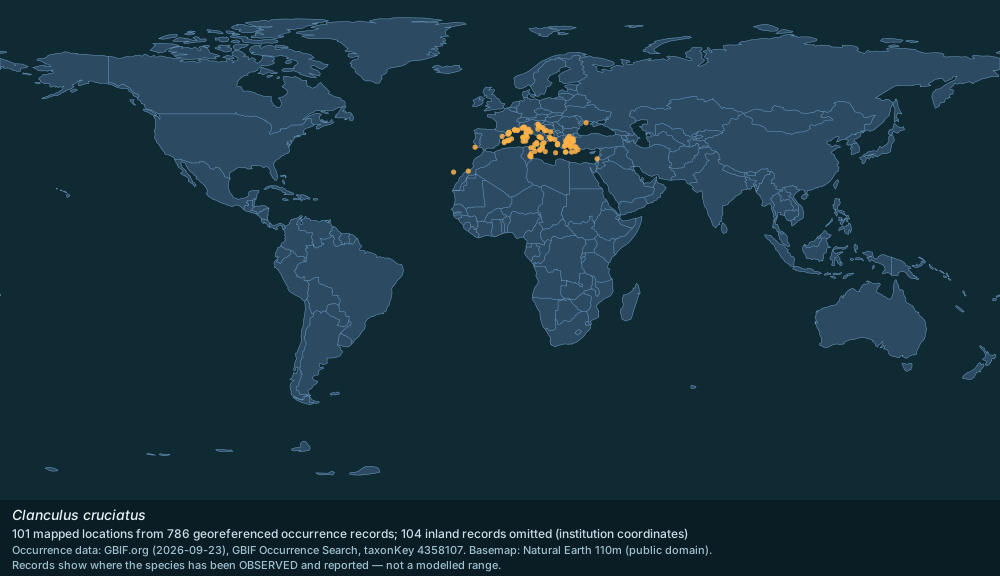
Most records by country or area: France (199); Italy (197); Spain (135); Greece (87); Croatia (36); Tunisia (30); Malta (26); Albania (25); Cyprus (7); Morocco (7); Algeria (6); Israel (6); Türkiye (6); Egypt (5); Portugal (5).
Marine regions with a valid WoRMS distribution record: European waters (ERMS scope); South West Coast of Apulia; Italy; Israeli part of the Mediterranean Sea - Eastern Basin; Spain - Demarcación Marina del Estrecho y Alborán; Spain - Demarcación Marina Levantino-Balear; Marmara Sea; Turkish part of the Aegean Sea; Turkish part of the Mediterranean Sea - Eastern Basin; Dardanelles; Tunisian part of the Mediterranean Sea - Eastern Basin; Egyptian part of the Mediterranean Sea - Eastern Basin.
Source: GBIF Occurrence Search (taxonKey 4358107) — https://www.gbif.org/occurrence/search?taxon_key=4358107&has_coordinate=true (records CC0 / CC BY); WoRMS distribution records (MarineRegions) — https://www.marinespecies.org/aphia.php?p=taxdetails&id=141772 (CC BY 4.0); Natural Earth 110m basemap — https://www.naturalearthdata.com/ (public domain). Accessed 2026-09-25.
Description and natural history (Wikipedia)
The size of the shell varies between 6 mm and 10 mm. The narrowly umbilicate shell has a globose-conic shape with a conic spire and an acute apex. It is pinkish, dark brown, blackish or pink, radiately maculated with white below the sutures, and dotted with white around the center of the base. The 5 to 6 whorls are convex and separated by canaliculate sutures, and spirally granose-lirate.
The body whorl is rounded, and encircled by about 13 lirae. Those above the periphery are granulose, about as wide as the interstices, those beneath more separated and smoother. The interstices are finely spirally striate. The base of the shell is convex.
The oblique aperture is subcircular. The outer and basal lips are rounded and finely crenulate within. The columella is slightly concave, bearing a small denticle at its base and above near the insertion. The parietal wall is nearly smooth.
The deep umbilicus is narrow, smooth, and white within. It is bordered by a strong smooth or obsoletely crenulated marginal rib, and surrounded by narrow tract of white.
This species occurs in the Mediterranean Sea.
Source: Wikipedia: Clanculus cruciatus — https://en.wikipedia.org/wiki/Clanculus_cruciatus (CC BY-SA 4.0). Accessed 2026-09-25.
Sources
Compiled from Wikipedia and the sources listed below. Text from Wikipedia is available under CC BY-SA 4.0; this entry is adapted from it.
- Wikipedia: Clanculus cruciatus (CC BY-SA 4.0).
- Classification: the source article's taxobox; order, family and genus checked against WoRMS, the World Register of Marine Species (CC BY 4.0).
- Occurrence records: GBIF (CC0 / CC BY). Basemap: Natural Earth (public domain).
- Biology values: SeaLifeBase species summary (CC BY-NC 3.0, non-commercial).
- Word definitions: the , each quoted from its Wikipedia article.
Spotted an error? Know more?
Reader corrections go straight into our review queue. Suggest an edit · How this site is sourced