Paradox top (Chrysostoma paradoxum)
Source-cited species reference: taxonomy from WoRMS, biology from SeaLifeBase, occurrence map from GBIF, description from Wikipedia.
Last updated

H. Zell · via Wikipedia: Chrysostoma paradoxum · CC BY-SA 3.0
Chrysostoma paradoxum, common name the orange-mouthed top shell, is a species of sea snail, a marine gastropod mollusk in the family Trochidae, the top snails.
Scientific classification
- KingdomAnimalia
- PhylumMollusca
- ClassGastropoda
- SubclassVetigastropoda
- OrderTrochida
- FamilyTrochidae
- GenusChrysostoma
- SpeciesChrysostoma paradoxum
Named by (Born, 1778)
Sources: Wikipedia taxobox: Chrysostoma paradoxum (CC BY-SA 4.0) · order, family and genus agree with WoRMS AphiaID 547321 (CC BY 4.0)
How big is it?
Largest length in the source, 0.03 m, next to a 1.8 m person.
Diagram: drawn by Codexery, schematic shapes to scale (not a likeness). Length: SeaLifeBase species summary
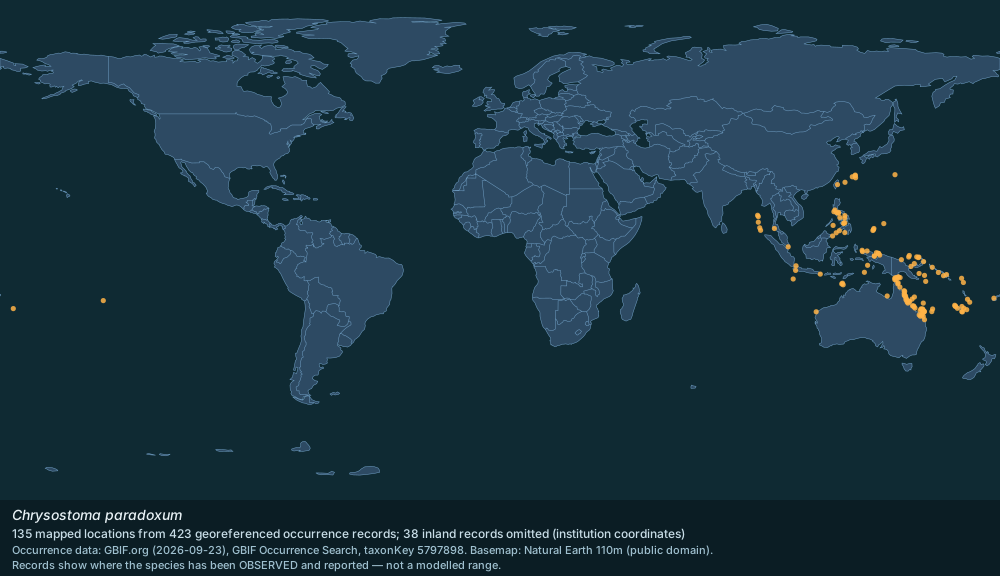
Where the paradox top (chrysostoma paradoxum) has been recorded
Each dot is a place where the species has been observed and reported (423 records, half-degree grid) — not a modelled range. 38 inland records left out (institution coordinates). 2 isolated far-off records not drawn.
Map: drawn by Codexery. Data: GBIF occurrence search (records CC0 / CC BY) · Natural Earth basemap (public domain) · place coordinates: Wikipedia (CC BY-SA 4.0)
Classification (WoRMS)
Full classification as recorded by WoRMS: Kingdom: Animalia · Phylum: Mollusca · Class: Gastropoda · Order: Trochida · Family: Trochidae · Genus: Chrysostoma.
Accepted name: Chrysostoma paradoxum · Authority: (Born, 1780) · Taxonomic status: accepted · AphiaID: 547321.
Synonyms and superseded combinations recorded for this taxon: Helix paradoxa Born, 1780; Turbo nicobaricus Gmelin, 1791.
Source: World Register of Marine Species (WoRMS) — https://www.marinespecies.org/aphia.php?p=taxdetails&id=547321 (CC BY 4.0). Accessed 2026-09-25.
Biology and life history (SeaLifeBase)
Measured values published by SeaLifeBase for Chrysostoma paradoxum. Only fields the database actually holds for this species are shown; these are database values, not aquarium guidance.
Maximum length: 2.5 cm · Habitat zone: benthic · Vulnerability index: 10 of 100.
SeaLifeBase notes: Found in intertidal on gravel (Ref. 75835). Subtidal among rocks (Ref. 799).
Source: SeaLifeBase species summary (SpecCode 103389) — https://www.sealifebase.se/summary/Chrysostoma-paradoxum.html (CC BY-NC 3.0 — non-commercial use only). Accessed 2026-09-25.
Distribution and occurrence records (GBIF)
423 georeferenced occurrence records for Chrysostoma paradoxum are published through GBIF from 20 countries or marine areas. The map above plots 135 distinct locations from a sample of 423 records, omitting 38 inland records that carry an institution's coordinates rather than a collection site; it shows where the species has been observed and reported, not a modelled range.
Most records by country or area: Australia (193); Papua New Guinea (52); New Caledonia (47); Philippines (29); Japan (25); Indonesia (18); Palau (16); Solomon Islands (11); Vanuatu (10); India (7); Micronesia (Federated States of) (5); Thailand (2); Christmas Island (1); Fiji (1); Israel (1).
Source: GBIF Occurrence Search (taxonKey 5797898) — https://www.gbif.org/occurrence/search?taxon_key=5797898&has_coordinate=true (records CC0 / CC BY); WoRMS distribution records (MarineRegions) — https://www.marinespecies.org/aphia.php?p=taxdetails&id=547321 (CC BY 4.0); Natural Earth 110m basemap — https://www.naturalearthdata.com/ (public domain). Accessed 2026-09-25.
Description and natural history (Wikipedia)
The length of the shell varies between 18 mm and 21 mm. The globular shell is imperforate or nearly so, thick and strong, with a porcelaneous texture. The surface of the shell is smooth, with scarcely visible lines of growth.
The upper whorls are microscopically, and densely, spirally striated. The color of the shell is whitish, closely reticulated and mottled all over with red or pinkish, often with a few large darker maculations above. The spire is very short. The sutures are linear. They are bordered by a slight concavity of the whorl or margination.
The six whorls are convex, the last globular. The aperture is half-moon shaped and has a reddish or golden-orange color within. The parietal wall is covered with a very thick orange-colored (rarely crimson) callus, which projects in a short tongue-shaped lobe above the slight, often closed, umbilical perforation.
This marine species occurs on corals in the intertidal zone of the East China Sea, off the Philippines, Japan, New Caledonia, Papua New Guinea and Queensland, Australia.
Source: Wikipedia: Chrysostoma paradoxum — https://en.wikipedia.org/wiki/Chrysostoma_paradoxum (CC BY-SA 4.0). Accessed 2026-09-25.
Sources
Compiled from Wikipedia and the sources listed below. Text from Wikipedia is available under CC BY-SA 4.0; this entry is adapted from it.
- Wikipedia: Chrysostoma paradoxum (CC BY-SA 4.0).
- Classification: the source article's taxobox; order, family and genus checked against WoRMS, the World Register of Marine Species (CC BY 4.0).
- Occurrence records: GBIF (CC0 / CC BY). Basemap: Natural Earth (public domain).
- Biology values: SeaLifeBase species summary (CC BY-NC 3.0, non-commercial).
- Word definitions: the , each quoted from its Wikipedia article.
Spotted an error? Know more?
Reader corrections go straight into our review queue. Suggest an edit · How this site is sourced