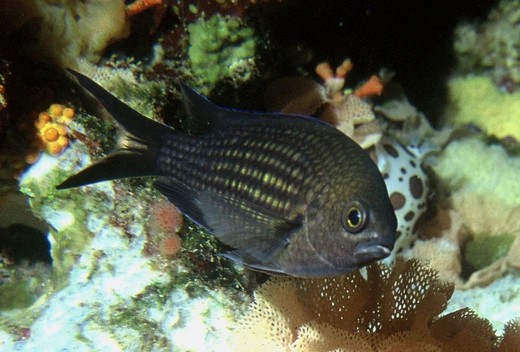
Where Azores chromis has been recorded
GBIF occurrence records for Chromis limbata, mapped and tabulated by country.

1,376 georeferenced occurrence records with coordinates are published for Chromis limbata through GBIF, from 9 countries or marine areas. This page maps those records and lists where they come from. Occurrence records reflect where people have looked as well as where the species lives, so well-surveyed coastlines are over-represented.
- Georeferenced records
- 1,376
- Countries / areas
- 9
- Mapped locations
- 47
- Records sampled for the map
- 1,376
- Inland records omitted
- 4
- Gbif taxonkey
- 9724320
Physical Form and Coloration
The Island grouper is a notably large member of the grouper family, reaching a maximum length of eighty centimetres. Adults display a dark grey to brownish body adorned with irregular pale blotches and spots, along with a striking maxillary streak. One of the species' most remarkable traits is its ability to reverse its entire body colour and pattern when under stress, a defensive adaptation that likely helps it blend into shifting reef environments. Juveniles present a very different appearance: their bodies are mottled greenish brown with prominent white spots scattered across the head and flanks, while the dorsal, anal, and caudal fins carry white streaks and the pectoral fins glow with a translucent golden hue. The body shape is oblong and laterally compressed, with a depth measuring roughly three to three-and-a-third times the standard length. The interorbital region is convex, and the preopercle bears enlarged serrations at its angle that form a rounded lobe beneath a shallow vertical indentation. In adults, the posterior nostril grows to three times the size of the anterior one, and the lower jaw projects noticeably beyond the upper. The fin counts follow the formula D XI, 14–16 and A III, 10–12.
Habitat, Hunting, and Reproduction
As a demersal species, the Island grouper spends most of its life near the ocean floor, favouring rocky substrates across a depth range of one to two hundred metres. Young fish are often spotted in shallow tidal pools, while all age groups seek out crevices, caves, and dense seaweed beds for shelter. The species is a protogynous hermaphrodite, meaning individuals are born female and later transition to male, and researchers have documented aggregations of fish coming together to spawn. In the Canary Islands, the spawning season runs from February through July. These groupers can live for thirty to forty years, giving them a long window to grow and reproduce. As active hunters, they patrol their territory in search of prey, targeting crustaceans, cephalopods, and a variety of reef fish. Their most commonly consumed species include Chromis limbata, Thalassoma pavo, Boops boops, and Similiparma lurida. Rather than ambushing from cover, the Island grouper is described as an active forager that explores its surroundings to locate and capture meals.
Geographic Range and Insularity
The Island grouper is a strictly insular species, meaning its entire natural range is confined to island groups in the eastern Atlantic Ocean. Specifically, it is endemic to the Macaronesian archipelagos, with confirmed populations in the Canary Islands, the Azores, Madeira, and Cape Verde. This restricted, island-bound distribution makes the species particularly vulnerable to localized threats, as there is no vast mainland population to serve as a buffer. The species' rarity is well documented, and it is especially scarce in regions where commercial and recreational fishing has been intense. In a notable outlier event in 2010, just two individuals were recorded in the Mediterranean Sea off the coast of Israel, a location far outside the species' typical Macaronesian range. This isolated sighting underscores how uncommon the Island grouper is, even in waters adjacent to its known habitat. The combination of a narrow geographic footprint and low population densities means that any single localized disturbance—whether from overfishing, habitat degradation, or invasive species—can have an outsized impact on the species' overall survival.
Conservation Pressures and Vulnerability
The IUCN Red List classifies the Island grouper as Vulnerable, a designation reflecting the serious pressures facing this already rare species. Multiple studies have demonstrated a clear negative correlation between grouper abundance and the intensity of local fishing activity, pointing to overexploitation as a primary driver of population decline. In heavily fished areas, the fish has become particularly scarce, suggesting that sustained harvest has significantly reduced numbers across its range. Beyond direct fishing, the species faces additional threats from invasive non-native predators and competitors. The European seabass, Dicentrarchus labrax, has escaped from aquaculture operations in the Canaries and now competes with the grouper while potentially transmitting parasites. Similarly, the African hind, Cephalopholis taeniops, is believed to have arrived in the Canaries via ships' ballast water originating from West Africa, adding another layer of competition and disease risk to an ecosystem already under strain. The convergence of these multiple, compounding threats on a species with such a limited and island-restricted range makes its long-term survival increasingly precarious without targeted conservation intervention.
Related in Azores chromis
Links follow this subject's own source article.
Elsewhere in Azores chromis
Spotted an error? Know more?
Reader corrections go straight into our review queue. Suggest an edit · How this site is sourced