
Bootlace weed (Chorda filum)
Source-cited species reference: taxonomy from WoRMS, biology from SeaLifeBase, occurrence map from GBIF, description from Wikipedia.

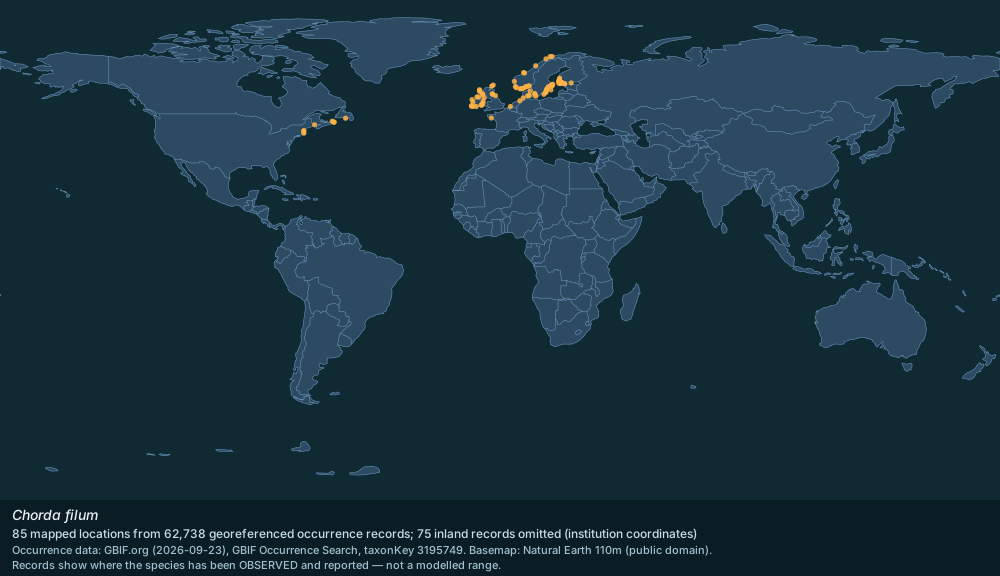
Distribution map plotted from GBIF.org occurrence records; basemap Natural Earth 110m · GBIF records CC0 / CC BY; Natural Earth public domain
Chorda filum, commonly known as dead man's rope or sea lace among other names, is a species of brown algae in the genus Chorda. It is widespread in the temperate waters of the northern hemisphere. The species has numerous other common names related to its physical appearance. These include mermaid's tresses, cat's gut or sea-catgut, bootlace weed, sea-twine, and mermaid's fishing line.
- Scientific name
- Chorda filum
- Authority
- (Linnaeus) Stackhouse, 1797
- Family
- Chordaceae
- Order
- Chordales
- Habitat zone
- sessile
- Gbif occurrence records
- 62,738
Classification (WoRMS)
Full classification as recorded by WoRMS: Kingdom: Chromista · Phylum: Ochrophyta · Class: Phaeophyceae · Order: Chordales · Family: Chordaceae · Genus: Chorda.
Accepted name: Chorda filum · Authority: (Linnaeus) Stackhouse, 1797 · Taxonomic status: accepted · AphiaID: 145722.
Synonyms and superseded combinations recorded for this taxon: Ceramium filum (Linnaeus) Wiggers, 1780; Chondrus filum (Linnaeus) J.V.Lamouroux, 1824; Chorda filum f. subtomentosa (Areschoug) Kjellman, 1883; Chorda filum var. subtomentosa Areschoug, 1875; Chorda filum var. thrix W.J.Hooker; Chorda thrix (Stackhouse) Stackhouse, 1797; Chordaria filum (Linnaeus) C.Agardh, 1817; Flagellaria thrix (Stackhouse) Stackhouse, 1816; Fucus filiformis Strøm, 1762; Fucus filum Linnaeus, 1753; Scytosiphon filum (Linaeus) C.Agardh, 1820.
Source: World Register of Marine Species (WoRMS) — https://www.marinespecies.org/aphia.php?p=taxdetails&id=145722 (CC BY 4.0). Accessed 2026-09-23.
Biology and life history (SeaLifeBase)
Measured values published by SeaLifeBase for Chorda filum. Only fields the database actually holds for this species are shown; these are database values, not aquarium guidance.
Habitat zone: sessile.
Source: SeaLifeBase species summary (SpecCode 115456) — https://www.sealifebase.se/summary/Chorda-filum.html (CC BY-NC 3.0 — non-commercial use only). Accessed 2026-09-23.
Distribution and occurrence records (GBIF)
62,738 georeferenced occurrence records for Chorda filum are published through GBIF from 31 countries or marine areas. The map above plots 85 distinct locations from a sample of 3,000 records, omitting 75 inland records that carry an institution's coordinates rather than a collection site; it shows where the species has been observed and reported, not a modelled range.
Most records by country or area: Sweden (24,012); Canada (13,332); Finland (11,111); United Kingdom of Great Britain and Northern Ireland (6,836); Estonia (2,479).
The full country table, WoRMS marine regions and the sampling notes are on this species' Distribution page.
Source: GBIF Occurrence Search (taxonKey 3195749) — https://www.gbif.org/occurrence/search?taxon_key=3195749&has_coordinate=true (records CC0 / CC BY); WoRMS distribution records (MarineRegions) — https://www.marinespecies.org/aphia.php?p=taxdetails&id=145722 (CC BY 4.0); Natural Earth 110m basemap — https://www.naturalearthdata.com/ (public domain). Accessed 2026-09-23.
Description and natural history (Wikipedia)
In the spring of 2025, a groundbreaking breakthrough was made in the cultivation of this type of seaweed: for the first time, it was successfully grown using spore propagation. The work, carried out by the Danish company Dansk Tang, marks a historic step forward in enabling seaweed farming in environments with lower salinity than previously thought possible.
Chorda filum have typically long, unbranched and hollow rope-like brown fronds about 5 mm in diameter but can reach to lengths of 8 m. The holdfast is disc-shaped. C. filum is found in sheltered marine and estuarine bodies of water at depths of up to 5 m. They are usually anchored to loose substrates like gravel and pebbles or other macroalgae and eelgrass. C. filum grow at an average of 17 cm per month, with the spiral-shaped, often gas-inflated, termini of fronds being dead, but receiving replacement by growth from a sub-terminal meristem. They are annuals, and die during winter. The fronds bear short colorless hairs in summer.
Chorda filum is similar to Halosiphon tomentosus. However H. tomentosus is less common and is covered with long brown paraphyses or sterile hairs.
Chorda filum is to be found in very sheltered shores. It may be common or abundant near low water and in the sublittoral to 25 m areas in mud and sand.
Chorda filum is found in temperate waters in the northern hemisphere, on the coasts of the northern Atlantic and Pacific oceans. Within this, it is noted as being widespread and generally common around Ireland, Great Britain, the Shetland Isles, and the Isle of Man.
Source: Wikipedia: Chorda filum — https://en.wikipedia.org/wiki/Chorda_filum (CC BY-SA 4.0). Accessed 2026-09-23.
Gallery
Related in Bootlace weed
Links follow this subject's own source article.
Elsewhere in Bootlace weed
Spotted an error? Know more?
Reader corrections go straight into our review queue. Suggest an edit · How this site is sourced