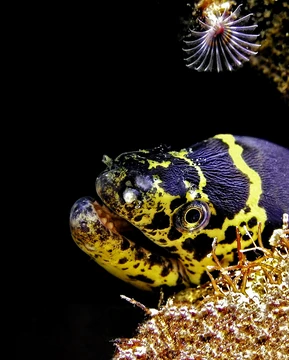
Chain moray (Echidna catenata)
Source-cited species reference: taxonomy from WoRMS, biology from FishBase, occurrence map from GBIF, conservation from IUCN Red List, description from Wikipedia.

Echidna catenata, commonly known as the chain moray, is a moray eel found in shallow parts of the western Atlantic Ocean and from islands elsewhere in the Atlantic. It occasionally makes its way into the aquarium trade. It grows to a maximum length of 165 cm but a more common length is about 40 cm.
- Scientific name
- Echidna catenata
- Authority
- (Bloch, 1795)
- Family
- Muraenidae
- Order
- Anguilliformes
- Maximum length
- 165 cm
- Depth range
- 0–12 m
- Habitat zone
- reef-associated
- Iucn red list
- Least Concern
- Gbif occurrence records
- 1,568
Classification (WoRMS)
Full classification as recorded by WoRMS: Kingdom: Animalia · Phylum: Chordata · Class: Teleostei · Order: Anguilliformes · Family: Muraenidae · Genus: Echidna.
Accepted name: Echidna catenata · Authority: (Bloch, 1795) · Taxonomic status: accepted · AphiaID: 278676.
Synonyms and superseded combinations recorded for this taxon: Echida catenata (Bloch, 1795); Echidna catenata flavofasciata Poey, 1867; Echidna flavofasciata Poey, 1867; Echidna fuscomaculata Poey, 1867; Gymnothorax catenatus Bloch, 1795; Muraena alusis Bleeker, 1856; Muraena catenata (Bloch, 1795); Muraena sordida Cuvier, 1816; Muraenophis catenula Lacepède, 1803; Poecilophis catenatus (Bloch, 1795).
Source: World Register of Marine Species (WoRMS) — https://www.marinespecies.org/aphia.php?p=taxdetails&id=278676 (CC BY 4.0). Accessed 2026-09-23.
Biology and life history (FishBase)
Measured values published by FishBase for Echidna catenata. Only fields the database actually holds for this species are shown; these are database values, not aquarium guidance.
Maximum length: 165 cm · Common length: 40 cm · Depth range: 0–12 m · Habitat zone: reef-associated · Body shape: eel-like · Vulnerability index: 90 of 100 · Fishery importance: minor commercial · Aquarium trade: commercial.
FishBase notes: A benthic and solitary species (Ref. 26340) found commonly on reefs and rocky shore areas. Feeds on small fishes and crustaceans (Ref. 5521). At Fernando de Noronha Archipelago, off NE Brazil, forages for sally lightfoot crabs ( Grapsus grapsus ) on exposed reefs at ebb tide and in tide-pools mostly at daytime. Able to withstand up to 30 minutes out of water while foraging, uses four main tactics both in and out of the water. Searches for prey at pool rims and rock bases poking into crevices and holes, stealthily approaches previously sighted prey, chases prey and ambushes prey from under rocks and crevices. Hunting success varies with employed tactic, but overall success is about 50%. May move up to 6 meters in about 1 hour while foraging on the exposed reef. Its crab hunting is mostly visually guided and a fish darting nearby a stealthily foraging moray may cause it to miss the strike; the missed crab may be chased up to 5 m on the reef. Able to strike with its body partly or entirely out of the water, usually strikes from a distance of 5 to10 centimeters. Small crabs are swallowed whole, whereas larger ones are torn apart by a combination of tugging, rotating, knotting, and thrashing movements. Handling time is related to prey size, the largest crabs (carapace width 2.3-3.2 times larger than moray’s head width) broken up and swallowed within 90 to 240 seconds. Attracted to plastic or rubber decoys dragged on a nylon string nearby, striking at these (Ref. 50922).
Source: FishBase species summary (SpecCode 2609) — https://www.fishbase.se/summary/Echidna-catenata.html (CC BY-NC 3.0 — non-commercial use only). Accessed 2026-09-23.
Distribution and occurrence records (GBIF)
1,568 georeferenced occurrence records for Echidna catenata are published through GBIF from 42 countries or marine areas. The map above plots 123 distinct locations from a sample of 1,568 records, omitting 39 inland records that carry an institution's coordinates rather than a collection site; it shows where the species has been observed and reported, not a modelled range.
Most records by country or area: Puerto Rico (502); Mexico (134); Bonaire, Sint Eustatius and Saba (108); Brazil (73); Guadeloupe (70).
The full country table, WoRMS marine regions and the sampling notes are on this species' Distribution page.
Source: GBIF Occurrence Search (taxonKey 5213083) — https://www.gbif.org/occurrence/search?taxon_key=5213083&has_coordinate=true (records CC0 / CC BY); WoRMS distribution records (MarineRegions) — https://www.marinespecies.org/aphia.php?p=taxdetails&id=278676 (CC BY 4.0); Natural Earth 110m basemap — https://www.naturalearthdata.com/ (public domain). Accessed 2026-09-23.
Conservation status (IUCN Red List)
The IUCN Red List assesses Echidna catenata Bloch, 1795 as Least Concern (code LC). No trend, population estimate or threat analysis is given here, because none is available from this source without the Red List API; follow the source link for the full assessment, including its date.
Source: IUCN Red List of Threatened Species (taxon 195680) — https://www.iucnredlist.org/species/195680/0; GBIF IUCN Red List category endpoint (taxonKey 5213083) — https://api.gbif.org/v1/species/5213083/iucnRedListCategory. Accessed 2026-09-23.
Description and natural history (Wikipedia)
The chain moray is an elongated, heavy, eel-like fish that commonly grows to a length of about 30 to 45 cm. The head has a rounded snout and pointed, blunt teeth, especially on the roof of the mouth. These teeth are used to crush the shells of crabs, their main source of food. The dorsal, tail and anal fins are combined into a single long fin, and there are no pectoral or ventral fins. The skin does not bear scales, but is covered with a layer of clear mucus. This fish is dark brown to black, marked with an interconnecting lattice-work of yellow, chain-like lines. The eyes are yellow.
The species is found in the western Atlantic Ocean, where its range extends from Bermuda, Florida, and The Bahamas, to the Antilles and Brazil. It is common in the Caribbean, and is also reported from the eastern Atlantic (Cape Verde and Ascension Island) and some southern Atlantic islands. It is found on reefs and rocky shores in clear water at depths of less than 12 m, and usually within 2 m of the surface.
Mainly nocturnal, the chain moray hides in holes and crevices in shallow water during the day, often with its head projecting. It continually opens and closes its mouth to increase the flow of water over its gills. A carnivore, it feeds on such organisms as crabs, which are the mainstay of its diet, shrimps, worms, octopuses and small fish. Its blunt teeth are especially adapted for feeding on crustaceans. It does not always leave its hiding place to forage, sometimes remaining where it is, ready to grab any prey that passes. It sometimes forages in tide pools and is able to survive for up to half an hour out of water. As well as ambushing prey, its feeding strategies include searching under the rims of pools, beneath rocks and in holes for prey, stalking observed prey or chasing it for a distance of up to 5 m. When close enough to its prey, usually when it is within 5 to 10 cm, it strikes, an action it can perform with its body wholly or partly out of the water. When captured, large crabs are torn apart while small ones are swallowed whole.
Source: Wikipedia: Chain moray — https://en.wikipedia.org/wiki/Chain_moray (CC BY-SA 4.0). Accessed 2026-09-23.
Frequently Asked Questions
Who is Chain moray (Echidna catenata)?
The chain moray is a species of moray eel in the family Muraenidae, originally described by Bloch back in 1795. It is a slender, elongated fish classified under the order Anguilliformes and is native to coastal Atlantic waters.
Where does Chain moray (Echidna catenata) live?
This eel is found in shallow regions of the western Atlantic Ocean as well as around various islands scattered across the Atlantic. It typically occupies depths from the surface down to roughly 12 meters.
How big does Chain moray (Echidna catenata) get?
Although the species can reach a maximum length of 165 cm, most individuals you would encounter in the wild are closer to 40 cm. That means the vast majority of chain morays are far smaller than their theoretical maximum size.
Why is Chain moray (Echidna catenata) notable to aquarium hobbyists?
The chain moray occasionally shows up in the marine aquarium trade, making it a recognizable species among saltwater enthusiasts. Its relatively modest size for most adults and distinctive eel-like form make it an appealing option for experienced keepers.
What family and order does Chain moray (Echidna catenata) belong to?
Taxonomically, the chain moray sits in the family Muraenidae, which groups it with other true moray eels. At the order level it is placed in Anguilliformes, the eel order characterized by long, snake-like bodies.
Related in Chain moray
Links follow this subject's own source article.
Elsewhere in Chain moray
Spotted an error? Know more?
Reader corrections go straight into our review queue. Suggest an edit · How this site is sourced