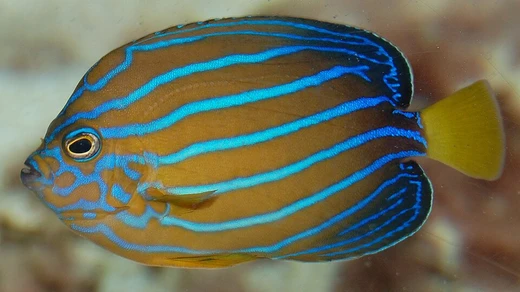
Bluestriped angelfish (Chaetodontoplus septentrionalis)
Source-cited species reference: taxonomy from WoRMS, biology from FishBase, occurrence map from GBIF, conservation from IUCN Red List, description from Wikipedia.

Photo by and (C)2007 Derek Ramsey ( Ram-Man ) · CC BY-SA 2.5
Chaetodontoplus septentrionalis, the blue-striped angelfish and bluelined angelfish, is a species of marine ray-finned fish, a marine angelfish belonging to the family Pomacanthidae. it is found in the Western Pacific Ocean.
- Scientific name
- Chaetodontoplus septentrionalis
- Authority
- (Temminck & Schlegel, 1844)
- Family
- Pomacanthidae
- Order
- Acanthuriformes
- Maximum length
- 22 cm
- Depth range
- 5–15 m
- Habitat zone
- reef-associated
- Iucn red list
- Least Concern
- Gbif occurrence records
- 188
Coloration and Sexual Dimorphism
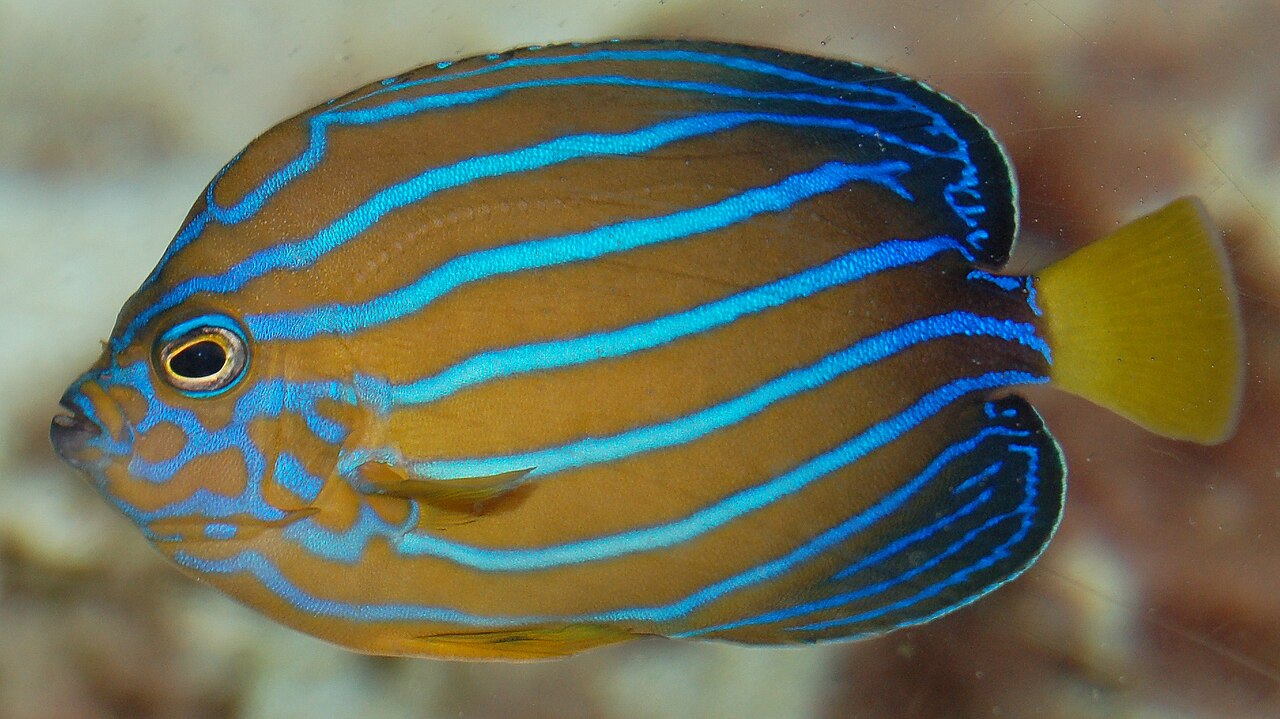
The bluestriped angelfish presents one of the more striking visual profiles among marine angelfish. Its body carries a warm yellow-to-tan base tone, across which vivid longitudinal blue stripes are laid like painted lines. The tail fin is a matching bright yellow, tying the color scheme together. What makes this species particularly interesting to observe is the clear visual difference between the sexes. In females, those bold blue stripes extend uninterrupted from head to tail, giving the fish a uniformly patterned appearance. Males, by contrast, display noticeably duller body lines and instead carry distinctive blue markings across the face, shifting the visual emphasis forward. Juveniles look almost like a different species altogether: their body is predominantly black, punctuated by yellow markings on the fins and a single yellow bar positioned just behind the head. This dramatic shift from dark juvenile to colorful adult is a hallmark of many angelfish but is especially pronounced here.
Geographic Range and Reef Preference
The bluestriped angelfish occupies a defined stretch of the western Pacific, ranging from the waters off southern Japan and South Korea down through Taiwan and the southern coast of China. Within this range, it shows a clear preference for structurally complex rocky habitats rather than open sandy areas. Large boulders, scattered stones, and rubble-covered slopes form its typical environment, and it is most commonly encountered on rocky reefs that offer plenty of crevices and overhangs. Its depth range spans from just 2 metres down to 30 metres, though there is a notable pattern in where different life stages are found. Small juveniles are particularly common at greater depths, between 15 and 30 metres, where they inhabit rocky patch reefs. At these deeper sites, young fish tend to remain close to a crevice or small cavity, keeping a ready escape route available should a predator approach. This shelter-seeking behavior in the deeper zones contrasts with the broader depth range available to adults across the reef structure.
Diet and the Hermaphroditic Life Cycle
Like all members of the angelfish family, the bluestriped angelfish follows a protogynous hermaphroditic reproductive strategy. Every individual is born and initially lives as a female. Over time, the dominant individuals within a group undergo a sex change and become functional males. This means that in any given population, the males are not simply a separate cohort but are former females that have assumed a leadership role. The species' diet is fairly specialized for an angelfish: it feeds primarily on sponges and tunicates, two groups of sessile invertebrates that are abundant on the rocky reefs where this fish lives. This dietary focus on soft-bodied, attached organisms fits well with the crevice-rich habitat the species favors, as sponges and tunicates commonly colonize the undersides of boulders and the walls of rocky outcrops. The combination of a specialized diet and a sex-change reproductive system makes the bluestriped angelfish a useful subject for understanding how reef fish partition both food resources and social roles within their communities.
Taxonomic Origins and Aquarium Presence
The bluestriped angelfish was first formally described in 1844 by the Dutch naturalists Coenraad Jacob Temminck and Hermann Schlegel, who designated Nagasaki, Japan, as the type locality. The specific epithet septentrionalis translates to northern, a name the authors likely chose to highlight that this species occupies a more northerly stretch of the western Pacific than its apparently related congeners. That taxonomic decision, made nearly two centuries ago, still anchors the species' identity today. In terms of human interaction, the bluestriped angelfish is a relatively rare sight in the aquarium trade. It is infrequently offered to hobbyists, and when specimens do make their way into the market, they tend to perform well in captivity, often thriving in well-maintained reef tanks. This combination of scarcity in the trade and good captive performance makes each individual a noteworthy addition for serious aquarists. The species remains a member of the family Pomacanthidae, the marine angelfishes, and is classified as a ray-finned fish.
Gallery
Spotted an error? Know more?
Reader corrections go straight into our review queue. Suggest an edit · How this site is sourced