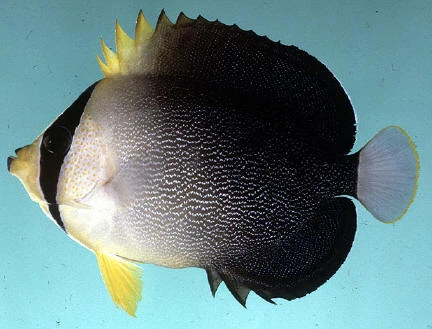
Greytail angelfish (Chaetodontoplus poliourus)
Source-cited species reference: taxonomy from WoRMS, biology from FishBase, occurrence map from GBIF, conservation from IUCN Red List, description from Wikipedia.

Chaetodontoplus poliourus, the greytail angelfish, is a species of marine angelfish in the class Actinopterygii. It is found in the coastal Pacific waters of Papua New Guinea, Palau, the Solomon Islands, and Indonesia.
- Scientific name
- Chaetodontoplus poliourus
- Authority
- Randall & Rocha, 2009
- Family
- Pomacanthidae
- Order
- Acanthuriformes
- Maximum length
- 8.600000381469727 cm
- Depth range
- 1–20 m
- Habitat zone
- reef-associated
- Iucn red list
- Least Concern
- Gbif occurrence records
- 84
Taxonomy & the 2009 Description
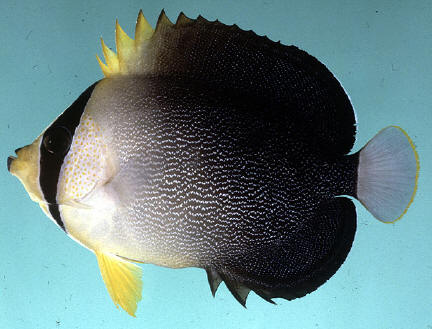
The greytail angelfish was formally recognized as a distinct species in 2009, when ichthyologists John Ernest Randall and Luiz A. Rocha published its original description. The specimen that served as the type for this new species was collected from waters near New Britain, an island in Papua New Guinea. Placing the fish within the family Pomacanthidae and the class Actinopterygii, Randall and Rocha had to carefully separate it from its closest relative, Chaetodontoplus mesoleucus, commonly known as the vermiculate angelfish. The two species look nearly identical in most respects, and their geographic ranges even overlap across portions of Indonesia, making field identification a genuine challenge. The single reliable visual distinction lies in the tail fin: the vermiculate angelfish displays a solid yellow caudal fin, whereas the greytail angelfish shows a grey tail edged with a thin yellow border. This modest difference in pigmentation was sufficient to justify a new species name, and the specific epithet poliourus reflects that greyish tail coloration.
Coloration & Morphology
At first glance, the greytail angelfish presents a striking gradient of color along its body. The head glows in warm yellow, which fades into a pale grey across the midsection before deepening into dark brown toward the posterior, where scattered white spots break up the darker tone. The face bears a bold black bar running through the eye, while the lips are tinged blue and the chest remains a vivid yellow. Fin coloration adds further contrast: the pelvic fins are yellow, the pectoral fins are grey, and the dorsal fin shifts from yellow at its anterior edge to dark brown at the rear. The caudal fin, which gives the species its common name, is predominantly grey with a narrow yellow margin. Structurally, the dorsal fin carries twelve spines followed by seventeen soft rays, while the anal fin has three spines and between sixteen and seventeen soft rays. Despite this elaborate coloration, the fish remains small, reaching a maximum standard length of just 8.6 centimetres.
Range & Reef Habitat
The greytail angelfish is a resident of coral reefs throughout the western Pacific Ocean. Its documented range stretches from Papua New Guinea eastward to Palau and the Solomon Islands, and southward into Indonesian waters, where it has been recorded in the Lesser Sunda Islands, the Molucca Islands, Halmahera, and West Papua. Within these reef systems, the species occupies depths ranging from just two metres to as deep as twenty-five metres. Rather than favoring exposed, high-energy reef slopes, the greytail angelfish shows a clear preference for sheltered, calm environments such as lagoons where the substrate tends to be silty. This habitat selection likely reflects the fish's small size and its need for protection from strong currents. The overlap of its range with that of the vermiculate angelfish in parts of Indonesia means that both species can be encountered in the same general region, though the greytail's preference for quieter, lagoon-type settings may help separate their microhabitats in practice.
Conservation Status & Aquarium Trade
From a conservation standpoint, the greytail angelfish enjoys a relatively secure position. The IUCN Red List classifies the species as Least Concern, a designation that reflects both its broad geographic distribution across multiple island nations in the western Pacific and the absence of any identified major threats to its populations. No widespread habitat destruction, overfishing, or pollution event has been documented as posing a significant risk to the species as a whole. The one notable human interaction is its occasional collection for the ornamental aquarium trade. Because the fish is small, colorful, and inhabits accessible shallow reef and lagoon habitats, it is a practical target for divers and collectors. However, the trade appears to remain at a level that does not currently threaten the species' overall viability in the wild. The broad range spanning Papua New Guinea, Palau, the Solomon Islands, and Indonesia provides a natural buffer, ensuring that localized collection pressure in one area is unlikely to impact the species across its full distribution.
Gallery
Spotted an error? Know more?
Reader corrections go straight into our review queue. Suggest an edit · How this site is sourced